Stakeholder engagement is the process of involving individuals, groups, or entities that are affected by or can affect an organization’s actions, decisions, or policies. These stakeholders can include employees, customers, suppliers, investors, communities, government agencies, non-governmental organizations (NGOs), and more. The goal of stakeholder engagement is to establish a mutually beneficial relationship based on open communication, trust, and collaboration.
Stakeholder engagement is not a one-size-fits-all approach; it varies in scope and intensity depending on the nature of the organization, its industry, and the specific issues at hand. It can range from informal conversations and surveys to formal advisory committees and partnerships.
Stakeholder engagement holds considerable significance for organizations across various sectors and industries. Its importance extends to multiple dimensions:
1. Improved Decision-Making
Engaging with stakeholders provides organizations with valuable insights, diverse perspectives, and a deeper understanding of the potential impacts of their decisions. This information leads to more informed and effective decision-making.
2. Risk Mitigation
By involving stakeholders early in the decision-making process, organizations can identify potential risks and issues, allowing them to take preventive measures and reduce the likelihood of crises or conflicts.
3. Enhanced Reputation
Positive stakeholder engagement can enhance an organization’s reputation. Engaging transparently and addressing concerns demonstrates commitment to ethical practices, which can build trust with customers, investors, and the public.
4. Innovation and Adaptation
Stakeholder input can drive innovation by inspiring new ideas and approaches to solving challenges. It also helps organizations adapt to changing market conditions and evolving societal expectations.
5. Competitive Advantage
Organizations that actively engage with stakeholders can gain a competitive advantage. By aligning their strategies with stakeholder interests, they can better meet customer demands and differentiate themselves in the market.
6. Social and Environmental Responsibility
Stakeholder engagement supports corporate social responsibility (CSR) and sustainability efforts. It helps organizations address environmental and social issues, such as climate change, labor practices, and community development.
7. Legal and Regulatory Compliance
Engaging with stakeholders can help organizations stay compliant with evolving laws and regulations. By involving relevant stakeholders, organizations can navigate complex legal landscapes more effectively.
Key Principles of Effective Stakeholder Engagement
Effective stakeholder engagement is guided by a set of principles that organizations should consider when developing their strategies:
1. Inclusivity
Engagement should be inclusive, encompassing a wide range of stakeholders with diverse perspectives and interests. No single group should dominate the process.
2. Early Engagement
Organizations should engage stakeholders early in the decision-making process to allow for meaningful input and the identification of potential issues before they escalate.
3. Transparency
Transparency is essential. Organizations should provide stakeholders with clear and accurate information about their intentions, plans, and activities.
4. Mutual Respect
Mutual respect and open-mindedness are fundamental. All stakeholders should be treated with respect, and their opinions should be considered seriously.
5. Two-Way Communication
Engagement should involve two-way communication, with organizations actively listening to stakeholder concerns and feedback and responding appropriately.
6. Accountability
Organizations should be accountable for their actions and commitments resulting from stakeholder engagement. They should follow through on promises and report on progress.
7. Consistency
Engagement efforts should be consistent over time, rather than being sporadic or solely reactive to crises or issues.
Types of Stakeholder Engagement
Stakeholder engagement takes various forms, depending on the organization’s objectives, the nature of the stakeholders, and the specific context. Some common types of stakeholder engagement include:
1. Information Sharing
Organizations may inform stakeholders about their activities, plans, or performance through various channels, such as reports, websites, or newsletters.
2. Consultation
Consultation involves seeking input and feedback from stakeholders on specific issues, projects, or policies. Surveys, focus groups, and public meetings are common consultation methods.
3. Collaboration
Collaboration implies active cooperation between an organization and its stakeholders to achieve shared goals. This often involves joint initiatives, partnerships, or advisory committees.
4. Advocacy
Some stakeholders may engage in advocacy or activism to influence an organization’s actions or policies. This can include public campaigns, protests, or legal action.
5. Grievance Mechanisms
Organizations may establish grievance mechanisms that allow stakeholders to raise concerns or complaints and seek resolutions in a transparent and accountable manner.
6. Reporting and Disclosure
Organizations may disclose information on their performance, impacts, and sustainability efforts, providing stakeholders with insights into their operations.
Examples of Effective Stakeholder Engagement
Effective stakeholder engagement can lead to positive outcomes and create shared value. Here are some real-world examples that illustrate its significance:
1. Stakeholder Engagement in Sustainable Supply Chains
Companies like Unilever and Nestlé engage with suppliers, farmers, and local communities to promote sustainable agricultural practices and ensure the ethical sourcing of raw materials. These engagements help address issues related to deforestation, child labor, and environmental degradation.
2. Community Engagement in Energy Projects
Energy companies, such as Ørsted, actively engage with local communities when planning and developing renewable energy projects. This involvement allows communities to have a say in project design, job opportunities, and the distribution of benefits.
3. Employee Engagement for Well-being
Companies like Google and Microsoft prioritize employee engagement to enhance workplace well-being. They involve employees in decision-making processes, offer health and wellness programs, and encourage feedback to create a positive work environment.
4. Investor Engagement for ESG Integration
Investors increasingly engage with companies on environmental, social, and governance (ESG) issues. Asset managers like BlackRock and CalPERS advocate for improved ESG practices and disclosure in their portfolio companies.
5. Stakeholder Engagement in Public Policy
Non-governmental organizations (NGOs) and advocacy groups engage with governments and corporations to influence public policies on issues such as climate change, human rights, and healthcare access.
Challenges and Criticisms
Despite its numerous benefits, stakeholder engagement is not without challenges and criticisms:
1. Resource Constraints
Organizations may lack the resources, expertise, or dedicated staff to effectively engage with a wide range of stakeholders, particularly in smaller businesses or resource-constrained sectors.
2. Differing Interests
Stakeholders often have divergent interests, making it challenging to balance competing concerns and reach consensus on certain issues.
3. Time-Consuming
Effective stakeholder engagement can be time-consuming, especially when dealing with complex or contentious matters that require extensive dialogue and negotiation.
4. Resistance to Change
Some organizations may resist engaging with stakeholders who advocate for changes that could disrupt existing business practices or revenue streams.
5. Authenticity Concerns
Stakeholders may question the authenticity of engagement efforts if they perceive them as token gestures or attempts to “greenwash” corporate image without substantive action.
6. Lack of Standardization
There is a lack of standardized practices and metrics for measuring the effectiveness of stakeholder engagement efforts, making it challenging to assess their impact.
The Future of Stakeholder Engagement
The future of stakeholder engagement is shaped by several key trends and developments:
1. Focus on ESG and Sustainability
Stakeholder engagement will increasingly revolve around environmental, social, and governance (ESG) issues, as organizations respond to growing societal concerns about sustainability and responsible business practices.
2. Digital Transformation
Advancements in technology will enable more efficient and widespread stakeholder engagement through digital platforms, social media, and online collaboration tools.
3. Regulatory Requirements
Regulators in various jurisdictions are likely to impose stricter requirements for stakeholder engagement, particularly concerning ESG disclosures and reporting.
4. Investor Activism
Investors will continue to play a significant role in advocating for stakeholder engagement and ESG integration, with increasing demands for transparency and accountability.
5. Stakeholder Capitalism
The concept of stakeholder capitalism, which emphasizes the broader responsibilities of businesses to all stakeholders, is gaining traction and will influence stakeholder engagement strategies.
6. Community Empowerment
Local communities and grassroots movements will play a more active role in shaping corporate decisions, especially regarding projects with significant local impact.
Conclusion
Stakeholder engagement is a fundamental component of modern business practices, enabling organizations to build trust, make informed decisions, and create shared value for all stakeholders. It goes beyond compliance with legal requirements and involves actively listening to, collaborating with, and responding to the concerns and interests of those affected by or affecting an organization’s actions.
In a functional organizational structure, groups and teams are organized based on function. Therefore, this organization follows a top-down structure, where most decision flows from top management to bottom. Thus, the bottom of the organization mostly follows the strategy detailed by the top of the organization.
In a flat organizational structure, there is little to no middle management between employees and executives. Therefore it reduces the space between employees and executives to enable an effective communication flow within the organization, thus being faster and leaner.
Project portfolio management (PPM) is a systematic approach to selecting and managing a collection of projects aligned with organizational objectives. That is a business process of managing multiple projects which can be identified, prioritized, and managed within the organization. PPM helps organizations optimize their investments by allocating resources efficiently across all initiatives.
Harvard Business School professor Dr. John Kotter has been a thought-leader on organizational change, and he developed Kotter’s 8-step change model, which helps business managers deal with organizational change. Kotter created the 8-step model to drive organizational transformation.
The Nadler-Tushman Congruence Model was created by David Nadler and Michael Tushman at Columbia University. The Nadler-Tushman Congruence Model is a diagnostic tool that identifies problem areas within a company. In the context of business, congruence occurs when the goals of different people or interest groups coincide.
McKinsey’s Seven Degrees of Freedom for Growth is a strategy tool. Developed by partners at McKinsey and Company, the tool helps businesses understand which opportunities will contribute to expansion, and therefore it helps to prioritize those initiatives.
Mintzberg’s 5Ps of Strategy is a strategy development model that examines five different perspectives (plan, ploy, pattern, position, perspective) to develop a successful business strategy. A sixth perspective has been developed over the years, called Practice, which was created to help businesses execute their strategies.
The COSO framework is a means of designing, implementing, and evaluating control within an organization. The COSO framework’s five components are control environment, risk assessment, control activities, information and communication, and monitoring activities. As a fraud risk management tool, businesses can design, implement, and evaluate internal control procedures.
The TOWS Matrix is an acronym for Threats, Opportunities, Weaknesses, and Strengths. The matrix is a variation on the SWOT Analysis, and it seeks to address criticisms of the SWOT Analysis regarding its inability to show relationships between the various categories.
Lewin’s change management model helps businesses manage the uncertainty and resistance associated with change. Kurt Lewin, one of the first academics to focus his research on group dynamics, developed a three-stage model. He proposed that the behavior of individuals happened as a function of group behavior.
OpenAI is an artificial intelligence research laboratory that transitioned into a for-profit organization in 2019. The corporate structure is organized around two entities: OpenAI, Inc., which is a single-member Delaware LLC controlled by OpenAI non-profit, And OpenAI LP, which is a capped, for-profit organization. The OpenAI LP is governed by the board of OpenAI, Inc (the foundation), which acts as a General Partner. At the same time, Limited Partners comprise employees of the LP, some of the board members, and other investors like Reid Hoffman’s charitable foundation, Khosla Ventures, and Microsoft, the leading investor in the LP.
Airbnb follows a holacracy model, or a sort of flat organizational structure, where teams are organized for projects, to move quickly and iterate fast, thus keeping a lean and flexible approach. Airbnb also moved to a hybrid model where employees can work from anywhere and meet on a quarterly basis to plan ahead, and connect to each other.
The Amazon organizational structure is predominantly hierarchical with elements of function-based structure and geographic divisions. While Amazon started as a lean, flat organization in its early years, it transitioned into a hierarchical organization with its jobs and functions clearly defined as it scaled.
The Coca-Cola Company has a somewhat complex matrix organizational structure with geographic divisions, product divisions, business-type units, and functional groups.
Costco has a matrix organizational structure, which can simply be defined as any structure that combines two or more different types. In this case, a predominant functional structure exists with a more secondary divisional structure.
Costco’s geographic divisions reflect its strong presence in the United States combined with its expanding global presence. There are six divisions in the country alone to reflect its standing as the source of most company revenue.
Compared to competitor Walmart, for example, Costco takes more a decentralized approach to management, decision-making, and autonomy. This allows the company’s stores and divisions to more flexibly respond to local market conditions.
Dell has a functional organizational structure with some degree of decentralization. This means functional departments share information, contribute ideas to the success of the organization and have some degree of decision-making power.
eBay was until recently a multi-divisional (M-form) organization with semi-autonomous units grouped according to the services they provided. Today, eBay has a single division called Marketplace, which includes eBay and its international iterations.
Facebook is characterized by a multi-faceted matrix organizational structure. The company utilizes a flat organizational structure in combination with corporate function-based teams and product-based or geographic divisions. The flat organization structure is organized around the leadership of Mark Zuckerberg, and the key executives around him. On the other hand, the function-based teams are based on the main corporate functions (like HR, product management, investor relations, and so on).
Goldman Sachs has a hierarchical structure with a clear chain of command and defined career advancement process. The structure is also underpinned by business-type divisions and function-based groups.
Google (Alphabet) has a cross-functional (team-based) organizational structure known as a matrix structure with some degree of flatness. Over the years, as the company scaled and it became a tech giant, its organizational structure is morphing more into a centralized organization.
IBM has an organizational structure characterized by product-based divisions, enabling its strategy to develop innovative and competitive products in multiple markets. IBM is also characterized by function-based segments that support product development and innovation for each product-based division, which include Global Markets, Integrated Supply Chain, Research, Development, and Intellectual Property.
McDonald’s has a divisional organizational structure where each division – based on geographical location – is assigned operational responsibilities and strategic objectives. The main geographical divisions are the US, internationally operated markets, and international developmental licensed markets. And on the other hand, the hierarchical leadership structure is organized around regional and functional divisions.
McKinsey & Company has a decentralized organizational structure with mostly self-managing offices, committees, and employees. There are also functional groups and geographic divisions with proprietary names.
Microsoft has a product-type divisional organizational structure based on functions and engineering groups. As the company scaled over time it also became more hierarchical, however still keeping its hybrid approach between functions, engineering groups, and management.
Nestlé has a geographical divisional structure with operations segmented into five key regions. For many years, Swiss multinational food and drink company Nestlé had a complex and decentralized matrix organizational structure where its numerous brands and subsidiaries were free to operate autonomously.
Nike has a matrix organizational structure incorporating geographic divisions. Nike’s matrix structure is also present at the regional and sub-regional levels. Managerial responsibility is segmented according to business unit (apparel, footwear, and equipment) and function (human resources, finance, marketing, sales, and operations).
Patagonia has a particular organizational structure, where its founder, Chouinard, disposed of the company’s ownership in the hands of two non-profits. The Patagonia Purpose Trust, holding 100% of the voting stocks, is in charge of defining the company’s strategic direction. And the Holdfast Collective, a non-profit, holds 100% of non-voting stocks, aiming to re-invest the brand’s dividends into environmental causes.
Samsung has a product-type divisional organizational structure where products determine how resources and business operations are categorized. The main resources around which Samsung’s corporate structure is organized are consumer electronics, IT, and device solutions. In addition, Samsung leadership functions are organized around a few career levels grades, based on experience (assistant, professional, senior professional, and principal professional).
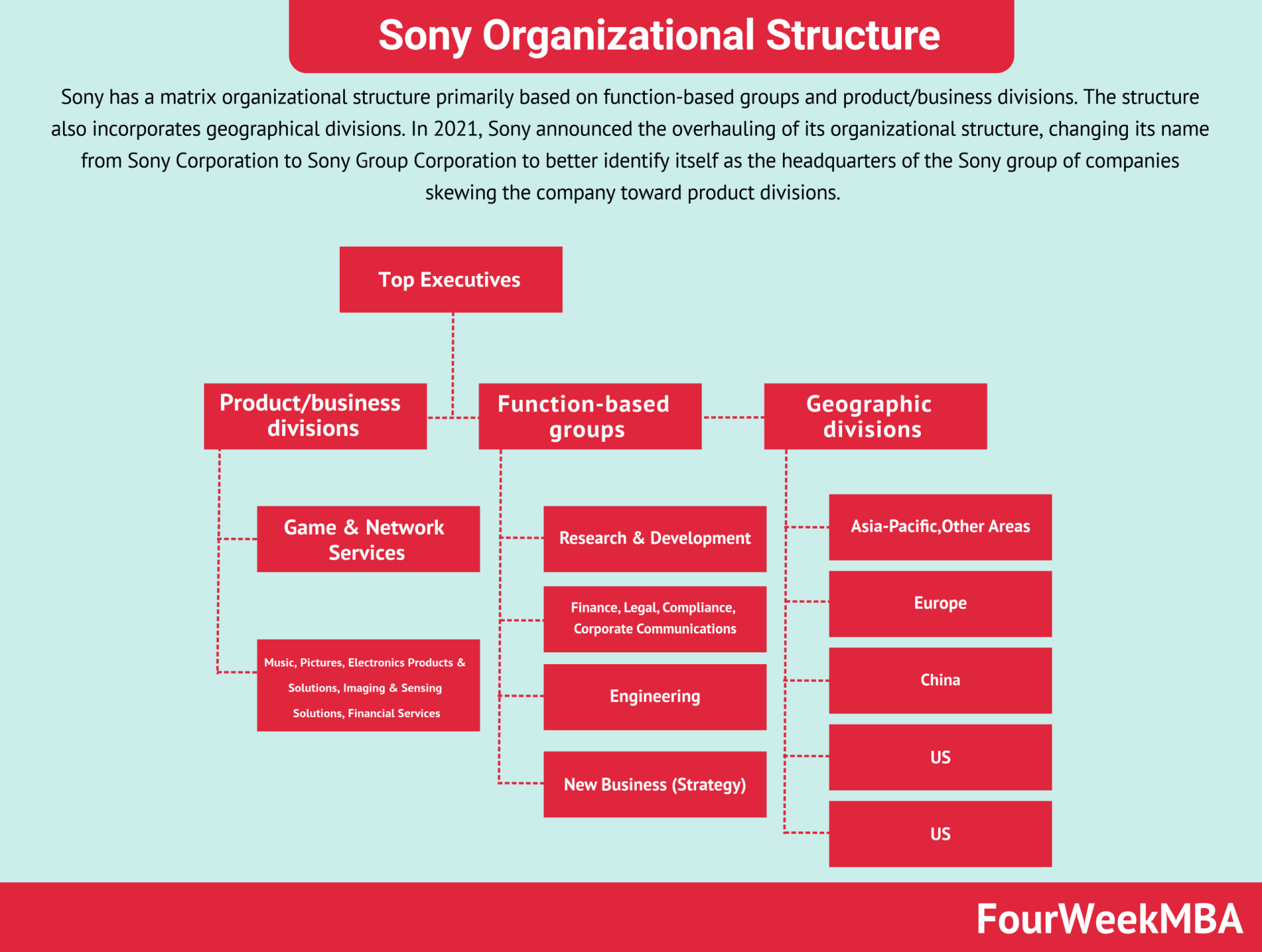
Sony has a matrix organizational structure primarily based on function-based groups and product/business divisions. The structure also incorporates geographical divisions. In 2021, Sony announced the overhauling of its organizational structure, changing its name from Sony Corporation to Sony Group Corporation to better identify itself as the headquarters of the Sony group of companies skewing the company toward product divisions.
Starbucks follows a matrix organizational structure with a combination of vertical and horizontal structures. It is characterized by multiple, overlapping chains of command and divisions.
Tesla is characterized by a functional organizational structure with aspects of a hierarchical structure. Tesla does employ functional centers that cover all business activities, including finance, sales, marketing, technology, engineering, design, and the offices of the CEO and chairperson. Tesla’s headquarters in Austin, Texas, decide the strategic direction of the company, with international operations given little autonomy.
Toyota has a divisional organizational structure where business operations are centered around the market, product, and geographic groups. Therefore, Toyota organizes its corporate structure around global hierarchies (most strategic decisions come from Japan’s headquarter), product-based divisions (where the organization is broken down, based on each product line), and geographical divisions (according to the geographical areas under management).
Walmart has a hybrid hierarchical-functional organizational structure, otherwise referred to as a matrix structure that combines multiple approaches. On the one hand, Walmart follows a hierarchical structure, where the current CEO Doug McMillon is the only employee without a direct superior, and directives are sent from top-level management. On the other hand, the function-based structure of Walmart is used to categorize employees according to their particular skills and experience.
Gennaro is the creator of FourWeekMBA, which reached about four million business people, comprising C-level executives, investors, analysts, product managers, and aspiring digital entrepreneurs in 2022 alone | He is also Director of Sales for a high-tech scaleup in the AI Industry | In 2012, Gennaro earned an International MBA with emphasis on Corporate Finance and Business Strategy.