Project portfolio management (PPM) is a systematic approach to selecting and managing a collection of projects aligned with organizational objectives. That is a business process of managing multiple projects which can be identified, prioritized, and managed within the organization. PPM helps organizations optimize their investments by allocating resources efficiently across all initiatives.
Aspect
Explanation
Definition
Project Portfolio Management (PPM) is a strategic management approach that organizations use to prioritize, select, execute, and oversee projects and programs within their portfolio. It involves the centralized planning and management of a collection of projects and programs to align with an organization’s strategic goals and objectives. PPM aims to optimize resource allocation, increase project efficiency, minimize risks, and ensure that projects contribute effectively to an organization’s overall success. It provides a structured framework for decision-making, allowing organizations to focus on projects that deliver the highest value and align with their strategic direction. PPM is crucial for managing multiple projects and programs concurrently, especially in large and complex organizations.
Key Elements
– Project Prioritization: PPM involves the prioritization of projects based on their alignment with strategic objectives and available resources. – Resource Allocation: Effective resource allocation ensures that projects receive the necessary personnel, budget, and equipment. – Portfolio Governance: Governance mechanisms oversee project selection, execution, and monitoring to ensure alignment with strategic goals. – Performance Measurement: PPM relies on key performance indicators (KPIs) to evaluate project and portfolio performance. – Risk Management: PPM includes risk assessment and mitigation strategies to address potential project challenges.
Characteristics
– Strategic Alignment: PPM aligns projects with organizational strategies to ensure they contribute to overall objectives. – Centralized Management: PPM centralizes project oversight, allowing for consistent governance and decision-making. – Resource Optimization: It optimizes resource allocation, reducing conflicts and enhancing efficiency. – Risk Mitigation: PPM includes risk management strategies to proactively address project risks. – Performance Measurement: KPIs are used to assess project and portfolio performance.
Implications
– Enhanced Strategic Execution: PPM ensures that projects contribute to strategic goals, enhancing strategic execution. – Resource Efficiency: Effective resource allocation improves resource utilization and reduces waste. – Risk Reduction: Proactive risk management minimizes potential project disruptions. – Improved Decision-Making: PPM provides data-driven insights for better decision-making. – Maximized Value: Prioritizing projects based on strategic value maximizes organizational benefits.
Advantages
– Strategic Alignment: PPM aligns projects with organizational strategy, enhancing strategic execution. – Resource Optimization: Effective resource allocation improves efficiency and reduces resource conflicts. – Risk Mitigation: Proactive risk management minimizes project disruptions. – Informed Decision-Making: Data-driven insights support better decision-making in project selection and execution. – Maximized Value: Prioritizing projects based on strategic value maximizes the value delivered by the organization.
Drawbacks
– Complexity: Implementing PPM can be complex, especially in large organizations. – Resource Intensive: It requires resources for governance, monitoring, and data analysis. – Resistance to Change: Employees and teams may resist changes in project selection and management processes. – Initial Investment: Setting up PPM processes may require an initial investment in tools and training. – Overemphasis on Metrics: Overreliance on metrics can lead to overlooking qualitative aspects of projects.
Applications
– Large Enterprises: Large organizations with numerous projects and programs use PPM to manage their portfolios effectively. – Government: Government agencies apply PPM to ensure efficient project execution and alignment with public policy goals. – Healthcare: Healthcare institutions use PPM to manage clinical and administrative projects while optimizing resources. – IT Sector: The IT sector implements PPM to oversee software development projects, infrastructure upgrades, and IT service management. – Construction: Construction companies use PPM to manage complex construction projects, controlling budgets and schedules.
Use Cases
– Multinational Corporation: A multinational corporation implements PPM to manage a diverse portfolio of global projects, ensuring alignment with corporate strategy. – Government Agency: A government agency uses PPM to oversee infrastructure projects, ensuring they align with public policy objectives. – Hospital: A hospital adopts PPM to manage clinical initiatives, allocate resources effectively, and improve patient care. – IT Department: An IT department applies PPM to prioritize software development projects and optimize IT service delivery. – Construction Company: A construction company employs PPM to manage multiple construction projects, control costs, and meet deadlines effectively.
The goal of PPM is to maximize the value generated from each project while minimizing risk exposure.
Organizations benefit from implementing PPM by having improved resource utilization through more efficient allocation of personnel and financial resources across multiple projects.
Additionally, better decision-making capabilities are achieved as data-driven insights allow stakeholders to make informed decisions about which initiatives should be pursued or abandoned based on their potential return on investment (ROI).
Finally, increased visibility into project progress allows managers to quickly identify any issues or delays before they become major problems down the line.
Challenges of Project Portfolio Management
The implementation of PPM does come with some challenges such as:
Establishing governance structures for overseeing different portfolios;
Allocating resources effectively between various initiatives;
Monitoring progress and performance against predetermined goals;
Adjusting strategies as needed when new information becomes available;
Evaluating results and outcomes after completion;
Analyzing data to improve decision making processes;
Leveraging technology to streamline processes where possible, and utilizing best practices for continuous improvement over time.
Developing a Project Portfolio Strategy
Developing a successful project portfolio strategy requires setting goals and objectives, assessing available resources and capabilities, and establishing criteria for selecting projects.
This process should also involve stakeholders in order to ensure that their needs are taken into account when making decisions about which projects to pursue.
Identifying Goals and Objectives
The first step in developing a project portfolio strategy is identifying the desired outcomes of the organization.
These can include short-term goals such as increasing revenue or reducing costs, as well as long-term objectives like expanding market share or improving customer satisfaction.
It’s important to consider both quantitative (measurable) and qualitative (subjective) factors when determining these goals so that they accurately reflect the company’s priorities.
Assessing Resources and Capabilities
Once you have identified your desired outcomes, it’s time to assess what resources you have available in order to achieve them.
This includes both tangible assets such as money, personnel, technology, etc., but also intangible ones like knowledge or expertise within the organization.
Knowing what skillsets exist within your team will help inform which projects are feasible given current constraints on time or budget.
After understanding what resources are at your disposal, it is then necessary to establish priorities for each potential project based on its alignment with organizational goals as well as any other criteria deemed important by stakeholders involved in decision-making processes (e.g., risk tolerance).
Establishing clear selection criteria helps streamline the evaluation process while ensuring that only those initiatives with the highest potential value get pursued further down the line.
Implementing the Project Portfolio Strategy
Once the project portfolio strategy has been developed, it must be implemented in order to ensure that the desired outcomes are achieved.
This involves setting up processes and procedures for managing the portfolio, establishing governance structures to ensure accountability, and allocating resources appropriately to each project.
Setting Up Processes and Procedures
The first step in implementing a project portfolio strategy is to set up processes and procedures for managing the projects within it.
This includes creating a system of communication between stakeholders, defining roles and responsibilities of team members, developing an effective workflow process for completing tasks on time, and establishing protocols for tracking progress against goals.
Establishing Governance Structures
Establishing governance structures is essential when implementing a project portfolio strategy as they provide oversight into how projects are managed from start to finish.
These structures should include clear decision-making authority among stakeholders as well as policies regarding resource allocation across different projects within the portfolio.
Additionally, having regular meetings with key stakeholders can help keep everyone informed about progress towards goals while ensuring accountability throughout the entire process.
Once processes have been established and governance structures put in place, resources need to be allocated accordingly across different projects within the portfolio based on their priority level or risk profile.
It is important that these decisions are made objectively so that resources are not wasted on low-priority initiatives while more important ones remain underfunded or neglected altogether.
Additionally, budget constraints should also be taken into consideration when allocating resources so that costs do not exceed available funds over time which could lead to delays or even cancellation of certain projects down the line if not managed properly from day one.
Managing the Project Portfolio
Managing a project portfolio requires ongoing monitoring of progress and performance in order to identify any issues or risks that may arise during implementation.
Monitoring progress and performance involves tracking the milestones, budget, timeline, resources, and other key metrics associated with each project within the portfolio.
This helps ensure that projects are on track to meet their goals and objectives. It also allows for early identification of potential problems so they can be addressed quickly before they become major issues.
Adjusting strategies as needed is an important part of managing a project portfolio.
As new information becomes available or changes occur within the organization’s environment, it may be necessary to adjust existing strategies in order to keep projects on track or address unforeseen challenges that arise during execution.
This could involve changing resource allocations, altering timelines, re-prioritizing tasks, or adjusting budgets as needed in order to ensure successful completion of projects within the portfolio.
Evaluating results and outcomes is another essential component of managing a project portfolio.
After all projects have been completed, it is important to review how well they met their goals and objectives in terms of cost savings achieved, customer satisfaction levels reached, timeframes adhered to etc.
This allows for lessons learned to be applied going forward when making decisions about future portfolios or individual projects within them.
Optimizing the Project Portfolio
Optimizing a project portfolio is essential for any organization that wants to stay competitive in today’s market.
By analyzing data from past projects, organizations can make better decisions about future ones and ensure their success.
Leveraging technology can also help streamline processes and save time and money. Finally, utilizing best practices helps ensure continuous improvement over time.
Analyzing Data to Improve Decision Making
Gathering data from past projects is key when it comes to optimizing the project portfolio.
This information can be used to identify areas of improvement, track progress, and adjust strategies as needed in order to achieve desired outcomes.
Organizations should take advantage of available tools such as analytics software or dashboards that provide real-time insights into performance metrics so they can make informed decisions quickly and accurately.
Leveraging Technology to Streamline Processes
Utilizing technology is an effective way for organizations to optimize their project portfolios by automating manual tasks or consolidating multiple systems into one platform.
For example, using cloud-based solutions allows teams to collaborate more efficiently while artificial intelligence (AI) algorithms can help predict outcomes based on historical data points which could lead to improved decision making capabilities down the line.
Implementing best practices helps organizations maintain consistent standards across all projects within the portfolio, leading to higher quality results over time.
This includes setting up clear governance structures with defined roles and responsibilities as well as establishing criteria for selecting new projects that align with organizational goals and objectives before committing resources towards them.
Additionally, regularly monitoring progress against predetermined milestones will help keep teams on track throughout each stage of development while providing valuable feedback along the way; this should be taken into consideration when making adjustments if necessary in order to meet desired targets set out at the beginning of each initiative.
What are the four types of portfolio management?
Strategic Portfolio Management
This type of portfolio management involves setting goals and objectives, determining the best projects to pursue, and allocating resources accordingly.
It also includes assessing risks and making decisions on how to mitigate them.
Financial Portfolio Management
This type of portfolio management focuses on financial aspects such as budgeting, forecasting cash flow, monitoring expenses, and tracking return on investment (ROI).
Operational Portfolio Management
This type of portfolio management is concerned with managing project timelines, ensuring quality control standards are met, resolving conflicts between stakeholders or teams working together on a project, and overseeing progress reports from team members or departments involved in the project.
Technical Portfolio Management
This type of portfolio management deals with technical issues such as software development processes or IT infrastructure maintenance tasks associated with a given project.
It also includes evaluating new technologies that may be beneficial for the company’s operations or future projects it plans to undertake.
What are the three phases of project portfolio management?
The three phases of project portfolio management are:
Planning
During the planning phase, objectives and goals are established for each project within the portfolio.
Execution
The execution phase involves executing tasks related to each project in order to meet the predetermined objectives and goals.
And Closure
Finally, during the closure phase, projects are evaluated against their original objectives and any lessons learned from them documented for future reference.
This process helps ensure that all projects within a portfolio are completed on time and with maximum efficiency.
What are the five levels of project portfolio management?
Strategic Portfolio Management
This is the highest level of project portfolio management and involves setting long-term goals, analyzing potential projects, and selecting those that best align with the company’s objectives.
This level of project portfolio management focuses on managing multiple related projects to ensure they are completed in a timely manner and within budget.
At this stage, individual projects are managed by assigning tasks to team members, tracking progress against deadlines, and ensuring quality standards are met throughout the process.
Resource Management
This level of project portfolio management ensures resources such as personnel or materials are allocated efficiently across all active projects while also accounting for future needs based on forecasted demand.
Performance Measurement & Reporting
The final step in successful project portfolio management is measuring performance metrics such as cost savings or time-to-market results against established targets and then reporting these findings back to stakeholders for further analysis and decision making purposes
Key takeaways
In conclusion, project portfolio management is an essential tool for any startup looking to grow and succeed.
By defining the project portfolio strategy, implementing it effectively, managing it on a regular basis and optimizing it as needed, startups can ensure that their projects are successful and their goals are met.
With proper project portfolio management in place, startups can maximize their resources while achieving success with each individual project.
Project portfolio management is key to ensuring the long-term success of any startup venture.
Key Highlights
Definition and Purpose: Project Portfolio Management (PPM) is a systematic approach to selecting, prioritizing, and managing a collection of projects aligned with organizational objectives. It helps organizations optimize resource allocation and maximize value while minimizing risk exposure.
Benefits: PPM offers several benefits, including improved resource utilization, enhanced decision-making through data-driven insights, increased visibility into project progress, and the ability to identify and address issues early.
Challenges: Implementing PPM comes with challenges such as establishing governance structures, effective resource allocation, monitoring progress, adjusting strategies, evaluating outcomes, analyzing data, leveraging technology, and continuous improvement.
Developing a Strategy:
Identifying Goals and Objectives: Define short-term and long-term goals, considering both quantitative and qualitative factors.
Assessing Resources and Capabilities: Evaluate tangible and intangible resources and prioritize projects based on alignment with goals and stakeholder input.
Setting Selection Criteria: Establish clear criteria for project selection to ensure high-potential initiatives are pursued.
Implementing the Strategy:
Setting Up Processes and Procedures: Create communication systems, define roles, and establish protocols for tracking progress.
Establishing Governance Structures: Implement decision-making authority and resource allocation policies.
Allocating Resources: Distribute resources objectively based on priority and risk, considering budget constraints.
Managing the Portfolio:
Monitoring Progress: Continuously track project milestones, budget, and other metrics to identify issues early.
Adjusting Strategies: Adapt strategies as new information emerges, making resource allocation, timeline, and task adjustments.
Evaluating Results: Assess project outcomes against goals to gather lessons learned for future projects.
Optimizing the Portfolio:
Analyzing Data: Use data from past projects to improve decision-making and predict outcomes.
Leveraging Technology: Utilize technology for automation, collaboration, and data analysis.
Implementing Best Practices: Maintain consistent standards across projects to ensure quality and continuous improvement.
Four Types of Portfolio Management:
Strategic Portfolio Management: Setting goals, selecting projects, and allocating resources aligned with objectives.
Financial Portfolio Management: Focusing on budgeting, forecasting, and ROI tracking.
Operational Portfolio Management: Managing timelines, quality control, and stakeholder coordination.
Technical Portfolio Management: Addressing technical aspects and evaluating new technologies.
Three Phases of PPM:
Planning: Establish objectives and goals for projects.
Execution: Execute tasks to meet project objectives.
Closure: Evaluate projects against goals and document lessons learned.
Five Levels of PPM:
Strategic Portfolio Management: Setting long-term goals and aligning projects with objectives.
Program Management: Managing related projects for timely completion.
Project Management: Managing individual projects with tasks and quality control.
Resource Management: Efficiently allocating resources across projects.
Performance Measurement & Reporting: Measuring and reporting project performance.
Key Takeaways: Effective PPM is crucial for startup growth and success. It involves defining a strategy, implementing, managing, and optimizing it. PPM enables startups to maximize resources, achieve project success, and ensure long-term venture success.
Related Frameworks, Models, or Concepts
Description
When to Apply
Project Portfolio Management (PPM)
Project Portfolio Management (PPM) is a strategic approach to managing a collection of projects or initiatives within an organization to achieve its strategic objectives and maximize overall value and return on investment (ROI). PPM involves selecting, prioritizing, and optimizing projects based on their alignment with organizational goals, resource availability, risk factors, and expected benefits. By centralizing project governance, decision-making, and resource allocation, PPM helps organizations balance their project portfolios, mitigate risks, and enhance project success rates and business outcomes.
Apply Project Portfolio Management to align project investments with strategic priorities and organizational objectives. Use it to prioritize projects based on their potential impact, resource requirements, and alignment with business goals, and optimize resource allocation to maximize ROI and value creation. Implement PPM as a framework for strategic planning, portfolio optimization, and performance management to ensure that project investments are aligned with business strategy, deliver measurable benefits, and contribute to long-term organizational success.
Portfolio Prioritization Framework
Portfolio Prioritization Framework is a structured approach to evaluating and ranking projects within a portfolio based on predefined criteria or scoring models. Portfolio prioritization helps organizations identify and select the most valuable and strategically aligned projects to pursue given resource constraints and competing priorities. Common prioritization criteria include strategic fit, financial impact, risk assessment, resource availability, and stakeholder value. By systematically assessing and comparing projects against these criteria, organizations can make informed decisions about which projects to prioritize and allocate resources effectively.
Apply Portfolio Prioritization Frameworks to evaluate and rank projects within a portfolio based on strategic alignment and value contribution. Use them to assess projects against predefined criteria or scoring models, prioritize projects based on their potential impact and resource requirements, and allocate resources to maximize portfolio value and ROI. Implement Portfolio Prioritization Frameworks as part of PPM processes to optimize project selection, mitigate risks, and ensure that project investments align with strategic objectives and deliver measurable benefits to the organization.
Resource Capacity Planning
Resource Capacity Planning is the process of determining the availability and allocation of resources, such as personnel, budget, equipment, and facilities, to support project execution within a portfolio. Resource capacity planning helps organizations balance demand for resources against available capacity, identify resource constraints or bottlenecks, and optimize resource utilization to meet project objectives and timelines. By aligning resource allocation with project priorities and strategic goals, organizations can ensure that projects are adequately resourced to deliver expected outcomes and maximize overall portfolio performance.
Apply Resource Capacity Planning to assess resource availability and allocation across projects within a portfolio. Use it to identify resource constraints or bottlenecks, allocate resources based on project priorities and strategic objectives, and optimize resource utilization to maximize project success and portfolio performance. Implement Resource Capacity Planning as part of PPM processes to forecast resource needs, balance resource demand and capacity, and make data-driven decisions about resource allocation and project staffing to ensure project success and achieve organizational goals.
Risk Management Framework
Risk Management Framework is a structured approach to identifying, assessing, mitigating, and monitoring risks associated with projects within a portfolio. Risk management helps organizations anticipate and proactively address potential threats or uncertainties that may impact project success or portfolio performance. Common risk management activities include risk identification, risk analysis, risk response planning, and risk monitoring and control. By integrating risk management into PPM processes, organizations can minimize project disruptions, optimize risk-reward trade-offs, and enhance overall portfolio resilience and performance.
Apply Risk Management Frameworks to identify, assess, and mitigate risks associated with projects within a portfolio. Use them to proactively identify potential threats or uncertainties, analyze their potential impact on project objectives and portfolio performance, and develop risk response strategies to minimize or mitigate their effects. Implement Risk Management Frameworks as part of PPM processes to integrate risk management into project planning and execution, monitor risk exposure and mitigation activities, and ensure that projects are delivered on time, within budget, and according to stakeholder expectations.
Strategic Alignment Matrix
Strategic Alignment Matrix is a visual tool used to assess the alignment between projects within a portfolio and organizational strategic objectives or goals. Strategic alignment matrices help organizations evaluate the contribution of individual projects to strategic priorities, identify gaps or redundancies in project portfolios, and ensure that project investments are aligned with business strategy and value drivers. By mapping projects against strategic objectives and assessing their strategic fit, organizations can prioritize projects that deliver the greatest value and support long-term strategic goals.
Apply Strategic Alignment Matrices to assess the alignment between projects within a portfolio and organizational strategic objectives. Use them to evaluate the contribution of individual projects to strategic priorities, identify gaps or redundancies in project portfolios, and ensure that project investments are aligned with business strategy and value drivers. Implement Strategic Alignment Matrices as part of PPM processes to prioritize projects that support long-term strategic goals, allocate resources effectively, and maximize overall portfolio value and business impact.
Benefits Realization Management (BRM)
Benefits Realization Management (BRM) is a discipline focused on maximizing the value and benefits derived from project investments throughout their lifecycle. BRM involves defining, tracking, and realizing expected benefits and value outcomes from projects within a portfolio, ensuring that project deliverables align with business objectives and stakeholder expectations. By establishing clear objectives, metrics, and accountability mechanisms, BRM helps organizations measure and demonstrate the value delivered by projects and optimize their impact on organizational performance and strategic goals.
Apply Benefits Realization Management (BRM) principles to define, track, and realize expected benefits and value outcomes from projects within a portfolio. Use BRM to establish clear objectives, metrics, and accountability mechanisms, measure and demonstrate the value delivered by projects, and optimize their impact on organizational performance and strategic goals. Implement BRM as part of PPM processes to ensure that project investments are aligned with business objectives, deliver measurable benefits, and contribute to long-term organizational success and value creation.
Agile Project Management
Agile Project Management is an iterative and flexible approach to managing projects that emphasizes collaboration, adaptability, and customer value delivery. Agile methodologies, such as Scrum, Kanban, and Lean, enable organizations to break down projects into smaller, manageable increments or iterations, prioritize work based on customer feedback and changing requirements, and deliver incremental value to stakeholders. By embracing Agile principles and practices, organizations can accelerate project delivery, improve responsiveness to market changes, and enhance customer satisfaction and business agility.
Apply Agile Project Management methodologies to manage projects within a portfolio more effectively. Use Agile approaches, such as Scrum, Kanban, and Lean, to break down projects into smaller, manageable increments, prioritize work based on customer feedback and changing requirements, and deliver incremental value to stakeholders. Implement Agile Project Management as part of PPM processes to improve project delivery speed and quality, enhance collaboration and communication among project teams, and increase customer satisfaction and business agility.
Stage-Gate Process
Stage-Gate Process is a structured project management approach that divides project lifecycles into distinct stages or phases, each culminating in a decision gate or review point where project progress is evaluated and decisions are made to proceed to the next stage or terminate the project. Stage-Gate processes help organizations manage project risks, ensure alignment with strategic objectives, and maintain control over project scope, schedule, and budget. By providing clear milestones and decision criteria, Stage-Gate processes enable organizations to make informed decisions about project investments and optimize resource allocation across projects within a portfolio.
Apply Stage-Gate Processes to manage project lifecycles and decision-making within a portfolio. Use Stage-Gate processes to break down projects into manageable stages or phases, define clear milestones and decision criteria, and evaluate project progress and viability at key decision gates or review points. Implement Stage-Gate Processes as part of PPM processes to ensure that project investments are aligned with strategic objectives, manage project risks effectively, and optimize resource allocation across projects to maximize overall portfolio value and performance.
Earned Value Management (EVM)
Earned Value Management (EVM) is a project performance measurement technique that integrates cost, schedule, and scope metrics to assess project progress and performance against planned objectives. EVM compares the value of work completed (earned value) with the actual costs incurred (actual cost) and the planned costs (planned value) to measure project efficiency, schedule adherence, and cost performance. By analyzing variances between earned value and planned values, organizations can identify deviations from baseline plans, forecast project outcomes, and take corrective actions to keep projects on track and within budget.
Apply Earned Value Management (EVM) techniques to assess project progress and performance within a portfolio. Use EVM to integrate cost, schedule, and scope metrics, compare earned value with planned values, and analyze variances to identify deviations from baseline plans and forecast project outcomes. Implement EVM as part of PPM processes to monitor project performance, identify potential risks or issues, and take corrective actions to keep projects on track, within budget, and aligned with organizational objectives and stakeholder expectations.
Continuous Improvement Framework
Continuous Improvement Framework is a systematic approach to driving ongoing improvements in project management processes, practices, and outcomes within an organization. Continuous improvement involves establishing feedback loops, measuring performance metrics, identifying opportunities for enhancement, and implementing changes to optimize project delivery and portfolio performance. By fostering a culture of learning, innovation, and adaptability, continuous improvement frameworks enable organizations to increase project success rates, enhance operational efficiency, and drive sustainable growth and competitive advantage.
Apply Continuous Improvement Frameworks to drive ongoing improvements in project management processes and practices within an organization. Use continuous improvement approaches to establish feedback mechanisms, measure performance metrics, identify areas for enhancement, and implement changes to optimize project delivery and portfolio performance. Implement Continuous Improvement Frameworks as part of PPM processes to foster a culture of learning, innovation, and adaptability, improve project success rates, and drive sustainable growth and competitive advantage through continuous learning and improvement.
A Blockchain Business Model according to the FourWeekMBA framework is made of four main components: Value Model (Core Philosophy, Core Values and Value Propositions for the key stakeholders), Blockchain Model (Protocol Rules, Network Shape and Applications Layer/Ecosystem), Distribution Model (the key channels amplifying the protocol and its communities), and the Economic Model (the dynamics/incentives through which protocol players make money). Those elements coming together can serve as the basis to build and analyze a solid Blockchain Business Model.
In an asymmetric businessmodel, the organization doesn’t monetize the user directly, but it leverages the data users provide coupled with technology, thus have a key customer pay to sustain the core asset. For example, Google makes money by leveraging users’ data, combined with its algorithms sold to advertisers for visibility.
In a business world driven by technology and digitalization, competition is much more fluid, as innovation becomes a bottom-up approach that can come from anywhere. Thus, making it much harder to define the boundaries of existing markets. Therefore, a proper business competition analysis looks at customer, technology, distribution, and financial model overlaps. While at the same time looking at future potential intersections among industries that in the short-term seem unrelated.
Technological modeling is a discipline to provide the basis for companies to sustain innovation, thus developing incremental products. While also looking at breakthrough innovative products that can pave the way for long-term success. In a sort of Barbell Strategy, technological modeling suggests having a two-sided approach, on the one hand, to keep sustaining continuous innovation as a core part of the businessmodel. On the other hand, it places bets on future developments that have the potential to break through and take a leap forward.
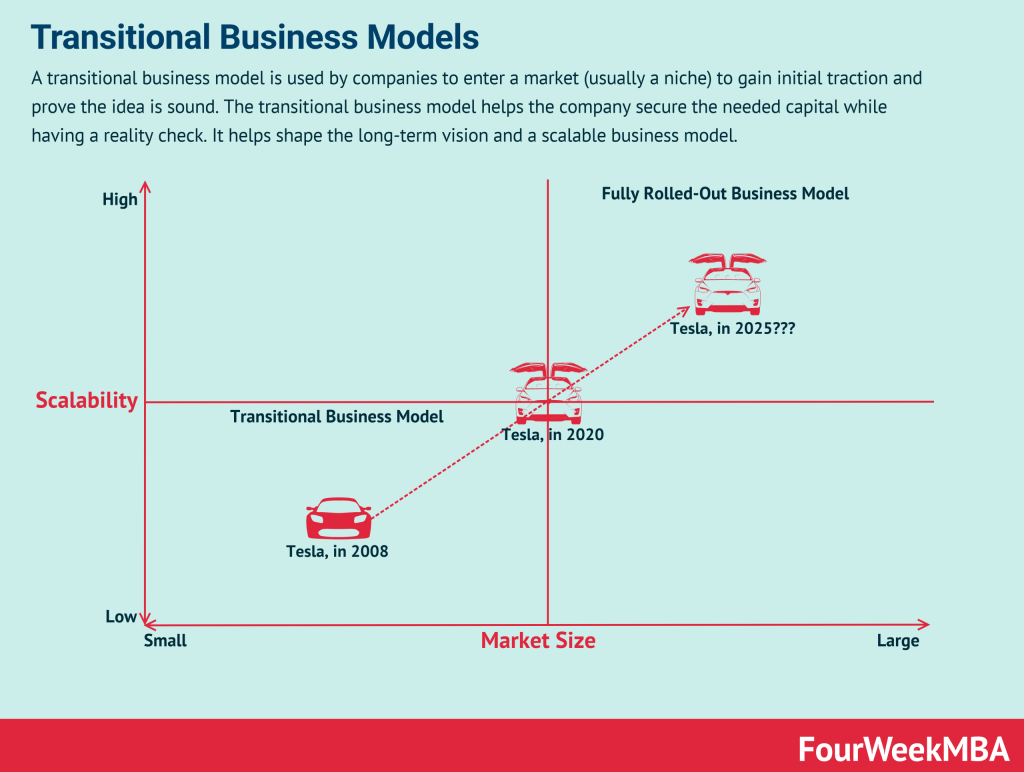
A transitional business model is used by companies to enter a market (usually a niche) to gain initial traction and prove the idea is sound. The transitional business model helps the company secure the needed capital while having a reality check. It helps shape the long-term vision and a scalable businessmodel.
The minimum viable audience (MVA) represents the smallest possible audience that can sustain your business as you get it started from a microniche (the smallest subset of a market). The main aspect of the MVA is to zoom into existing markets to find those people which needs are unmet by existing players.
Business scaling is the process of transformation of a business as the product is validated by wider and wider market segments. Business scaling is about creating traction for a product that fits a small market segment. As the product is validated it becomes critical to build a viable businessmodel. And as the product is offered at wider and wider market segments, it’s important to align product, businessmodel, and organizational design, to enable wider and wider scale.
The market expansion consists in providing a product or service to a broader portion of an existing market or perhaps expanding that market. Or yet, market expansions can be about creating a whole new market. At each step, as a result, a company scales together with the market covered.
In the FourWeekMBA growth matrix, you can apply growth for existing customers by tackling the same problems (gain mode). Or by tackling existing problems, for new customers (expand mode). Or by tackling new problems for existing customers (extend mode). Or perhaps by tackling whole new problems for new customers (reinvent mode).
In the FourWeekMBA Revenue Streams Matrix, revenue streams are classified according to the kind of interactions the business has with its key customers. The first dimension is the “Frequency” of interaction with the key customer. As the second dimension, there is the “Ownership” of the interaction with the key customer.
Revenue model patterns are a way for companies to monetize their business models. A revenue model pattern is a crucial building block of a business model because it informs how the company will generate short-term financial resources to invest back into the business. Thus, the way a company makes money will also influence its overall businessmodel.
A pricing strategy or model helps companies find the pricing formula in fit with their business models. Thus aligning the customer needs with the product type while trying to enable profitability for the company. A good pricing strategy aligns the customer with the company’s long term financial sustainability to build a solid businessmodel.
Gennaro is the creator of FourWeekMBA, which reached about four million business people, comprising C-level executives, investors, analysts, product managers, and aspiring digital entrepreneurs in 2022 alone | He is also Director of Sales for a high-tech scaleup in the AI Industry | In 2012, Gennaro earned an International MBA with emphasis on Corporate Finance and Business Strategy.