Instagram’s marketingstrategy focuses on its visual platform, user engagement, influencer marketing, advertising solutions, stories and ephemeral content, influencing online shopping, and community guidelines. It emphasizes user-generated content, influencer partnerships, targeted advertising, and promoting seamless shopping experiences. Instagram aims to create a safe and engaging environment for users while providing effective marketing opportunities for businesses.
Marketing Strategy
Description
Example
Implications
Integration
Visual Storytelling
Instagram is a visual-centric platform that emphasizes storytelling through images and videos. It encourages users and businesses to tell their stories visually.
Brands on Instagram share visually appealing content, including behind-the-scenes glimpses, user-generated content, and product showcases, creating narratives through visuals.
– Engages users emotionally through compelling visuals. – Fosters brand identity and awareness through storytelling. – Showcases products and services in a relatable way.
Visual storytelling is at the core of Instagram and is integrated into every aspect of the platform, aligning with user-generated content for authentic narratives. It complements content marketing for sharing brand stories through visuals.
User-Generated Content (UGC)
Instagram leverages UGC as a powerful marketing tool. Brands encourage users to create content related to their products or services, which is then shared and promoted on their profiles.
Brands run UGC campaigns, contests, or hashtags to encourage users to create content featuring their products. They often repost or share this UGC on their own profiles, giving credit to the creators.
– Builds trust and authenticity through real user experiences. – Expands brand reach and engagement through user-generated content. – Encourages community participation and advocacy.
UGC campaigns are integrated into Instagram’s marketing strategy, aligning with visual storytelling for authentic narratives. They complement community engagement for fostering connections with users and encouraging content creation.
Influencer Partnerships
Instagram utilizes influencer marketing by collaborating with popular users and celebrities to promote products or services. Influencers have large and engaged followings, making them effective brand advocates.
Brands partner with relevant influencers who align with their target audience to promote their products. Influencers create content showcasing the brand’s offerings and share it with their followers.
– Expands brand reach and credibility through influencer endorsements. – Leverages influencers’ authenticity and connection with their followers. – Reaches niche or specific target audiences effectively.
Influencer partnerships are an integral part of Instagram’s marketing landscape, aligning with user-generated content for authenticity. They complement content marketing for sharing influencer-created content and align with community engagement for building relationships with influencers.
Stories and Ephemeral Content
Instagram Stories and ephemeral content provide a platform for sharing temporary content that disappears after 24 hours. Brands use this feature for timely updates, promotions, and behind-the-scenes content.
Brands post temporary Stories featuring limited-time offers, product launches, and exclusive content to create urgency and engagement. They often use features like polls and questions to interact with their audience.
– Creates a sense of urgency and exclusivity for promotions. – Encourages real-time interaction and engagement with the audience. – Showcases authentic and unpolished content.
Stories and ephemeral content are seamlessly integrated into Instagram’s platform, aligning with visual storytelling for sharing real-time updates. They complement digital marketing for promoting time-sensitive offers and events.
Instagram Shopping
Instagram has introduced shopping features that allow businesses to tag products in posts and Stories, providing a direct shopping experience for users without leaving the app.
Brands set up shopping catalogs and tag products in their posts. Users can click on the tagged products to view details, prices, and make purchases directly through Instagram.
– Simplifies the shopping process, increasing conversions. – Provides a seamless and integrated shopping experience. – Allows brands to showcase their products visually.
Instagram Shopping is fully integrated into the platform, aligning with user-generated content for product showcases. It complements e-commerce strategies by offering a direct purchase option to users.
Data-Driven Advertising
Instagram offers targeted advertising options to businesses, allowing them to reach specific demographics and interests. Advertisers can create highly personalized campaigns based on user data.
Advertisers use Instagram’s ad platform to target specific demographics, interests, or behaviors. They can create visually appealing ads and track the performance of their campaigns in real-time.
– Provides highly targeted and relevant ad placements. – Maximizes return on investment (ROI) through data-driven insights. – Offers advanced tracking and analytics for ad performance.
Data-driven advertising is seamlessly integrated into Instagram’s platform, aligning with influencer partnerships for targeted campaigns. It complements digital marketing for reaching specific demographics and optimizing ad performance.
Instagram Live
Instagram Live allows users and businesses to broadcast live video content, fostering real-time interaction with their followers. Brands use this feature for live product launches, Q&A sessions, and behind-the-scenes content.
Brands go live to engage with their audience in real-time. They may host live events, interviews, or interactive sessions where viewers can comment and ask questions. The content disappears after the broadcast ends.
– Fosters real-time engagement and interaction with the audience. – Allows for immediate feedback and connection with followers. – Creates a sense of urgency for viewers to tune in.
Instagram Live is seamlessly integrated into the platform, aligning with Stories for real-time updates. It complements content marketing for sharing live event broadcasts and aligns with community engagement for fostering direct interactions with followers.
Hashtag Campaigns
Hashtags are widely used on Instagram to categorize and discover content. Brands create branded hashtags for campaigns and encourage users to participate by using these hashtags in their posts.
Brands create and promote branded hashtags for specific campaigns or promotions. Users can participate by using the hashtag in their posts, and brands often feature user-generated content with the hashtag on their profiles.
– Increases brand visibility and engagement through user participation. – Organizes and categorizes content related to specific campaigns. – Encourages community involvement and conversation.
Hashtag campaigns are integrated into Instagram’s marketing strategy, aligning with user-generated content for engagement. They complement community engagement for encouraging participation and align with digital marketing for tracking campaign reach.
Analytics and Insights
Instagram provides businesses with analytics and insights about their profile and content performance. This data includes metrics on reach, engagement, audience demographics, and more.
Brands use Instagram Insights to track the performance of their posts, Stories, and overall profile. They gain insights into audience demographics, engagement rates, and the effectiveness of their content strategy.
– Informs data-driven decision-making for content and strategy optimization. – Provides valuable audience insights for targeting and segmentation. – Measures the impact of marketing efforts and campaigns.
Analytics and insights are seamlessly integrated into Instagram’s platform, aligning with data-driven advertising for campaign optimization. They complement digital marketing for measuring the impact of Instagram marketing efforts.
Social Responsibility
Instagram emphasizes social responsibility by promoting causes, charity work, and sustainability efforts. Brands often use their platform to support various social and environmental initiatives.
Brands showcase their commitment to social responsibility by sharing content related to charitable partnerships, sustainability practices, or community involvement. They may run campaigns to raise awareness and funds for specific causes.
– Enhances brand reputation and aligns with socially conscious consumers. – Demonstrates corporate values and responsibility to the community. – Encourages user engagement and support for social causes.
Social responsibility initiatives are integrated into Instagram’s marketing strategy, aligning with visual storytelling for showcasing charitable efforts. They complement content marketing for raising awareness and align with community engagement for encouraging support and participation.
Visual Platform:Instagram’s core strategy centers around its visual nature, encouraging users to share photos and videos that engage and inspire.
User Engagement: The platform focuses on fostering high user engagement through likes, comments, shares, and direct messaging.
Influencer Marketing: Instagram leverages influencer partnerships to showcase products, services, and brands, utilizing influencers’ reach and credibility.
Advertising Solutions: The platform offers targeted advertising options that allow businesses to reach specific demographics based on user behavior and preferences.
Stories and Ephemeral Content: Instagram Stories provide a way for users and businesses to share temporary, engaging content, promoting urgency and authenticity.
Online Shopping Influence: Instagram integrates shopping features, allowing users to discover and purchase products directly through the platform.
Community Guidelines: The platform emphasizes community guidelines to create a safe and respectful environment for users, fostering positive interactions.
User-Generated Content: Instagram encourages users to create and share their content, promoting authenticity and user involvement in brandmarketing.
Seamless Shopping Experiences: Instagram facilitates seamless shopping experiences by enabling users to explore and buy products without leaving the app.
Business Marketing Opportunities: Instagram provides businesses with diverse marketing opportunities, from sponsored posts to shoppable tags, to effectively engage with their target audience.
Mark Zuckerberg is the largest shareholder in the company. Zuckerberg retains ownership and control of the company. Like Google, Facebook has issued two common stocks, Class A and Class B. The holders of Class B common stocks are entitled to ten votes per share, and holders of our Class A common stocks are entitled to one vote per share. Mark Zuckerberg has a voting power of 61.1%; he’s the primary decision-maker. Other individual investors comprise Sheryl Sandberg, Christopher Cox, Marc Andreessen, Peter Thiel, Dustin Moskovitz, and Eduardo Saverin.
Facebook, the main product of Meta is an attention merchant. As such, its algorithms condense the attention of over 2.91 billion monthly active users as of June 2021. Meta generated $117.9 billion in revenues, in 2021, of which $114.9 billion from advertising (97.4% of the total revenues) and over $2.2 billion from Reality Labs (the augmented and virtual reality products arm).
Facebook generated most of its revenue from advertising in 2023. Indeed, the company generated $131.95B from advertising, $1.89B billion from its reality labs segment, and over a billion in other revenue.
By September 2022, Facebook’s (Meta) employee count had peaked at 87,314. Yet, as revenue slew down for the first time in years, the company announced a layoff of 13% of its workforce, bringing the headcount to 75,964. By March 2023, Meta announced another round of layoffs, dubbed “The Year of Efficiency,” which brought the headcount down to less than 66 thousand employees. By the end of 2023, Facebook reported 67,317 employees.
In 2022, post layoffs, Facebook generated $1,535,056 per employee, compared to $1,638,586 in 2021. In 2023, as Facebook (now Meta) completed its mass layoffs, the company reported nearly $135 billion in revenue and 67,317 employees, with a $2,003,981 revenue per employee.
Facebook (Meta) gained users in 2023. In fact, in 2023, Facebook had over three billion users worldwide, of which 272 million were in Canada, 408 million were in Europe, over 1.3 billion were in Asia, and over a billion were in the rest of the world.
ARPU, or average revenue per user, is a crucial metric for attention merchants like Facebook. It assesses the ability of the platform to monetize its users. For instance, by the end of 2023, Meta’s ARPU worldwide was $13.12. In the US & Canada, it was $68.44; in Europe, it was $23.14; in Asia-Pacific, $5.52; and in the rest of the world, it was $4.50.
ARPU, or average revenue per user, is a crucial metric for attention merchants like Facebook. It assesses the ability of the platform to monetize its users. For instance, by the end of 2023, Meta’s ARPU worldwide was $13.12. In the US & Canada, it was $68.44; in Europe, it was $23.14; in Asia-Pacific, $5.52; and in the rest of the world, it was $4.50.
Facebook (Meta) revenue in 2023 increased to $134.9B, compared to $116.6B in 2022. Its profitability increased to $39.1B in 2023, compared to $23.2B in 2022 and $39.37B in 2021.
Facebook is characterized by a multi-faceted matrix organizational structure. The company utilizes a flat organizational structure in combination with corporate function-based teams and product-based or geographic divisions. The flat organizationstructure is organized around the leadership of Mark Zuckerberg, and the key executives around him. On the other hand, the function-based teams based on the main corporate functions (like HR, productmanagement, investor relations, and so on).
Instagram makes money via visual advertising. Acquired by Facebook for a billion-dollar in 2012, today, Instagram is integrated into the overall Facebook (now rebranded as Meta) business strategy. In 2018, Instagram founders Kevin Systrom and Mike Krieger left the company as Facebook pushed toward tighter integration of the two platforms. In 2022, Instagram is the most successful product still, in Meta’s portfolio.
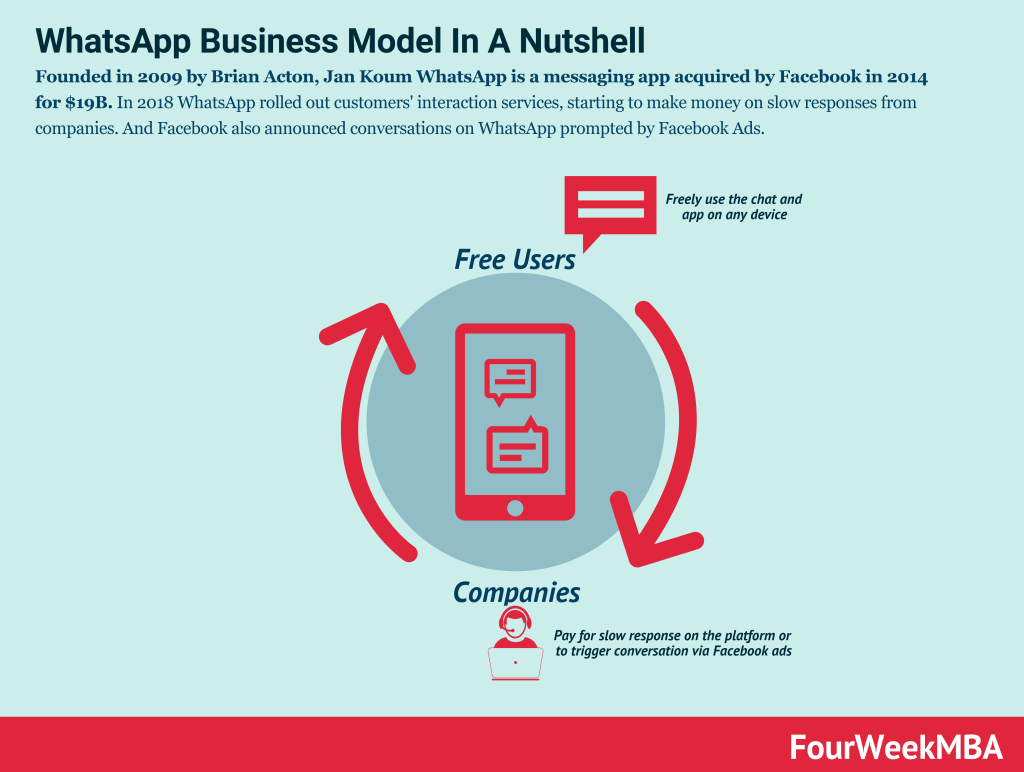
Founded in 2009 by Brian Acton, Jan Koum WhatsApp is a messaging app acquired by Facebook in 2014 for $19B. In 2018 WhatsApp rolled out customers’ interaction services, starting to make money on slow responses from companies. And Facebook also announced conversations on WhatsApp prompted by Facebook Ads.
Gennaro is the creator of FourWeekMBA, which reached about four million business people, comprising C-level executives, investors, analysts, product managers, and aspiring digital entrepreneurs in 2022 alone | He is also Director of Sales for a high-tech scaleup in the AI Industry | In 2012, Gennaro earned an International MBA with emphasis on Corporate Finance and Business Strategy.