The HEXACO Model of Personality is a comprehensive framework for understanding human personality traits. It differs from the widely known Big Five personality traits model by incorporating an additional factor: Honesty-Humility.
The HEXACO Model of Personality was developed by Kibeom Lee and Michael C. Ashton in the early 2000s as an extension of existing personality trait models, particularly the Big Five. The model identifies six major dimensions of personality, each representing a distinct aspect of an individual’s character and behavior. These dimensions are:
Honesty-Humility (H): This dimension reflects an individual’s sincerity, fairness, and avoidance of manipulative behavior. People high in Honesty-Humility tend to be genuine, straightforward, and ethical, while those low in this trait may engage in deceitful or exploitative behavior.
Emotionality (E): Emotionality pertains to the extent of an individual’s emotional attachment and sentimentality. Those high in Emotionality are often more sentimental, tender, and compassionate, whereas those low in this trait tend to be more emotionally detached and stoic.
eXtraversion (X): eXtraversion measures sociability, assertiveness, and the desire for social interaction. Individuals high in eXtraversion are outgoing, assertive, and enjoy socializing, while those low in this trait are more introverted and reserved.
Agreeableness (A): This dimension reflects an individual’s patience, tolerance, gentleness, and willingness to cooperate. People high in Agreeableness are typically warm, understanding, and accommodating, while those low in this trait may be more critical and competitive.
Conscientiousness (C): Conscientiousness pertains to an individual’s organization, responsibility, and diligence in tasks. Those high in Conscientiousness are often organized, reliable, and detail-oriented, while those low in this trait may be more careless and disorganized.
Openness to Experience (O): Openness to Experience measures an individual’s receptivity to new ideas, creativity, and intellectual curiosity. People high in Openness are imaginative, open to new experiences, and willing to explore novel concepts, while those low in this trait may prefer routine and familiarity.
Now, let’s delve into each of the six HEXACO dimensions in more detail:
1. Honesty-Humility (H)
High H: Individuals with high Honesty-Humility scores tend to be sincere, genuine, and straightforward. They have a strong sense of ethics and are unlikely to engage in deceitful or manipulative behavior. They value fairness and are considerate of others.
Low H: Those with low Honesty-Humility scores may exhibit manipulative tendencies, a lack of sincerity, and a willingness to exploit others for personal gain. They may be more inclined to deceive or take advantage of people.
2. Emotionality (E)
High E: Individuals high in Emotionality are emotionally expressive, compassionate, and empathetic. They are sensitive to the feelings of others and tend to form deep emotional connections.
Low E: People with low Emotionality scores may appear emotionally detached and less responsive to the emotions of others. They may have a more stoic and reserved demeanor.
3. eXtraversion (X)
High X: Those with high eXtraversion scores are outgoing, sociable, and enjoy social interactions. They are often assertive and comfortable in social settings.
Low X: Individuals low in eXtraversion are more introverted and reserved. They may prefer solitary activities and may find social interactions draining.
4. Agreeableness (A)
High A: People high in Agreeableness are patient, tolerant, and cooperative. They are generally warm, understanding, and easy to get along with.
Low A: Those with low Agreeableness scores may be more critical, competitive, and less willing to cooperate. They may have a more argumentative or confrontational style.
5. Conscientiousness (C)
High C: Individuals high in Conscientiousness are organized, responsible, and diligent in their tasks. They pay attention to details and are reliable and dependable.
Low C: People with low Conscientiousness scores may be more careless, disorganized, and less focused on responsibilities. They may struggle with time management and follow-through.
6. Openness to Experience (O)
High O: Those high in Openness to Experience are imaginative, creative, and open to new ideas and experiences. They are curious and enjoy exploring novel concepts.
Low O: Individuals low in Openness may prefer routine and familiarity. They may be more resistant to change and less interested in exploring new ideas.
Significance of the HEXACO Model
The HEXACO Model offers several advantages and insights into human personality:
1. Comprehensive Assessment:
Unlike some other personality models, the HEXACO Model provides a more comprehensive assessment of an individual’s character by including the Honesty-Humility dimension.
2. Cultural Sensitivity:
The HEXACO Model has been found to be particularly useful in cross-cultural studies, as it accounts for cultural variations in personality traits.
3. Predictive Value:
Research has shown that the HEXACO dimensions can predict behavior, attitudes, and outcomes in various domains, such as interpersonal relationships, ethical decision-making, and job performance.
4. Practical Applications:
The model has practical applications in areas such as personnel selection, leadership development, and conflict resolution
, as it provides insights into how individuals are likely to behave in different situations.
5. Ethical Decision-Making:
The inclusion of Honesty-Humility makes the HEXACO Model particularly relevant in the study of ethical decision-making and moral behavior.
Practical Applications of the HEXACO Model
The HEXACO Model finds applications in various domains:
1. Personnel Selection:
Organizations can use the HEXACO Model in the hiring process to assess candidates’ suitability for specific roles. For example, a role requiring high levels of conscientiousness and honesty may benefit from candidates with corresponding HEXACO traits.
2. Leadership Development:
Leadership development programs can use the model to identify and develop leadership qualities in individuals. For instance, those high in eXtraversion and Agreeableness might be groomed for leadership positions that require interpersonal skills.
3. Conflict Resolution:
Understanding the HEXACO dimensions can aid in resolving conflicts by identifying the underlying personality traits that may contribute to disagreements. This insight can help mediators and conflict resolution specialists find effective solutions.
4. Ethical Decision-Making:
Researchers and organizations can explore the role of Honesty-Humility in ethical decision-making processes, helping to prevent unethical behavior in various settings.
5. Cross-Cultural Studies:
The model is particularly valuable in cross-cultural studies, as it accommodates cultural differences in personality traits and behavior.
Criticisms and Limitations
While the HEXACO Model offers valuable insights, it is not without criticisms and limitations:
1. Complexity:
The model’s six dimensions can be more complex to measure and interpret compared to simpler models like the Big Five.
2. Cultural Variability:
Some critics argue that the model may not fully capture cultural variations in personality, as it still relies on self-report measures that can be influenced by cultural norms.
3. Limited Research:
Although the model has gained popularity, there is still ongoing research to fully understand its implications and applications.
4. Overlap with Big Five:
There is some overlap between the HEXACO Model and the Big Five, as some traits in both models share similarities.
Future Directions in Personality Research
The study of personality continues to evolve, with future directions in research likely to include:
1. Integration of Models:
Researchers may explore ways to integrate different personality models, such as the HEXACO Model and the Big Five, to create a more comprehensive framework.
2. Applied Psychology:
Further applications of personality research are expected in areas such as mental health, well-being, and personal development.
3. Neuroscience and Genetics:
Advances in neuroscience and genetics may provide deeper insights into the biological underpinnings of personality traits.
4. Cross-Cultural Studies:
Cross-cultural studies will continue to play a crucial role in understanding how personality traits manifest across different societies and cultures.
5. Technology and Assessment:
Technology, including artificial intelligence, may facilitate more accurate and efficient assessments of personality traits.
Conclusion
The HEXACO Model of Personality offers a comprehensive understanding of human personality traits, including an emphasis on Honesty-Humility, which distinguishes it from other models. Each of the six dimensions in the model provides unique insights into an individual’s character and behavior, making it a valuable tool for various applications, from personnel selection to conflict resolution. As the field of personality research continues to advance, the HEXACO Model remains a significant contribution to our understanding of what makes each of us unique.
Key Highlights:
Introduction to the HEXACO Model: Developed by Kibeom Lee and Michael C. Ashton, the HEXACO Model extends the Big Five personality traits by adding the dimension of Honesty-Humility.
Six Dimensions of the HEXACO Model:
Honesty-Humility (H)
Emotionality (E)
eXtraversion (X)
Agreeableness (A)
Conscientiousness (C)
Openness to Experience (O)
Understanding Each Dimension:
Provides insights into the characteristics of individuals high and low on each trait.
Helps in understanding behaviors and preferences based on personality traits.
Significance of the HEXACO Model:
Offers a more comprehensive assessment of personality.
Culturally sensitive and applicable in various contexts.
Predictive value in domains like interpersonal relationships and job performance.
Practical Applications:
Used in personnel selection, leadership development, conflict resolution, and ethical decision-making.
Valuable in cross-cultural studies and understanding individual differences.
Criticisms and Limitations:
Complexity in measurement and interpretation.
Cultural variability and reliance on self-report measures.
Overlap with other personality models.
Future Directions in Personality Research:
Integration of different personality models.
Applied psychology in mental health and well-being.
Advancements in neuroscience and genetics for understanding personality.
Continued focus on cross-cultural studies and technological advancements in assessment.
Conclusion: The HEXACO Model enhances our understanding of human personality by incorporating the dimension of Honesty-Humility and providing insights into various traits. Its practical applications extend to areas like personnel selection, leadership development, and conflict resolution, making it a valuable tool in psychology and related fields.
Related Framework
Description
When to Apply
Big Five Personality Traits
– A widely accepted model of personality that includes five broad dimensions: Openness to Experience, Conscientiousness, Extraversion, Agreeableness, and Neuroticism. This model serves as the foundation for understanding individual differences in personality traits and behaviors.
– Useful for personality assessment, team building, and career counseling to gain insights into individuals’ strengths, weaknesses, and compatibility with various roles and environments.
Self-Determination Theory (SDT)
– Focuses on the innate psychological needs for autonomy, competence, and relatedness. It suggests that satisfying these needs leads to intrinsic motivation and well-being, making it relevant to understanding individual differences in motivation and behavior.
– Applicable in motivation strategies, employee engagement initiatives, and educational settings where fostering autonomy and providing supportive environments are critical.
Hofstede’s Cultural Dimensions Theory
– Identifies six dimensions of culture: Power Distance, Individualism vs. Collectivism, Masculinity vs. Femininity, Uncertainty Avoidance, Long-term vs. Short-term Orientation, and Indulgence vs. Restraint. This framework helps to understand cultural differences and their impact on behavior and organizational practices.
– Useful for cross-cultural management, international business, and diversity training to navigate cultural differences and foster effective communication and collaboration across diverse teams.
Dark Triad
– Comprises three socially aversive personality traits: Machiavellianism, Narcissism, and Psychopathy. Individuals high in these traits exhibit manipulative, exploitative, and unethical behaviors, posing challenges in interpersonal relationships and organizational settings.
– Relevant in selection processes, leadership development, and conflict management, where identifying and mitigating the negative impacts of these traits are essential for maintaining a healthy organizational culture.
Cognitive-Behavioral Therapy (CBT)
– A widely used therapeutic approach that focuses on identifying and modifying dysfunctional thought patterns and behaviors. CBT aims to alleviate psychological distress and improve coping skills by challenging irrational beliefs and implementing behavioral strategies.
– Applicable in clinical psychology, stress management programs, and personal development interventions, where addressing maladaptive thought patterns and behaviors is essential for promoting mental well-being.
Strengths-Based Approach
– Emphasizes identifying and leveraging individuals’ strengths, talents, and positive attributes to enhance performance and well-being. This approach encourages focusing on what individuals do well rather than solely addressing weaknesses, fostering a sense of fulfillment and accomplishment.
– Useful in coaching, performance management, and team development, where recognizing and utilizing individual strengths can lead to increased engagement, productivity, and job satisfaction.
Transactional Analysis (TA)
– A psychoanalytic theory that explores interpersonal interactions and communication patterns through three ego states: Parent, Adult, and Child. TA helps individuals understand their habitual patterns of relating to others and develop healthier communication and relationship skills.
– Relevant in counseling, conflict resolution, and leadership training, where enhancing self-awareness and improving communication dynamics are essential for fostering positive relationships and effective teamwork.
Social Learning Theory
– Proposes that people learn from observing others’ behaviors, attitudes, and outcomes. Through imitation, modeling, and vicarious reinforcement, individuals acquire new skills and behaviors, shaping their own attitudes and actions based on social cues and environmental influences.
– Applicable in training programs, behavioral interventions, and organizational culture initiatives aimed at promoting desired behaviors and values by providing positive role models and reinforcing desired outcomes.
Job Crafting
– Involves employees proactively changing the boundaries of their jobs to increase engagement, job satisfaction, and well-being. It empowers employees to modify tasks, relationships, and perceptions of their jobs.
– Applicable in employee development and well-being initiatives, encouraging employees to take ownership of their work experiences and personalize their roles to better align with their strengths and preferences.
Appreciative Inquiry (AI)
– A positive approach to organizational change that focuses on identifying and amplifying what is working well within an organization. AI involves asking positive questions, envisioning a desired future, and co-creating solutions based on existing strengths and successes.
– Effective in change management processes, organizational development, and team-building exercises, where fostering a culture of positivity, collaboration, and innovation is essential for driving sustainable change and growth.
In a functional organizational structure, groups and teams are organized based on function. Therefore, this organization follows a top-down structure, where most decision flows from top management to bottom. Thus, the bottom of the organization mostly follows the strategy detailed by the top of the organization.
In a flat organizational structure, there is little to no middle management between employees and executives. Therefore it reduces the space between employees and executives to enable an effective communication flow within the organization, thus being faster and leaner.
Project portfolio management (PPM) is a systematic approach to selecting and managing a collection of projects aligned with organizational objectives. That is a business process of managing multiple projects which can be identified, prioritized, and managed within the organization. PPM helps organizations optimize their investments by allocating resources efficiently across all initiatives.
Harvard Business School professor Dr. John Kotter has been a thought-leader on organizational change, and he developed Kotter’s 8-step change model, which helps business managers deal with organizational change. Kotter created the 8-step model to drive organizational transformation.
The Nadler-Tushman Congruence Model was created by David Nadler and Michael Tushman at Columbia University. The Nadler-Tushman Congruence Model is a diagnostic tool that identifies problem areas within a company. In the context of business, congruence occurs when the goals of different people or interest groups coincide.
McKinsey’s Seven Degrees of Freedom for Growth is a strategy tool. Developed by partners at McKinsey and Company, the tool helps businesses understand which opportunities will contribute to expansion, and therefore it helps to prioritize those initiatives.
Mintzberg’s 5Ps of Strategy is a strategy development model that examines five different perspectives (plan, ploy, pattern, position, perspective) to develop a successful business strategy. A sixth perspective has been developed over the years, called Practice, which was created to help businesses execute their strategies.
The COSO framework is a means of designing, implementing, and evaluating control within an organization. The COSO framework’s five components are control environment, risk assessment, control activities, information and communication, and monitoring activities. As a fraud risk management tool, businesses can design, implement, and evaluate internal control procedures.
The TOWS Matrix is an acronym for Threats, Opportunities, Weaknesses, and Strengths. The matrix is a variation on the SWOT Analysis, and it seeks to address criticisms of the SWOT Analysis regarding its inability to show relationships between the various categories.
Lewin’s change management model helps businesses manage the uncertainty and resistance associated with change. Kurt Lewin, one of the first academics to focus his research on group dynamics, developed a three-stage model. He proposed that the behavior of individuals happened as a function of group behavior.
OpenAI is an artificial intelligence research laboratory that transitioned into a for-profit organization in 2019. The corporate structure is organized around two entities: OpenAI, Inc., which is a single-member Delaware LLC controlled by OpenAI non-profit, And OpenAI LP, which is a capped, for-profit organization. The OpenAI LP is governed by the board of OpenAI, Inc (the foundation), which acts as a General Partner. At the same time, Limited Partners comprise employees of the LP, some of the board members, and other investors like Reid Hoffman’s charitable foundation, Khosla Ventures, and Microsoft, the leading investor in the LP.
Airbnb follows a holacracy model, or a sort of flat organizational structure, where teams are organized for projects, to move quickly and iterate fast, thus keeping a lean and flexible approach. Airbnb also moved to a hybrid model where employees can work from anywhere and meet on a quarterly basis to plan ahead, and connect to each other.
The Amazon organizational structure is predominantly hierarchical with elements of function-based structure and geographic divisions. While Amazon started as a lean, flat organization in its early years, it transitioned into a hierarchical organization with its jobs and functions clearly defined as it scaled.
The Coca-Cola Company has a somewhat complex matrix organizational structure with geographic divisions, product divisions, business-type units, and functional groups.
Costco has a matrix organizational structure, which can simply be defined as any structure that combines two or more different types. In this case, a predominant functional structure exists with a more secondary divisional structure.
Costco’s geographic divisions reflect its strong presence in the United States combined with its expanding global presence. There are six divisions in the country alone to reflect its standing as the source of most company revenue.
Compared to competitor Walmart, for example, Costco takes more a decentralized approach to management, decision-making, and autonomy. This allows the company’s stores and divisions to more flexibly respond to local market conditions.
Dell has a functional organizational structure with some degree of decentralization. This means functional departments share information, contribute ideas to the success of the organization and have some degree of decision-making power.
eBay was until recently a multi-divisional (M-form) organization with semi-autonomous units grouped according to the services they provided. Today, eBay has a single division called Marketplace, which includes eBay and its international iterations.
Facebook is characterized by a multi-faceted matrix organizational structure. The company utilizes a flat organizational structure in combination with corporate function-based teams and product-based or geographic divisions. The flat organization structure is organized around the leadership of Mark Zuckerberg, and the key executives around him. On the other hand, the function-based teams are based on the main corporate functions (like HR, product management, investor relations, and so on).
Goldman Sachs has a hierarchical structure with a clear chain of command and defined career advancement process. The structure is also underpinned by business-type divisions and function-based groups.
Google (Alphabet) has a cross-functional (team-based) organizational structure known as a matrix structure with some degree of flatness. Over the years, as the company scaled and it became a tech giant, its organizational structure is morphing more into a centralized organization.
IBM has an organizational structure characterized by product-based divisions, enabling its strategy to develop innovative and competitive products in multiple markets. IBM is also characterized by function-based segments that support product development and innovation for each product-based division, which include Global Markets, Integrated Supply Chain, Research, Development, and Intellectual Property.
McDonald’s has a divisional organizational structure where each division – based on geographical location – is assigned operational responsibilities and strategic objectives. The main geographical divisions are the US, internationally operated markets, and international developmental licensed markets. And on the other hand, the hierarchical leadership structure is organized around regional and functional divisions.
McKinsey & Company has a decentralized organizational structure with mostly self-managing offices, committees, and employees. There are also functional groups and geographic divisions with proprietary names.
Microsoft has a product-type divisional organizational structure based on functions and engineering groups. As the company scaled over time it also became more hierarchical, however still keeping its hybrid approach between functions, engineering groups, and management.
Nestlé has a geographical divisional structure with operations segmented into five key regions. For many years, Swiss multinational food and drink company Nestlé had a complex and decentralized matrix organizational structure where its numerous brands and subsidiaries were free to operate autonomously.
Nike has a matrix organizational structure incorporating geographic divisions. Nike’s matrix structure is also present at the regional and sub-regional levels. Managerial responsibility is segmented according to business unit (apparel, footwear, and equipment) and function (human resources, finance, marketing, sales, and operations).
Patagonia has a particular organizational structure, where its founder, Chouinard, disposed of the company’s ownership in the hands of two non-profits. The Patagonia Purpose Trust, holding 100% of the voting stocks, is in charge of defining the company’s strategic direction. And the Holdfast Collective, a non-profit, holds 100% of non-voting stocks, aiming to re-invest the brand’s dividends into environmental causes.
Samsung has a product-type divisional organizational structure where products determine how resources and business operations are categorized. The main resources around which Samsung’s corporate structure is organized are consumer electronics, IT, and device solutions. In addition, Samsung leadership functions are organized around a few career levels grades, based on experience (assistant, professional, senior professional, and principal professional).
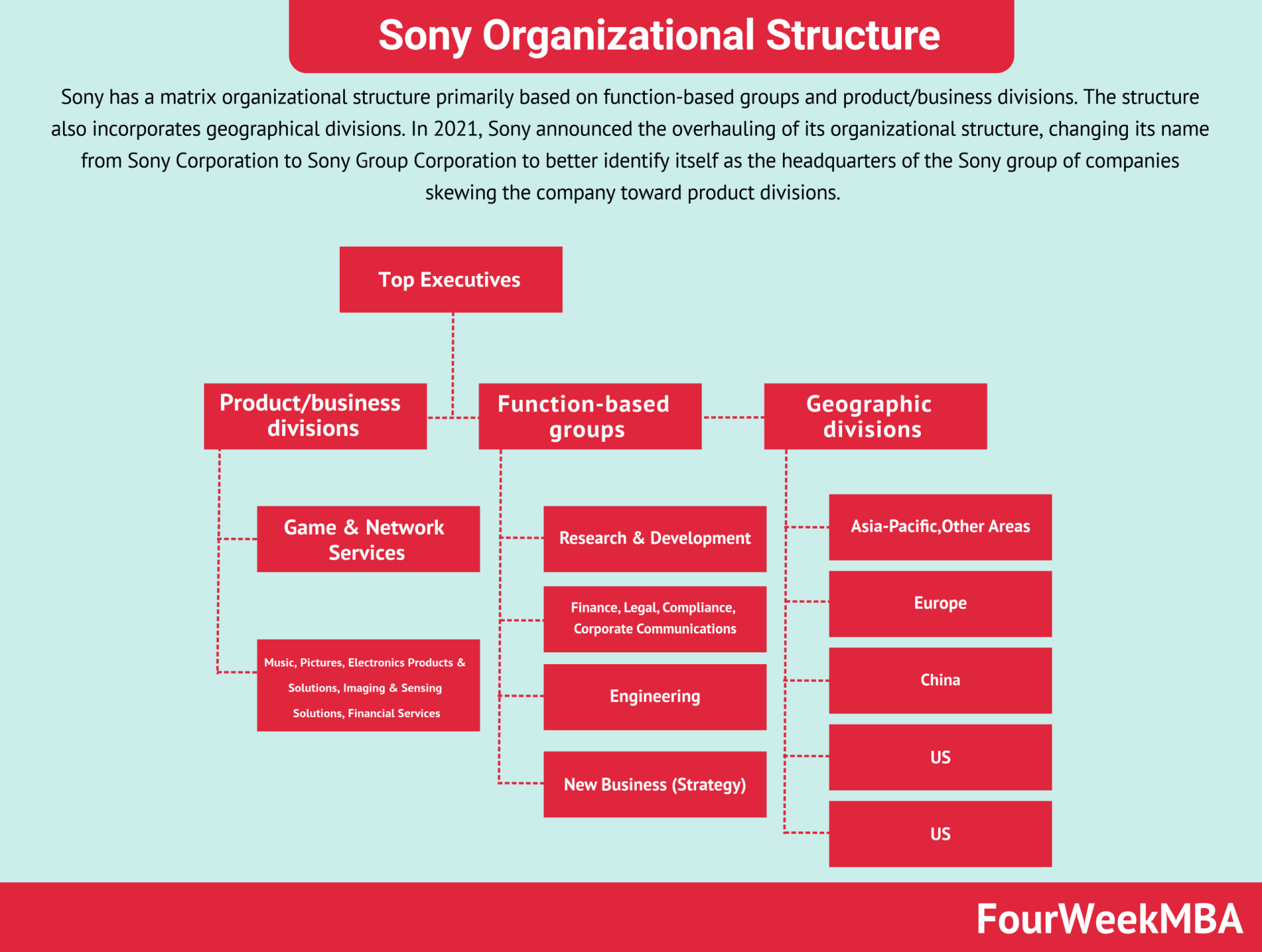
Sony has a matrix organizational structure primarily based on function-based groups and product/business divisions. The structure also incorporates geographical divisions. In 2021, Sony announced the overhauling of its organizational structure, changing its name from Sony Corporation to Sony Group Corporation to better identify itself as the headquarters of the Sony group of companies skewing the company toward product divisions.
Starbucks follows a matrix organizational structure with a combination of vertical and horizontal structures. It is characterized by multiple, overlapping chains of command and divisions.
Tesla is characterized by a functional organizational structure with aspects of a hierarchical structure. Tesla does employ functional centers that cover all business activities, including finance, sales, marketing, technology, engineering, design, and the offices of the CEO and chairperson. Tesla’s headquarters in Austin, Texas, decide the strategic direction of the company, with international operations given little autonomy.
Toyota has a divisional organizational structure where business operations are centered around the market, product, and geographic groups. Therefore, Toyota organizes its corporate structure around global hierarchies (most strategic decisions come from Japan’s headquarter), product-based divisions (where the organization is broken down, based on each product line), and geographical divisions (according to the geographical areas under management).
Walmart has a hybrid hierarchical-functional organizational structure, otherwise referred to as a matrix structure that combines multiple approaches. On the one hand, Walmart follows a hierarchical structure, where the current CEO Doug McMillon is the only employee without a direct superior, and directives are sent from top-level management. On the other hand, the function-based structure of Walmart is used to categorize employees according to their particular skills and experience.
Gennaro is the creator of FourWeekMBA, which reached about four million business people, comprising C-level executives, investors, analysts, product managers, and aspiring digital entrepreneurs in 2022 alone | He is also Director of Sales for a high-tech scaleup in the AI Industry | In 2012, Gennaro earned an International MBA with emphasis on Corporate Finance and Business Strategy.