Change is an important and necessary fact of life for all organizations. But change is often unsuccessful because the people within organizations are resistant to change. Change management is a systematic approach to managing the transformation of organizational goals, values, technologies, or processes.
The operating model is a visual representation and mapping of the processes and how the organization delivers value and, therefore, how it executes its businessmodel. Therefore, the operating model is how the whole organization is structured around the value chain to build a viable businessmodel.
The ladder of inference is a conscious or subconscious thinking process where an individual moves from a fact to a decision or action. The ladder of inference was created by academic Chris Argyris to illustrate how people form and then use mental models to make decisions.
The four-step innovation process is a simple tool that businesses can use to drive consistent innovation. The four-step innovation process was created by David Weiss and Claude Legrand as a means of encouraging sustainable innovation within an organization. The process helps businesses solve complex problems with creative ideas instead of relying on low-impact, quick-fix solutions.
The Total Quality Management (TQM) framework is a technique based on the premise that employees continuously work on their ability to provide value to customers. Importantly, the word “total” means that all employees are involved in the process – regardless of whether they work in development, production, or fulfillment.
First proposed by accounting academic Robert Kaplan, the balanced scorecard is a management system that allows an organization to focus on big-picture strategic goals. The four perspectives of the balanced scorecard include financial, customer, business process, and organizational capacity. From there, according to the balanced scorecard, it’s possible to have a holistic view of the business.
A sales cycle is the process that your company takes to sell your services and products. In simple words, it’s a series of steps that your sales reps need to go through with prospects that lead up to a closed sale.
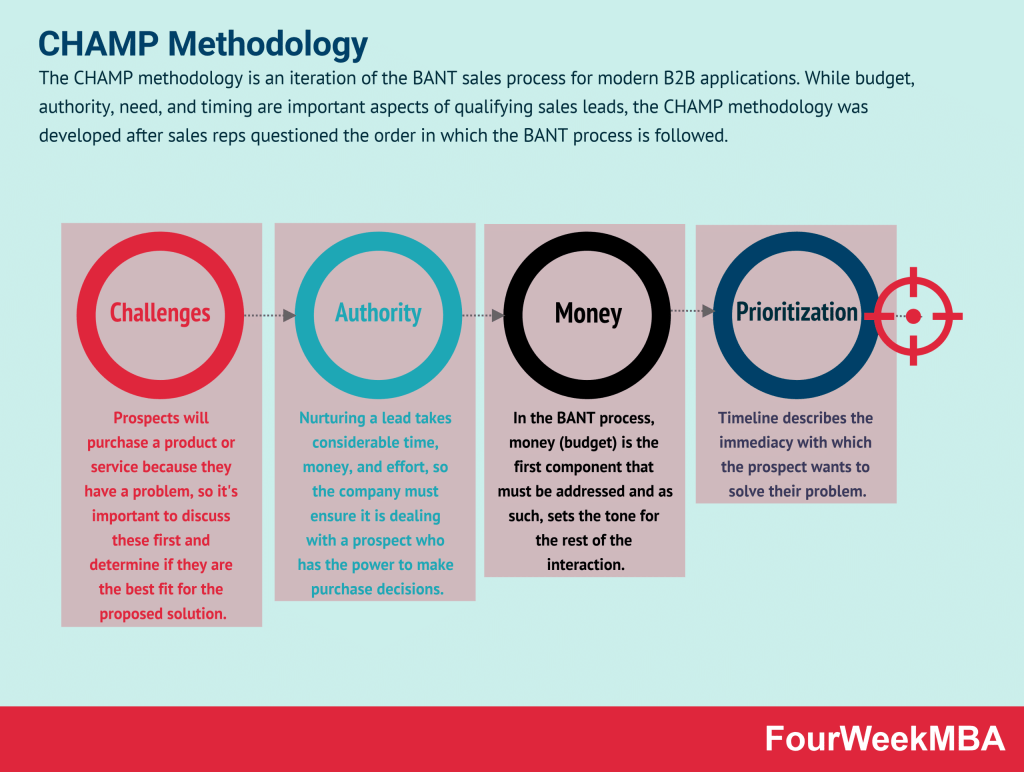
The CHAMP methodology is an iteration of the BANT sales process for modern B2B applications. While budget, authority, need, and timing are important aspects of qualifying sales leads, the CHAMP methodology was developed after sales reps questioned the order in which the BANT process is followed.
The BANT process was conceived at IBM in the 1950s as a way to quickly identify prospects most likely to make a purchase. Despite its introduction around 70 years ago, the BANT process remains relevant today and was formally adopted into IBM’s Business Agility Solution Identification Guide.
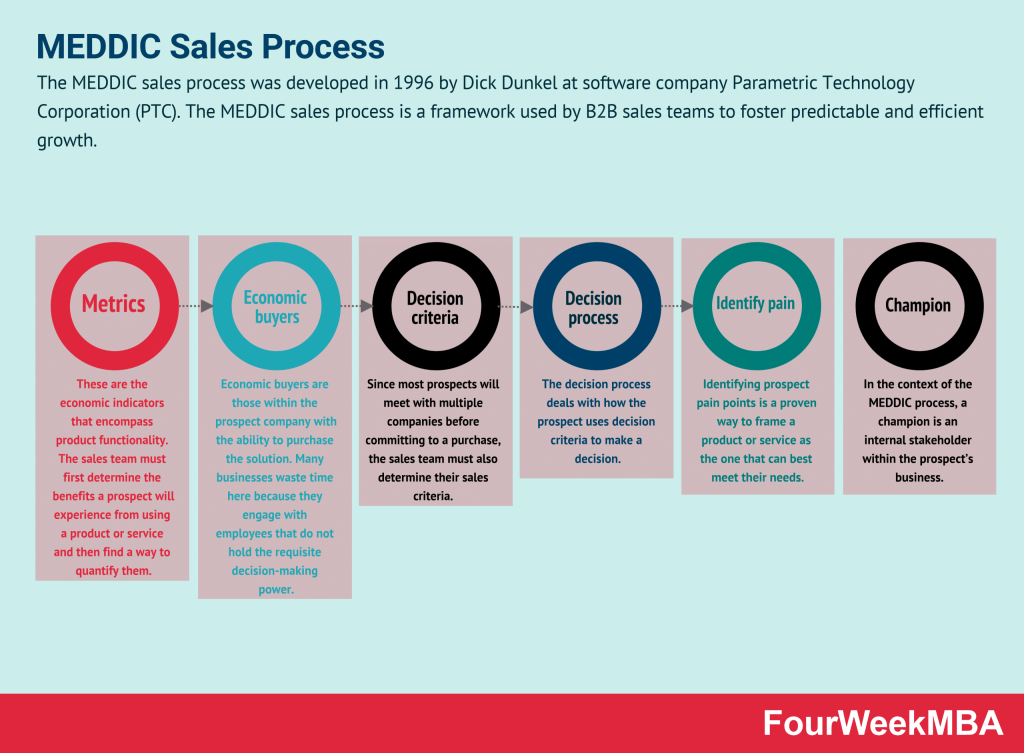
The MEDDIC sales process was developed in 1996 by Dick Dunkel at software company Parametric Technology Corporation (PTC). The MEDDIC sales process is a framework used by B2B sales teams to foster predictable and efficient growth.
STP marketing simplifies the market segmentation process and is one of the most commonly used approaches in modern marketing. The core focus of STP marketing is commercial effectiveness. Marketers use the approach to select the most valuable segments from a target audience and develop a product positioning strategy and marketing mix for each.
The product-process matrix was introduced in two articles published in the Harvard Business Review in 1979. Developed by Robert H. Hayes and Steven C. Wheelwright, the matrix assesses the relationship between:
The stages of the product life cycle (from ideation to growth or decline), and
The stages of the process (technological) life cycle.
Conceptual modeling is the process of developing an abstract model or graphical representation using real-world concepts or ideas. During conceptual modeling, various assumptions are made regarding how the system functions. Conceptual models also illustrate the dominant processes in a system and how they are linked. These processes may include factors known to drive change in the system, or they may encompass the consequences of change in the factors themselves.
The Hoffman Process was developed by American psychotherapist Bob Hoffman in 1967. The Hoffman Process is a tool used to help individuals identify negative behaviors and moods developed unconsciously during childhood. Hoffman recognized that during childhood, we imitate our parents to win their love and receive attention. Specifically, we embody aspects of their moods, attitudes, belief systems, spoken expressions, and even gestures. But if we grow up feeling unloved by our parents, we may later develop behaviors and moods that hinder our ability to show affection toward others.
An innovationfunnel is a tool or process ensuring only the best ideas are executed. In a metaphorical sense, the funnel screens innovative ideas for viability so that only the best products, processes, or business models are launched to the market. An innovation funnel provides a framework for the screening and testing of innovative ideas for viability.
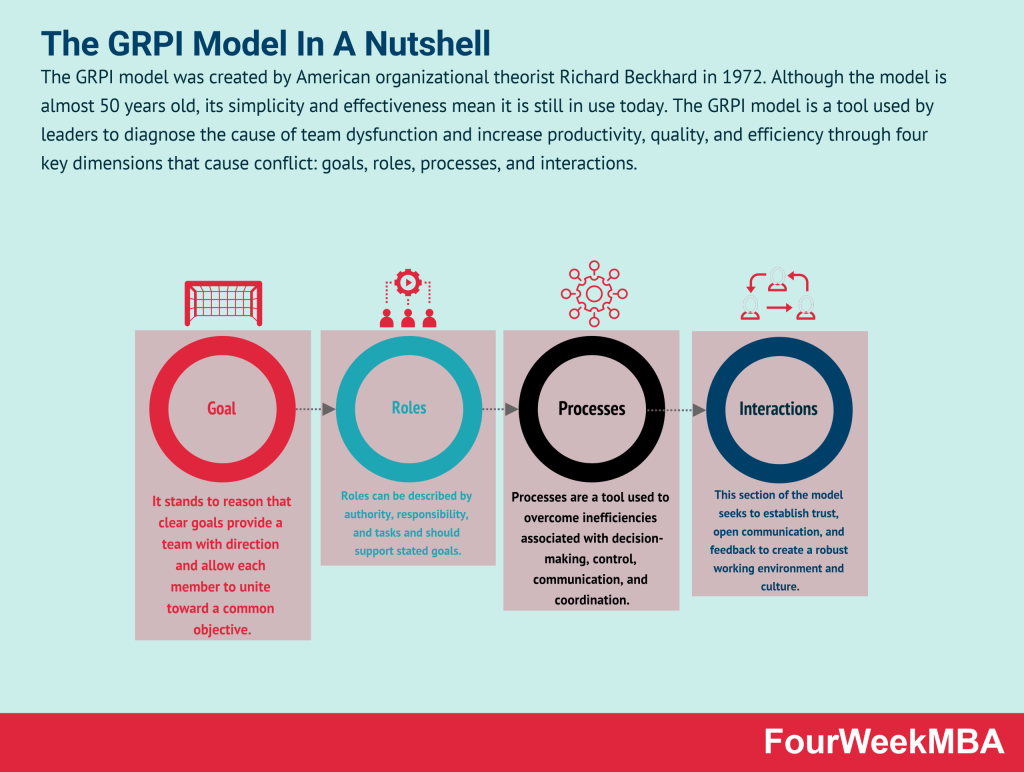
The GRPI model was created by American organizational theorist Richard Beckhard in 1972. Although the model is almost 50 years old, its simplicity and effectiveness mean it is still in use today. The GRPI model is a tool used by leaders to diagnose the cause of team dysfunction and increase productivity, quality, and efficiency through four key dimensions that cause conflict: goals, roles, processes, and interactions.
The ADKAR model is a management tool designed to assist employees and businesses in transitioning through organizational change. To maximize the chances of employees embracing change, the ADKAR model was developed by author and engineer Jeff Hiatt in 2003. The model seeks to guide people through the change process and importantly, ensure that people do not revert to habitual ways of operating after some time has passed.
In a SIPOC diagram, high-level process maps are used as simple yet effective illustration tools. Project leaders use them to quickly explain expectations and provide common reference points to all project team members. SIPOC diagrams are also helpful in identifying problem areas offering little value.
Highlights
Concept
Description
When to Use
Advantages
Drawbacks
Change Management
A systematic approach to managing organizational transformations, addressing resistance to change.
When implementing significant changes in an organization’s goals, values, technologies, or processes.
Helps navigate resistance to change.
May face challenges in employee buy-in.
Operating Model
A visual representation of an organization’s processes and value delivery, aligning with its business model.
When assessing and optimizing how an organization executes its business model and delivers value.
Provides clarity on organizational processes.
Requires a deep understanding of operations.
Ladder of Inference
A thinking process in which individuals move from facts to decisions or actions, illustrating the use of mental models.
When analyzing decision-making processes and addressing cognitive biases.
Helps identify and address cognitive biases.
May require introspection and self-awareness.
Four-Step Innovation Process
A tool to drive consistent innovation by encouraging sustainable problem-solving and creative solutions.
When seeking to foster innovation and solve complex problems within an organization.
Promotes creative problem-solving.
May require a cultural shift towards innovation.
TQM Framework
Total Quality Management emphasizes continuous improvement and employee involvement to provide value to customers.
When aiming to enhance product or service quality, customer satisfaction, and process efficiency.
Focuses on customer-centric quality.
Requires commitment to a quality-driven culture.
Balanced Scorecard
A management system focusing on four perspectives (financial, customer, process, organizational) to achieve strategic goals.
When aligning organizational efforts with strategic objectives and measuring performance.
Provides a holistic view of strategic goals.
Implementation may be complex and time-consuming.
Sales Cycle
The process that a company follows to sell its products or services, involving steps leading to a closed sale.
When managing sales processes, tracking customer interactions, and optimizing sales strategies.
Improves sales efficiency and tracking.
May vary in complexity across industries.
CHAMP Methodology
An iteration of the BANT sales process for B2B applications, focusing on challenges, authority, money, and prioritization.
When qualifying sales leads and improving B2B sales processes.
Emphasizes critical aspects of sales leads.
May not cover all dimensions of buyer behavior.
BANT Sales Process
An old but relevant process for identifying prospects most likely to make a purchase, focusing on budget, authority, need, and timing.
When identifying and qualifying potential customers based on specific criteria.
Simplifies lead qualification process.
May not consider all nuances of buyer readiness.
MEDDIC Sales Process
A framework used by B2B sales teams to foster predictable and efficient growth, focusing on metrics for qualification.
When pursuing growth and efficiency in B2B sales and improving lead qualification.
Enhances predictability in sales processes.
Requires alignment with organizational goals.
STP Marketing
A common marketing approach that simplifies market segmentation by focusing on Segmentation, Targeting, and Positioning.
When developing product positioning and marketing strategies based on customer segments.
Streamlines marketing strategy development.
May require extensive market research.
Product-Process Matrix
An assessment tool that examines the relationship between stages of the product life cycle and process (technological) life cycle.
When aligning product development with process capabilities and understanding life cycle dynamics.
Provides insights into product-process alignment.
Complexity may vary based on industry.
Conceptual Modeling
The process of developing an abstract model using real-world concepts, assumptions, and relationships to understand systems.
When visualizing, understanding, or simulating complex systems or processes.
Helps conceptualize and analyze systems.
Requires a deep understanding of system dynamics.
Hoffman Process
A therapeutic tool to help individuals identify and address negative behaviors and moods developed during childhood.
When individuals seek to identify and overcome behavioral patterns affecting their well-being.
Focuses on self-awareness and personal growth.
Requires personal introspection and commitment.
Innovation Funnel
A tool or process for screening and testing innovative ideas to ensure that only the best ideas are executed.
When managing innovation pipelines, selecting promising ideas, and aligning innovation with strategy.
Improves idea selection and innovation focus.
May require clear criteria for idea evaluation.
GRPI Model
A model that helps diagnose team dysfunction by addressing goals, roles, processes, and interactions as key dimensions.
When addressing team conflicts, improving team productivity, and fostering effective collaboration.
Identifies key dimensions of team dysfunction.
May require team members’ openness to change.
ADKAR Model
A change management tool to guide individuals and organizations through transitions, focusing on Awareness, Desire, Knowledge, Ability, and Reinforcement.
When managing organizational change and ensuring employee adoption of new initiatives.
Provides a structured approach to change management.
Requires ongoing support and reinforcement.
SIPOC Diagram
A visual tool to illustrate high-level processes and roles in a project, ensuring common understanding and reference points.
When explaining project expectations and processes, facilitating project team alignment.
Provides clarity and alignment in project management.
What are the key components of 18 Business Process Frameworks?
The key components of 18 Business Process Frameworks include Change Management, Operating Model, Ladder of Inference, Four-Step Innovation Process, TQM Framework. Change Management: A systematic approach to managing organizational transformations, addressing resistance to change.
Gennaro is the creator of FourWeekMBA, which reached about four million business people, comprising C-level executives, investors, analysts, product managers, and aspiring digital entrepreneurs in 2022 alone | He is also Director of Sales for a high-tech scaleup in the AI Industry | In 2012, Gennaro earned an International MBA with emphasis on Corporate Finance and Business Strategy.