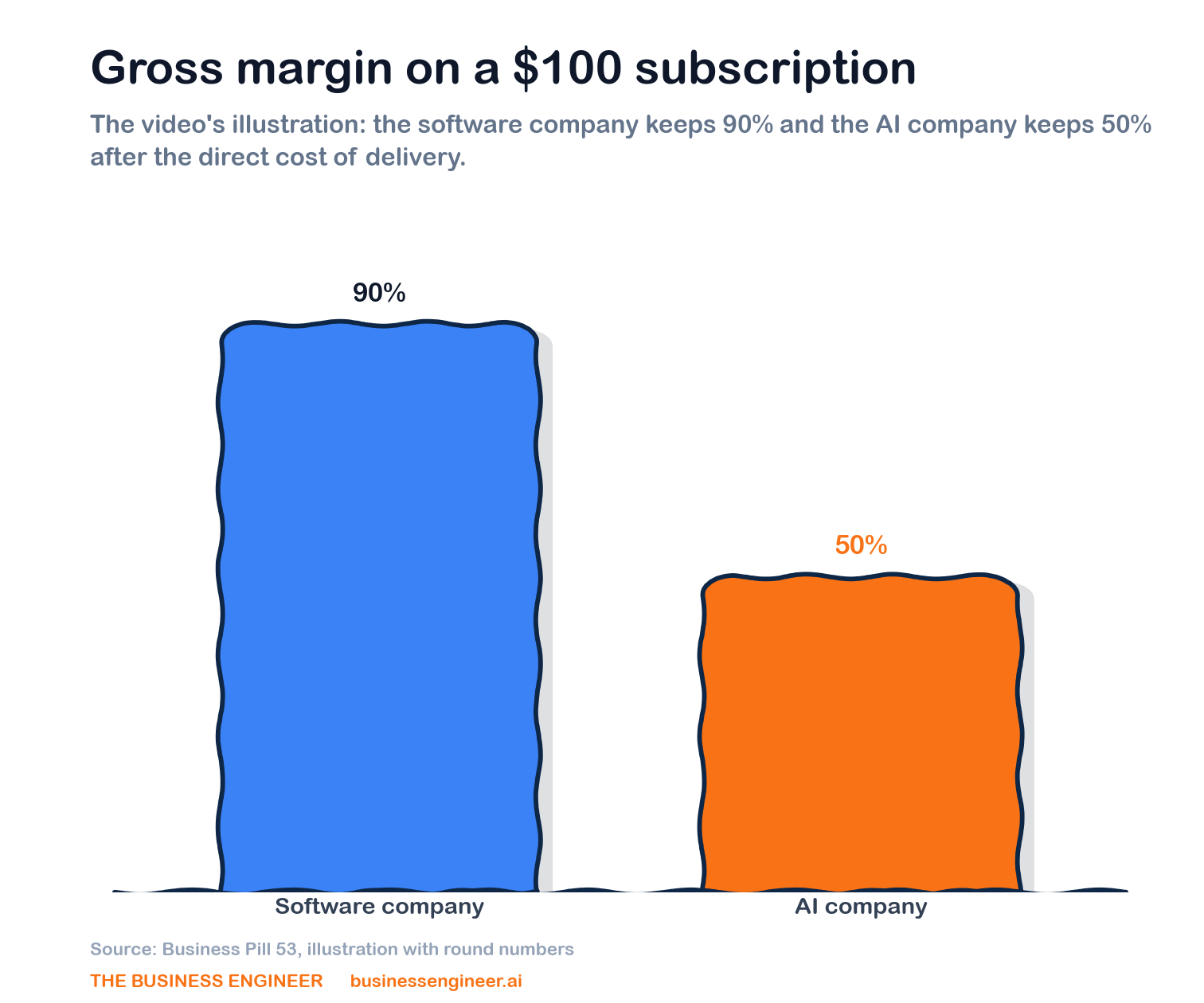
Gross margin is the share of revenue that remains after the direct cost of delivering the product. In the video’s example, the software company keeps 90% and the AI company keeps 50%.
A short explainer video, under a minute. The two companies and their figures are an illustration.
At a glance
What Gross Margin Is
What is left has a name. It is called gross margin: the share of revenue that remains after the direct cost of delivering the product.
What the Remainder Has to Pay For
The remainder has to pay for research, for sales, and for profit.
Why It Matters
The video turns this into one question: what is left from each dollar after the cost of the answers?
Two companies each sell a subscription for a hundred dollars. For the software company, serving that customer costs ten dollars.
For the AI company, every answer burns chips. Serving the same customer costs fifty.
What Gross Margin Is
What is left has a name. It is called gross margin: the share of revenue that remains after the direct cost of delivering the product.
This publication’s own arithmetic: a hundred dollars minus ten dollars is ninety, so the software company keeps 90%. A hundred minus fifty is fifty, so the AI company keeps 50%.
The video’s illustration. The percentages follow from a $100 subscription and costs of $10 and $50.
What the Remainder Has to Pay For
The remainder has to pay for research, for sales, and for profit.
Out of the same hundred-dollar subscription, the software company has ninety dollars left for those three things and the AI company has fifty.
The Idea on One Board
What Gross Margin Is
The software company
For the software company, serving that customer costs ten dollars.
The AI company
For the AI company, every answer burns chips. Serving the same customer costs fifty.
The Twist: Cost Grows With Use
In AI, the cost grows with use. The video’s example is a heavy user who asks ten thousand questions in a day, with a note on screen that reads pays $100, costs $140.
A heavy user can cost more than they pay. This publication’s own arithmetic: a hundred and forty minus a hundred is forty, so that customer costs forty more than the subscription brings in.
Why It Matters
The video turns this into one question: what is left from each dollar after the cost of the answers?
Revenue is what comes in. Gross margin is what you keep.
The key insight: Revenue is what comes in. Gross margin is what you keep.
Our report on Anthropic’s reported prospectus says that, as Reuters’ account of a confidential prospectus is relayed, Anthropic expects to spend at least $518 billion over a decade on compute from six partners, with about 80% non-cancellable or payable regardless of usage. We verified none of it independently. What is left after the cost of the answers is the margin this lesson describes.
The Business Engineer framework maps where each part of the AI stack sits and who holds the leverage. These pills are short lessons from the same library.
Inference drives the cost of Gross Margin. Inference is paid on every answer, so serving the same customer costs an AI company far more than a software company.
Model Routing drives the cost of Gross Margin. Sending simple questions to a small model cuts the cost of each answer, the direct cost gross margin subtracts.
Operating Leverage builds on Gross Margin. Operating leverage depends on costs staying flat as sales grow, and gross margin shows how much of each sale costs grow with.
Prompt Caching(lesson unlocks soon) drives the cost of Gross Margin. Not paying twice to read the same page lowers the direct cost of each answer, the cost gross margin subtracts.
Take Rate(lesson unlocks soon) contrasts with Gross Margin. A take rate is a share, not a profit: the market still pays for stalls and staff, as gross margin subtracts direct cost.
Gennaro Cuofano is a CRO and tech executive who has worked in AI since late 2015, starting with bringing NLP, natural-language generation, voice and chatbot products to the marketing industry. His background is in law and finance: he holds a Master's degree in Law and an International MBA with an emphasis on corporate finance (LUISS Business School and the University of San Diego, 2012), and worked as a financial analyst at a real-estate investment firm in San Diego and as an assistant controller. His work focuses on business model strategy, business engineering and, more broadly, structural analysis: how companies make money, read from their own filings. He created FourWeekMBA and leads research there and at The Business Engineer, his newsletter on AI and business strategy, with over 95,000 subscribers and more than 1,000 published analyses. His writing has also appeared on Entrepreneur (for example, How to Digitize a Family Business in Europe) and HackerNoon. Find him on LinkedIn and Substack. See how we source.