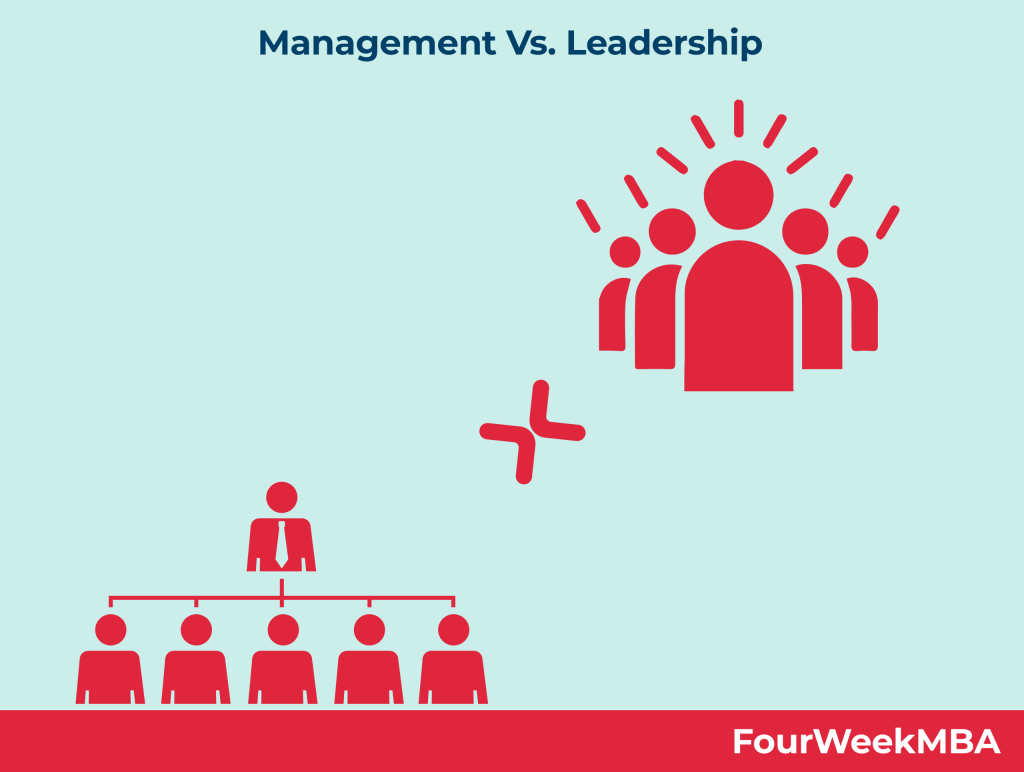
– Management refers to the process of planning, organizing, controlling, and directing an organization's resources (human, financial, and physical) to achieve s
Role and Focus
– Management roles are often associated with tasks such as organizing resources, setting and meeting deadlines, creating and implementing processes, and ensurin
Authority
– Managers typically derive authority from their positions within an organization's hierarchy. They have formal authority over their subordinates and are respon
Decision-Making
– Managers are responsible for making decisions that align with organizational objectives. They often use analytical and rational approaches, considering factor
Focus on Tasks
– Management primarily deals with tasks and processes. Managers focus on planning, organizing, coordinating, and controlling day-to-day activities to meet speci
Control and Efficiency
– Management is often associated with control mechanisms to ensure efficiency and effectiveness in operations. It emphasizes adherence to established procedures
Measuring Success
– Management typically measures success through key performance indicators (KPIs) and metrics related to productivity, cost control, quality, and meeting deadli
Skills and Competencies
– Key management skills include planning, organizing, decision-making, problem-solving, and monitoring performance. – Managers often require technical expertise
A manager uses technical skills, knowledge, or expertise to control subordinates and achieve a goal.
A leader, on the other hand, is an individual who influences, motivates, and enables others to contribute to organizational success.
Aspect
Management
Leadership
Definition
– Management refers to the process of planning, organizing, controlling, and directing an organization’s resources (human, financial, and physical) to achieve specific goals and objectives efficiently. – Managers focus on day-to-day operations and tasks to ensure the organization’s functions run smoothly.
– Leadership involves inspiring and influencing individuals or groups to work toward a common vision, purpose, or goal. Leaders often set the direction, motivate, and guide others to achieve strategic objectives. Leadership goes beyond authority and encompasses the ability to inspire and drive change.
Role and Focus
– Management roles are often associated with tasks such as organizing resources, setting and meeting deadlines, creating and implementing processes, and ensuring efficiency and effectiveness in daily operations. – Managers tend to focus on maintaining stability, controlling costs, and achieving short-term results.
– Leadership roles involve setting a vision, defining goals, motivating and empowering teams, fostering innovation, and guiding the organization through change and growth. Leaders concentrate on long-term strategies and inspiring others to embrace change and achieve a shared vision.
Authority
– Managers typically derive authority from their positions within an organization’s hierarchy. They have formal authority over their subordinates and are responsible for enforcing rules and policies. – Management authority is often associated with positional power.
– Leaders may or may not hold formal positions of authority. Leadership is not solely dependent on a title but can emerge from qualities such as influence, charisma, expertise, and the ability to inspire and gain followers voluntarily. Leadership authority is often associated with personal power.
Decision-Making
– Managers are responsible for making decisions that align with organizational objectives. They often use analytical and rational approaches, considering factors such as data, processes, and efficiency. – Decision-making in management focuses on addressing current issues and challenges.
– Leaders play a key role in shaping an organization’s strategic direction and making decisions that affect the organization’s future. Leadership decisions may involve taking calculated risks and embracing innovation to drive change and progress.
Focus on Tasks
– Management primarily deals with tasks and processes. Managers focus on planning, organizing, coordinating, and controlling day-to-day activities to meet specific targets and ensure the organization’s smooth functioning.
– Leadership emphasizes people and their development. Leaders focus on inspiring, empowering, and aligning individuals or teams to achieve common goals. They nurture talent and encourage personal and professional growth.
Control and Efficiency
– Management is often associated with control mechanisms to ensure efficiency and effectiveness in operations. It emphasizes adherence to established procedures and standards.
– Leadership promotes adaptability and may tolerate some level of chaos or ambiguity to foster innovation and creativity. Leaders encourage experimentation and learning from failures.
Measuring Success
– Management typically measures success through key performance indicators (KPIs) and metrics related to productivity, cost control, quality, and meeting deadlines. Success is often quantifiable and short-term.
– Leadership success is often measured by the realization of a long-term vision, the ability to inspire and motivate others, and the organization’s adaptability to change. It may involve qualitative measures, such as the organization’s reputation and culture.
Skills and Competencies
– Key management skills include planning, organizing, decision-making, problem-solving, and monitoring performance. – Managers often require technical expertise relevant to their field of management, such as financial management or project management skills.
– Leadership competencies encompass vision setting, communication, emotional intelligence, empathy, coaching, and the ability to build and lead high-performing teams. Leadership skills are transferable across various industries and contexts.
Style and Approach
– Management often follows a structured and process-driven approach. Managers may use a more directive style to ensure tasks are completed efficiently.
– Leadership styles can vary widely. Transformational leaders inspire and motivate, while servant leaders prioritize serving the needs of others. Leaders may use a participative or democratic style to involve team members in decision-making.
Example
– A manager in a manufacturing company ensures that production processes run smoothly, inventory is managed efficiently, and quality control standards are met. – A project manager oversees a team to complete a project on time and within budget.
– A CEO who sets a strategic vision for the organization and inspires employees to share the vision and work collaboratively toward its realization. – A coach who motivates and develops a sports team to achieve their full potential.
Communication
– Managers often communicate to provide instructions, clarify expectations, and ensure tasks are executed according to established procedures.
– Leaders emphasize clear and inspirational communication to convey vision, values, and a sense of purpose. Effective leadership communication fosters trust and commitment among team members.
Risk Tolerance
– Management tends to be risk-averse, focusing on minimizing risks to ensure the organization’s stability and efficiency.
– Leadership may involve a higher level of risk tolerance, as leaders are more inclined to take calculated risks to drive innovation, growth, and change.
Change Management
– Managers are typically responsible for implementing change initiatives once decisions have been made at higher levels. – Change management in management involves ensuring that changes are executed efficiently and with minimal disruption.
– Leaders often initiate and drive change. They create a vision for change, engage stakeholders, and guide the organization through transitions. Leadership in change management focuses on inspiring and motivating people to embrace change.
Examples in Organizations
– Middle-level managers in a manufacturing company oversee production processes and ensure efficiency. – IT managers maintain and optimize the company’s technology infrastructure.
– A CEO provides a strategic vision for the company and inspires employees to work toward long-term objectives. – A team leader fosters collaboration and innovation among team members to achieve project goals.
Training and Development
– Management training programs often focus on technical skills, process optimization, and operational efficiency.
– Leadership development programs emphasize soft skills, communication, emotional intelligence, and strategic thinking. They aim to nurture individuals who can inspire and lead others.
Understanding management vs. leadership
Many people assume management and leadership are one and the same thing.
While there are some overlapping functions and characteristics, the terms have different meanings and should not be used interchangeably.
For example, some individuals practice leadership without holding a formal managerial title.
These people are commonly referred to as informal leaders.
Many managers have no interest in true leadership or motivating subordinates vis-à-vis organizational success.
The issue of leadership vs. management has long been debated, with many scholars disagreeing on the degree of overlap between each role.
Organizational psychodynamics teacher Abraham Zaleznik argued each delivered different values to a company.
He suggested leaders advocated change and innovation and were concerned with understanding others, while managers advocated stability and authority and were concerned with how things were actually accomplished.
More recent research by John Kotter, Harvard Business School Professor of Leadership, suggests management and leadership are two complementary yet distinct functions.
In this case, leadership is tasked with developing a vision for the organization and aligning its employees with that vision through communication.
This process creates uncertainty and changes that managers address through planning, budgeting, organizing, staffing, controlling, and problem-solving.
Put differently; management is concerned with practically implementing the less tangible aspects of leadership.
Comparing leadership and management
To understand the complex and dynamic relationship between leadership and management, it can be helpful to consider both in terms of five pairs of attributes.
Each pair represents the extreme ends of a continuum and is grouped into five categories:
Thinking processes
Leadership focuses on people and looks outward, while management focuses on things and looks inward.
Goal setting
Leadership articulates a vision, creates the future, and sees the forest. Management executes plans, improves the present, and sees the trees.
Employee relations
Leadership considers employees to be colleagues that should be trusted and developed.
Management considers employees to be subordinates that must be controlled, directed, and coordinated.
Operation
Leadership does the right things, creates change, and serves subordinates.
Management does things right and manages change while serving superordinates.
Governance
Leadership uses to influence and conflict to act decisively, while management uses authority, avoids conflict, and acts responsibly.
When assessing each category and attribute pair, it must be remembered they exist on a continuum.
An individual may exhibit varying degrees of management or leadership characteristics, depending on the situation at hand.
In general, however, most will tend to favor one approach over the other.
What’s more critical, management or leadership?
Leadership might be more critical than management for smaller organizations focused on achieving ambitious goals.
Indeed, at that level, startups operate with strong leaders who can carry the whole team thanks to their vision.
Leadership is still essential when organizations get more extensive, and their success is based on enabling more people to work together.
However, management becomes critical.
In fact, at that point, without capable operators able to manage the organizations efficiently, there is no good execution.
And without good execution, there is no long-term success for these kinds of organizations.
For that reason, at that point, management becomes more critical.
Combining both management and leadership
It’s critical to strike a balance between management and leadership, as both are critical to business success.
A great leader might be able to motivate employees to join the team and create a short-term buzz.
Yet, without the proper day-to-day management of these employees, it gets tough to achieve ambitious business goals.
That is why leadership and management need to walk hand in hand.
When vision becomes critical through leadership
Leadership is critical in moments of hardship when the business context has shifted.
In fact, at that stage, leadership makes the hard decisions, and it decides what direction to follow.
At that moment, management follows suit.
In short, leaders know how to re-direct the business in the proper direction in moments of ambiguity, a fast-changing business landscape, and noise.
When execution becomes critical through management
When the proper direction has been enabled by leadership, it becomes critical to leave space for management for fast execution.
Leaders are still involved when execution moves away from the long-term vision.
Yet, on a day-to-day basis, it’s the management that plays a critical role.
In these moments of linear improvement, based on a more stable business landscape and context, management becomes critical to push things forward.
Management vs. leadership examples
Facebook management
Aware of the importance of management to its success, Facebook embarked on an initiative in 2012 to determine what separates a “great” manager from an “okay” manager.
Facebook’s most desirable and respected managers did not lead from the front or direct work in the traditional sense. Instead, they were found to be:
Supportive and caring.
Reinforcers of subordinate strengths, and
Facilitators of subordinate learning and growth opportunities.
The company’s supportive management style was reiterated by Mark Zuckerberg in a2018 Freakonomics podcast.
The CEO noted Facebook took a somewhat counterintuitive approach to management, permitting employees to be creative and pursue ideas he or other managers may disagree with.
One such example was the development of an instant messaging app which Zuckerberg initially hated.
This management style is somewhat of a departure from the company’s early days when a former Facebook employee noted that “Mark decides what do with the product, and everyone has to figure out how it will affect them.”
Day-to-day operations
In a Business Insider article, it was explained that Zuckerberg detests meetings and instead prefers face-to-face interactions.
He is known to move around the office toward the end of the day and check on staff, with new managers encouraged to do likewise.
What’s more, Facebook’s managers have access to internal software where they can track project progress and offer general assistance to subordinates.
In the employee’s biannual performance review, managers collect information from this system and incorporate feedback from five or six of the individual’s peers.
In keeping with the role of Facebook management, performance reviews promote the three key values of fairness, development, and transparency.
Employees walk away from the review with a score out of seven, and managers reward exceptional performers with promotions.
Managers use these reviews as checkpoints on employee progress such that poorly performing individuals are likely terminated before they reach their next review.
Apple leadership
For the leadership example, let’s review current Apple CEO Tim Cook.
Thinking processes
In a Q&A session at Duke University, Cook emphasized that leaders must “write their own rules”.
The best leaders know when to follow the rules and when to throw them away, but to do this, they must look outward and avoid blind adherence to the status quo.
Goal setting
In a 2019 manifesto, Cook stated that as a company, “We believe that we are on the face of the Earth to make great products, and that’s not changing.”
Cook has also made good on his promise to own and control the primary tech behind Apple’s core products, entering chip production to supply iMacs and iPhones.
Employee relations
Cook is a democratic leader who is trusting of the numerous senior executives around him.
He understands that there are limits to his knowledge and that others also have the capacity for innovation and brilliance.
One example is SVP of Worldwide Marketing Philip Schiller, who Cook admitted in 2020 “has helped make Apple the company it is today, and his contributions are broad, vast, and run deep.”
Operations
Cook is a leader who consistently does the right thing. When the company’s share price plummeted, he chose to forfeit around 33% of stock-based compensation worth around $133 million over 8 years.
Cook is also transparent. When he was criticized over working standards for Apple’s global employees, he opened the doors to the public so they could see how operations functioned in reality.
In the process, he restored confidence in Apple and redefined labor standards for manufacturers.
Key takeaways
A manager uses technical skills, knowledge, or expertise to control subordinates and achieve a goal. Conversely, a leader is an individual who influences, motivates, and enables others to contribute to organizational success.
The subject of management vs. leadership has been the subject of much debate and disagreement, particularly regarding the extent to which the functions of each overlap.
Management vs. leadership can be understood more clearly but considering each role in terms of five categories existing on a continuum: thinking processes, goal setting, employee relations, operation, and governance. Depending on the situation, leaders may exhibit some characteristics associated with management and vice versa.
Similarities between Management and Leadership:
Organizational Impact: Both management and leadership play crucial roles in influencing the success and performance of an organization.
Influence on Others: Both managers and leaders have the ability to influence and guide others to achieve common goals.
Decision-Making: Both roles involve decision-making, whether it’s setting strategic goals (leadership) or making operational choices (management).
Roles in Organizations: Managers and leaders often hold positions of authority within an organization, and their actions can significantly impact the overall functioning and culture of the company.
Differences between Management and Leadership:
Focus of Attention:
Management focuses on tasks, processes, and achieving specific goals within existing frameworks and procedures.
Leadership focuses on people, inspiration, and setting a vision for the future, often involving strategic changes and innovation.
Approach to Change:
Managers generally maintain stability and continuity, ensuring that operations run efficiently and according to established standards.
Leaders drive change, encouraging adaptation and transformation to meet new challenges and seize opportunities.
Perspective on Employees:
Managers tend to view employees as subordinates who need guidance and direction to perform their tasks effectively.
Leaders see employees as valuable contributors who can be empowered and motivated to achieve exceptional results.
Orientation Towards Goals:
Managers primarily focus on achieving short-term goals and immediate results that align with established plans.
Leaders often focus on long-term objectives, inspiring others to work towards a shared vision and future success.
Communication and Influence:
Managers often use authority and formal communication channels to direct and coordinate tasks among team members.
Leaders use influence, inspiration, and effective communication to engage and align employees towards a common purpose.
Role in Organizational Culture:
Managers contribute to the day-to-day functioning and efficiency of an organization, playing a role in maintaining the existing culture.
Leaders play a critical role in shaping the organizational culture, fostering innovation, and creating a positive work environment.
Handling Ambiguity and Uncertainty:
Managers excel at dealing with routine tasks and well-defined challenges within established frameworks.
Leaders are adept at navigating ambiguity, uncertainty, and complexity, driving change in dynamic and unpredictable environments.
Focus on People vs. Processes:
Management is often process-oriented, ensuring that tasks are completed according to established procedures.
Leadership is more people-oriented, focusing on building relationships, inspiring others, and developing talent.
Source of Influence:
Managers’ authority is derived from their position within the organizational hierarchy and their formal role.
Leaders’ influence is derived from their personal qualities, vision, and ability to inspire and gain support from others.
Time Horizon:
Management tends to have a shorter time horizon, focusing on day-to-day operations and short-term results.
Leadership often has a longer time horizon, envisioning the future and setting strategic directions for the organization.
Case Studies
Examples of Management vs. Leadership in Different Contexts:
Leadership styles encompass the behavioral qualities of a leader. These qualities are commonly used to direct, motivate, or manage groups of people. Some of the most recognized leadership styles include Autocratic, Democratic, or Laissez-Faire leadership styles.
Agile leadership is the embodiment of agile manifesto principles by a manager or management team. Agile leadership impacts two important levels of a business. The structural level defines the roles, responsibilities, and key performance indicators. The behavioral level describes the actions leaders exhibit to others based on agile principles.
Adaptive leadership is a model used by leaders to help individuals adapt to complex or rapidly changing environments. Adaptive leadership is defined by three core components (precious or expendable, experimentation and smart risks, disciplined assessment). Growth occurs when an organization discards ineffective ways of operating. Then, active leaders implement new initiatives and monitor their impact.
Authors and strategy experts Chan Kim and Renée Mauborgne developed the idea of blue ocean leadership. In the same way that Kim and Mauborgne’s blue ocean strategy enables companies to create uncontested market space, blue ocean leadership allows companies to benefit from unrealized employee talent and potential.
Developed by business consultants Kenneth Blanchard and Paul Hersey in the 1960s, delegative leadership is a leadership style where authority figures empower subordinates to exercise autonomy. For this reason, it is also called laissez-faire leadership. In some cases, this type of leadership can lead to increases in work quality and decision-making. In a few other cases, this type of leadership needs to be balanced out to prevent a lack of direction and cohesiveness of the team.
Distributed leadership is based on the premise that leadership responsibilities and accountability are shared by those with the relevant skills or expertise so that the shared responsibility and accountability of multiple individuals within a workplace, bulds up as a fluid and emergent property (not controlled or held by one individual). Distributed leadership is based on eight hallmarks, or principles: shared responsibility, shared power, synergy, leadership capacity, organizational learning, equitable and ethical climate, democratic and investigative culture, and macro-community engagement.
Ethical leaders adhere to certain values and beliefs irrespective of whether they are in the home or office. In essence, ethical leaders are motivated and guided by the inherent dignity and rights of other people.
Transformational leadership is a style of leadership that motivates, encourages, and inspires employees to contribute to company growth. Leadership expert James McGregor Burns first described the concept of transformational leadership in a 1978 book entitled Leadership. Although Burns’ research was focused on political leaders, the term is also applicable for businesses and organizational psychology.
Those who lead by example let their actions (and not their words) exemplify acceptable forms of behavior or conduct. In a manager-subordinate context, the intention of leading by example is for employees to emulate this behavior or conduct themselves.
A leader is someone within an organization who possesses the ability to influence and lead others by example. Leaders inspire, support, and encourage those beneath them and work continuously to achieve objectives. A boss is someone within an organization who gives direct orders to subordinates, tends to be autocratic, and prefers to be in control at all times.
Situational leadership is based on situational leadership theory. Developed by authors Paul Hersey and Kenneth Blanchard in the late 1960s, the theory’s fundamental belief is that there is no single leadership style that is best for every situation. Situational leadership is based on the belief that no single leadership style is best. In other words, the best style depends on the situation at hand.
Succession planning is a process that involves the identification and development of future leaders across all levels within a company. In essence, succession planning is a way for businesses to prepare for the future. The process ensures that when a key employee decides to leave, the company has someone else in the pipeline to fill their position.
Fielder’s contingency model argues no style of leadership is superior to the rest evaluated against three measures of situational control, including leader-member relations, task structure, and leader power level. In Fiedler’s contingency model, task-oriented leaders perform best in highly favorable and unfavorable circumstances. Relationship-oriented leaders perform best in situations that are moderately favorable but can improve their position by using superior interpersonal skills.
In the context of an organization, cultural models are frameworks that define, shape, and influence corporate culture. Cultural models also provide some structure to a corporate culture that tends to be fluid and vulnerable to change. Once upon a time, most businesses utilized a hierarchical culture where various levels of management oversaw subordinates below them. Today, however, there exists a greater diversity in models as leaders realize the top-down approach is outdated in many industries and that success can be found elsewhere.
Action-centered leadership defines leadership in the context of three interlocking areas of responsibility and concern. This framework is used by leaders in the management of teams, groups, and organizations.
Developed in the 1960s and first published in 1973, action-centered leadership was revolutionary for its time because it believed leaders could learn the skills they needed to manage others effectively.
Adair believed that effective leadership was exemplified by three overlapping circles (responsibilities): achieve the task, build and maintain the team, and develop the individual.
High-performance coaches work with individuals in personal and professional contexts to enable them to reach their full potential. While these sorts of coaches are commonly associated with sports, it should be noted that the act of coaching is a specific type of behavior that is also useful in business and leadership.
When most people are asked to define power, they think about the power a leader possesses as a function of their responsibility for subordinates. Others may think that power comes from the title or position this individual holds.
Tipping Point Leadership is a low-cost means of achieving a strategic shift in an organization by focusing on extremes. Here, the extremes may refer to small groups of people, acts, and activities that exert a disproportionate influence over business performance.
The Vroom-Yetton decision model is a decision-making process based on situational leadership. According to this model, there are five decision-making styles guides group-based decision-making according to the situation at hand and the level of involvement of subordinates: Autocratic Type 1 (AI), Autocratic Type 2 (AII), Consultative Type 1 (CI), Consultative Type 2 (CII), Group-based Type 2 (GII).
Likert’s management systems were developed by American social psychologist Rensis Likert. Likert’s management systems are a series of leadership theories based on the study of various organizational dynamics and characteristics. Likert proposed four systems of management, which can also be thought of as leadership styles: Exploitative authoritative, Benevolent authoritative, Consultative, Participative.
Gennaro is the creator of FourWeekMBA, which reached about four million business people, comprising C-level executives, investors, analysts, product managers, and aspiring digital entrepreneurs in 2022 alone | He is also Director of Sales for a high-tech scaleup in the AI Industry | In 2012, Gennaro earned an International MBA with emphasis on Corporate Finance and Business Strategy.