

The Leadership Grid is a leadership and management framework that was developed to help individuals and organizations assess and improve their leadership styles. It was created by Robert R. Blake and Jane S. Mouton and was first introduced in their 1964 book “The Managerial Grid: The Key to Leadership Excellence.”
At its core, the Leadership Grid is based on two fundamental leadership dimensions: concern for people and concern for production (task). These two dimensions create a grid with different leadership styles, each characterized by a combination of concern for people and concern for production.
Core Concepts of the Leadership Grid
To understand the Leadership Grid fully, it is essential to delve into its core concepts and the leadership styles it defines:
1. Concern for People:
- This dimension assesses the leader’s degree of focus on the well-being, satisfaction, and development of their team members or employees.
- Leaders who prioritize concern for people are attentive to their team’s needs, provide support, and foster a positive work environment.
2. Concern for Production (Task):
- This dimension evaluates the leader’s emphasis on achieving organizational goals, tasks, and performance outcomes.
- Leaders with a high concern for production are results-oriented, emphasize efficiency, and prioritize achieving objectives.
3. Five Leadership Styles:
The Leadership Grid defines five primary leadership styles based on the combinations of concern for people and concern for production:
- 1,1 – Impoverished (Indifferent) Style:
- Low concern for both people and production.
- Leaders in this style typically exert minimum effort in their roles and are not highly involved in either their team’s well-being or task accomplishment.
- 1,9 – Country Club Style:
- High concern for people but low concern for production.
- Leaders focus primarily on creating a positive and harmonious work environment but may not drive their teams toward achieving tasks and goals.
- 9,1 – Authority-Obedience Style:
- High concern for production but low concern for people.
- Leaders in this style prioritize task accomplishment, often at the expense of employee satisfaction. They may use authority and control to achieve results.
- 5,5 – Middle-of-the-Road (Balanced) Style:
- Moderate concern for both people and production.
- Leaders adopt a compromise approach, seeking a balance between employee needs and task accomplishment. However, they may not excel in either dimension.
- 9,9 – Team Style:
- High concern for both people and production.
- Leaders in this style aim to create a collaborative, high-performance work environment. They prioritize both achieving goals and fostering positive relationships among team members.
4. Leadership Development:
The Leadership Grid provides a framework for leaders and organizations to assess their current leadership styles and identify areas for development and improvement.
5. Adaptability:
One of the strengths of the Leadership Grid is its recognition that leadership styles can be adapted and modified based on situational requirements.
Significance of the Leadership Grid
The Leadership Grid holds significant importance for leaders, organizations, and the field of leadership development:
For Leaders:
- Self-Awareness:
- The grid allows leaders to gain insights into their own leadership styles, enabling self-awareness and personal growth.
- Adaptability:
- Leaders can learn to adapt their leadership styles to different situations and teams, enhancing their effectiveness.
- Employee Engagement:
- By understanding the impact of their leadership style on employee satisfaction, leaders can improve engagement and morale within their teams.
For Organizations:
- Leadership Development:
- The Leadership Grid serves as a valuable tool for leadership development programs, helping organizations nurture effective leaders.
- Cultural Alignment:
- Organizations can use the grid to align leadership styles with their cultural values and mission, creating a coherent and harmonious work environment.
- Performance Improvement:
- By promoting leadership styles that balance concern for people and production, organizations can improve overall performance and productivity.
Practical Applications of the Leadership Grid
The Leadership Grid offers practical applications for leaders and organizations seeking to enhance their leadership effectiveness:
Leadership Training and Development:
- Self-Assessment:
- Leaders can use the grid to assess their current leadership styles and identify areas for improvement.
- Leadership Coaching:
- Coaches can work with leaders to develop strategies for adapting their leadership styles to different situations and challenges.
Team Building:
- Team Assessment:
- Teams can collectively assess their leaders’ styles and provide feedback, leading to more productive team dynamics.
- Leadership Workshops:
- Organizations can conduct workshops to educate teams and leaders about the various leadership styles and their impact on team performance.
Organizational Change:
- Cultural Transformation:
- The Leadership Grid can be integrated into cultural change initiatives, helping organizations shift toward leadership styles that align with desired cultural values.
- Change Leadership:
- Leaders can use the grid to adapt their leadership approaches when leading teams through periods of change and transition.
Challenges and Considerations
While the Leadership Grid offers valuable insights, there are challenges and considerations to keep in mind when applying this framework:
- Situational Complexity:
- Real-world leadership situations can be highly complex, and the grid’s simplicity may not capture all nuances.
- Subjectivity:
- Assessing concern for people and production can be subjective, and individuals may have differing perceptions of a leader’s style.
- Leadership Development Efforts:
- Changing leadership styles may require significant effort and self-awareness, making it challenging for some leaders.
- Overreliance on Categories:
- Categorizing leaders into specific styles can be limiting, as leaders may exhibit a mix of styles in different situations.
Future Directions in the Leadership Grid
As the field of leadership continues to evolve, the Leadership Grid may adapt and expand in the following directions:
- Inclusion of Emotional Intelligence:
- Future iterations of the grid may incorporate elements of emotional intelligence, recognizing the significance of emotions in leadership.
- Global Leadership:
- Considering how leadership styles may vary across different cultural contexts and global leadership scenarios.
- Digital Leadership:
- Addressing the unique challenges and opportunities of leadership in a digital and virtual world.
- Ethical Leadership:
- Integrating ethical considerations into the framework to assess the ethical dimensions of leadership.
Conclusion
The Leadership Grid remains a valuable tool for understanding, assessing, and improving leadership styles within organizations. By emphasizing the dimensions of concern for people and concern for production, it provides a simple yet insightful framework for leadership development and self-awareness. In an era where effective leadership is crucial for organizational success, the Leadership Grid serves as a timeless guide, helping leaders adapt and evolve to meet the ever-changing demands of the modern workplace. As organizations continue to navigate complex challenges, the Leadership Grid reminds us of the importance of balancing task accomplishment with the well-being and satisfaction of those we lead.
Key Highlights
- Concept Overview:
- The Leadership Grid is a model developed by Robert R. Blake and Jane S. Mouton in 1964, focusing on two fundamental dimensions: concern for people and concern for production.
- It defines five primary leadership styles based on combinations of these dimensions: Impoverished, Country Club, Authority-Obedience, Middle-of-the-Road, and Team.
- Core Concepts:
- Concern for People evaluates a leader’s focus on team members’ well-being and development.
- Concern for Production assesses a leader’s emphasis on achieving organizational goals.
- The five leadership styles vary in their balance of concern for people and concern for production, ranging from low to high on both dimensions.
- Significance:
- For Leaders: The Leadership Grid promotes self-awareness, adaptability, and employee engagement.
- For Organizations: It facilitates leadership development, cultural alignment, and performance improvement.
- Practical Applications:
- Leadership Training: Used for self-assessment and coaching.
- Team Building: Teams assess their leaders’ styles for improved dynamics.
- Organizational Change: Integrated into cultural transformation and change leadership initiatives.
- Challenges and Considerations:
- Situational Complexity: Real-world situations may not always neatly fit into predefined styles.
- Subjectivity: Assessing styles can be subjective and vary among individuals.
- Leadership Development Efforts: Changing styles may require significant effort and self-awareness.
- Overreliance on Categories: Categorizing leaders into fixed styles may limit understanding of their full range of behaviors.
- Future Directions:
- Inclusion of Emotional Intelligence: Future versions may incorporate emotional intelligence elements.
- Global Leadership: Considering cultural variations in leadership styles.
- Digital Leadership: Addressing challenges of leadership in digital and virtual environments.
- Ethical Leadership: Integrating ethical dimensions into the framework.
- Conclusion:
- The Leadership Grid remains a valuable tool for understanding, assessing, and improving leadership styles.
- It emphasizes the importance of balancing task accomplishment with concern for people’s well-being in effective leadership.
| Related Frameworks | Description | Implications |
|---|---|---|
| Leadership Grid | – A leadership model developed by Robert R. Blake and Jane S. Mouton that evaluates leadership styles based on two dimensions: concern for people and concern for production. – Identifies five leadership styles: impoverished, country club, produce or perish, middle-of-the-road, and team leadership. | – Style assessment and development: The Leadership Grid provides a framework for leaders to assess their leadership styles and behaviors, identifying strengths and areas for improvement in balancing concern for people and concern for production, and developing adaptive leadership approaches that align with organizational goals, culture, and context. – Team effectiveness and performance: Leadership styles characterized by high concern for both people and production, such as team leadership, tend to be most effective in driving team performance, engagement, and satisfaction, fostering collaboration, accountability, and innovation that enhance organizational effectiveness and competitiveness in achieving strategic goals and objectives. – Employee motivation and satisfaction: Leaders who prioritize concern for people create a supportive work environment characterized by trust, communication, and empowerment, which fosters employee motivation, morale, and job satisfaction, reducing turnover, absenteeism, and conflict, and enhancing retention, loyalty, and commitment to organizational success and values. – Conflict resolution and change management: The Leadership Grid offers insights into managing conflict and driving change by adapting leadership styles to match the demands and dynamics of different situations, fostering collaboration, alignment, and resilience in addressing challenges and opportunities, and promoting a culture of continuous improvement, learning, and adaptation that drives organizational agility, innovation, and growth. |
| Situational Leadership | – Leadership model developed by Paul Hersey and Kenneth Blanchard that emphasizes adapting leadership styles to the maturity or readiness level of followers. – Identifies four leadership styles: directing, coaching, supporting, and delegating. | – Flexibility and adaptation: Situational leadership encourages leaders to flexibly adapt their leadership styles to the needs, capabilities, and development stages of individual followers or teams, maximizing effectiveness, engagement, and performance by providing the right level of direction, support, and autonomy that aligns with followers’ readiness and confidence in completing tasks and achieving goals. – Employee development and empowerment: Situational leadership promotes employee development and empowerment by fostering a dynamic and supportive relationship between leaders and followers, where leaders provide guidance, feedback, and resources to help followers develop their skills, confidence, and autonomy, enabling them to take ownership of their work, learn from experiences, and grow as individuals and contributors to organizational success and effectiveness. – Communication and trust: Situational leadership emphasizes clear communication, mutual respect, and trust between leaders and followers, enabling open dialogue, collaboration, and alignment in setting goals, clarifying expectations, and resolving challenges, building strong relationships and rapport that enhance engagement, commitment, and accountability in achieving shared objectives and overcoming obstacles in a dynamic and evolving work environment. – Change management and adaptation: Situational leadership equips leaders with the skills and mindset to navigate change and uncertainty by assessing followers’ readiness and adapting leadership approaches to address their concerns, challenges, and opportunities, fostering resilience, agility, and innovation in responding to evolving business conditions, market dynamics, and stakeholder expectations, driving organizational performance, competitiveness, and relevance in a dynamic and complex landscape. |
| Transactional Leadership | – Leadership approach focused on exchange and transaction between leaders and followers to achieve organizational goals. – Emphasizes contingent rewards, management by exception, and laissez-faire leadership. | – Goal alignment and performance management: Transactional leadership establishes clear expectations, goals, and performance standards, and rewards followers for meeting or exceeding targets, fostering accountability, motivation, and performance by linking individual and team efforts to organizational priorities, objectives, and outcomes, and providing incentives and recognition for achievement and contribution that reinforce desired behaviors and results. – Risk management and compliance: Transactional leadership relies on monitoring and management by exception to identify and address deviations from established norms, policies, or performance standards, mitigating risks, and ensuring compliance with rules, regulations, and procedures that govern organizational operations and activities, fostering consistency, reliability, and efficiency in achieving desired outcomes and minimizing disruptions, errors, or inefficiencies that may compromise organizational effectiveness or reputation. – Task orientation and efficiency: Transactional leadership prioritizes task accomplishment and efficiency by focusing on clarifying roles, responsibilities, and expectations, providing guidance, resources, and support to facilitate task execution and problem-solving, and intervening as needed to address issues, obstacles, or deviations from planned performance, ensuring smooth operations, productivity, and quality in delivering products, services, or outcomes that meet or exceed stakeholder requirements and expectations. – Transactional Leadership |
| Transformational Leadership | – Leadership approach that inspires and motivates followers to achieve greater performance and growth. – Emphasizes vision, inspiration, and intellectual stimulation. – Encourages innovation, creativity, and individual development. – Can be charismatic and visionary, yet demanding and challenging. | – Vision and inspiration: Transformational leadership inspires and motivates employees by articulating a compelling vision for the future, challenging the status quo, and instilling a sense of purpose, meaning, and commitment to shared goals and values, fostering alignment, engagement, and resilience in pursuit of organizational success and impact. – Innovation and creativity: Transformational leaders encourage innovation, creativity, and individual development by empowering employees to take risks, explore new ideas, and unleash their potential to drive change, growth, and innovation, fostering a culture of experimentation, learning, and adaptation that fuels organizational agility, competitiveness, and relevance in dynamic and uncertain market environments. – Individualized consideration: Transformational leaders provide individualized consideration and support to employees’ needs, aspirations, and development goals, fostering trust, loyalty, and commitment by valuing and recognizing their contributions, strengths, and growth potential, cultivating a culture of collaboration, inclusion, and empowerment that enhances employee engagement, retention, and satisfaction, driving organizational performance and success. – Continuous improvement and learning: Transformational leadership fosters a culture of continuous improvement, self-awareness, and learning that empowers individuals to adapt, grow, and evolve as leaders in response to changing business conditions, market dynamics, and leadership challenges, fostering resilience, agility, and adaptability in navigating uncertainty and driving sustainable success and growth. |
Read Next: Organizational Structure.
Types of Organizational Structures

Siloed Organizational Structures
Functional

Divisional

Open Organizational Structures
Matrix

Flat

Connected Business Frameworks


Nadler-Tushman Congruence Model

McKinsey’s Seven Degrees of Freedom


Organizational Structure Case Studies
OpenAI Organizational Structure

Airbnb Organizational Structure

Amazon Organizational Structure

Apple Organizational Structure

Coca-Cola Organizational Structure

Costco Organizational Structure


Facebook Organizational Structure

Goldman Sachs’ Organizational Structure

Google Organizational Structure


McDonald’s Organizational Structure

McKinsey Organizational Structure

Microsoft Organizational Structure

Nestlé Organizational Structure


Patagonia Organizational Structure

Samsung Organizational Structure

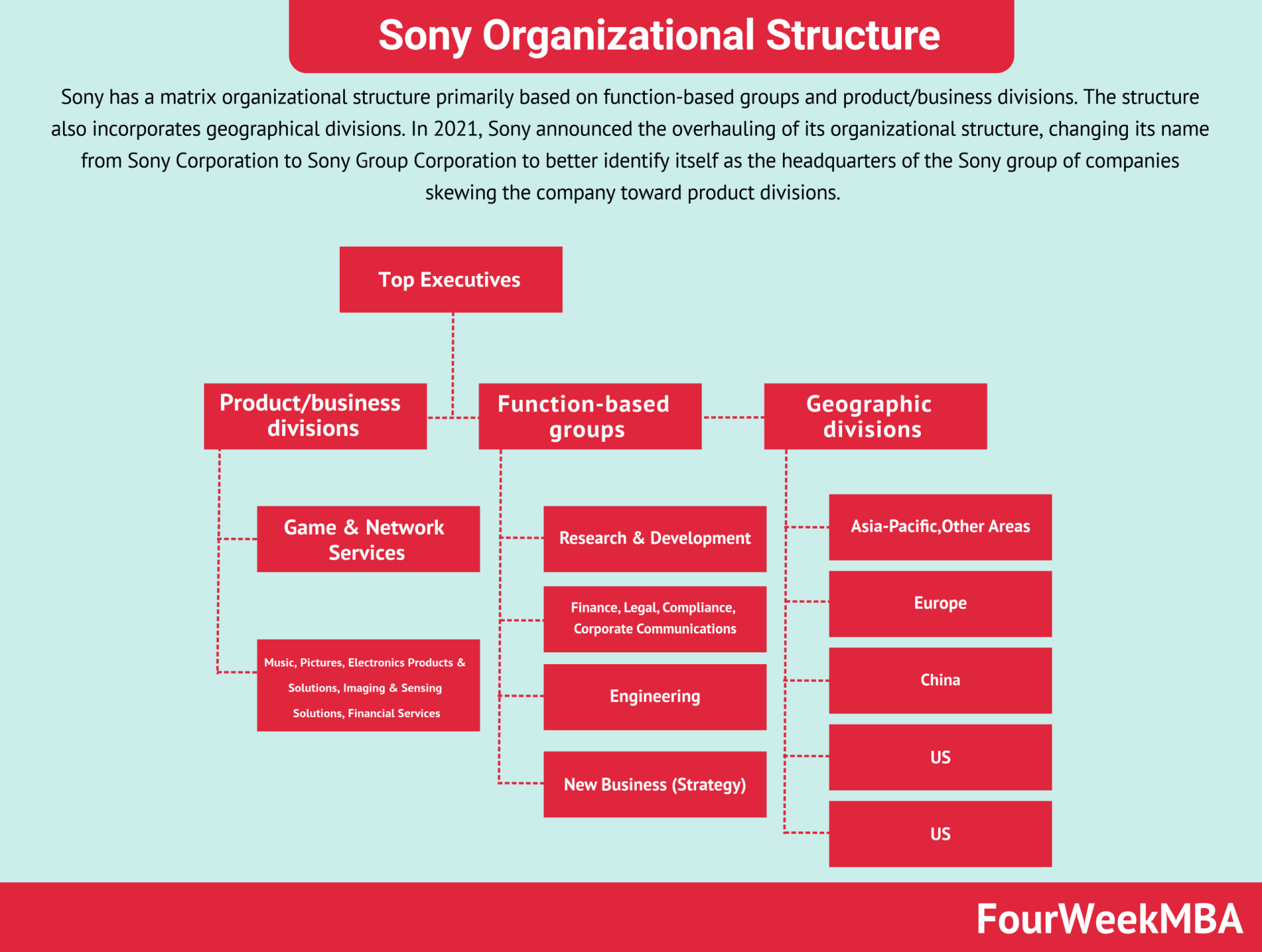
Starbucks Organizational Structure

Tesla Organizational Structure

Toyota Organizational Structure

Walmart Organizational Structure

Main Free Guides:


