Business modeling is a discipline that helps us experiment with the business we’re creating in the real world so that we can quickly test the underlying assumptions of a business model and iterate to build a viable business with a long-lasting advantage. Mind mapping can help you sketch that businessmodel.
Business models, contrary to business plans, continuously evolve and have as fewer assumptions as possible.
Even the assumptions comprised in a business model need to be tested quickly to enable your company to gain traction.
That is why a mind map rather than a simple document can be effective in testing your business model hypotheses.
In short, mind maps have the following advantages:
Those are visual tools, which help you simplify the process of understanding your whole business.
They also help you develop a more dynamic understanding of your business, contrary to what happens with business planning.
They give you the ability to track the changes in your businessmodel. As your business model mind map evolves, you can check how your business changed over the months and years, and what building blocks made it gain traction.
How to use mind mapping to sketch your business model
As explained over and over again on FourWeekMBA, business models are useful tools that entrepreneurs can use to sketch their business on a piece of paper. Yet, that business model will mostly not work, as it will need several iterations before finding the key building blocks which make it viable in the real world.
This is an ongoing, continuous process of experimentation and iteration. We used a FourWeekMBA partner’s tool (MindMeister mind mapping tool) to sketch a business model template that you can download and start using.
Below you can also find the public map template that I created which you can copy and then fill out (you just need a free MindMeister account to do this). As MindMeister also lets you share maps with colleagues and collaborate on them in real-time, so you can create your business model together.
Use as an example the template above to start building your business model with a mind map. Keep in mind, that based on the stage of conception, growth or scale your mind map will look quite different.
Indeed, if you’re at the conception stage, the business model mind map will be very simplified and it might have a few building blocks primarily comprising the product and the few key customers.
As the business grows and gain traction you can add more building blocks.
So few secrterts are:
Keep it simple: there is always time to make things more complex. To get started to keep the model as simple as possible by prioritizing the main building blocks.
Make it understandable: can other people understand that? This is a good test to realize whether you are keeping it simple. Why does it matter? See the next point!
Make it testable: if you don’t understand the key building blocks of your businessmodel, you won’t be able to test the assumptions underlying it. Thus, make sure you understand the key assumptions underneath your business model also because your team will need to be able to test them too.
Key takeaways
In this article, we saw how we can use a more dynamic tool like mind maps to sketch a businessmodel. As we’ve seen a mind map is visual, dynamic and simple to use.
For the sake of this article, we leveraged on MindMeister to build a template that you can reuse to start building and testing your business model today!
A Blockchain Business Model according to the FourWeekMBA framework is made of four main components: Value Model (Core Philosophy, Core Values and Value Propositions for the key stakeholders), Blockchain Model (Protocol Rules, Network Shape and Applications Layer/Ecosystem), Distribution Model (the key channels amplifying the protocol and its communities), and the Economic Model (the dynamics/incentives through which protocol players make money). Those elements coming together can serve as the basis to build and analyze a solid Blockchain Business Model.
In an asymmetric businessmodel, the organization doesn’t monetize the user directly, but it leverages the data users provide coupled with technology, thus have a key customer pay to sustain the core asset. For example, Google makes money by leveraging users’ data, combined with its algorithms sold to advertisers for visibility.
In a business world driven by technology and digitalization, competition is much more fluid, as innovation becomes a bottom-up approach that can come from anywhere. Thus, making it much harder to define the boundaries of existing markets. Therefore, a proper business competition analysis looks at customer, technology, distribution, and financial model overlaps. While at the same time looking at future potential intersections among industries that in the short-term seem unrelated.
Technological modeling is a discipline to provide the basis for companies to sustain innovation, thus developing incremental products. While also looking at breakthrough innovative products that can pave the way for long-term success. In a sort of Barbell Strategy, technological modeling suggests having a two-sided approach, on the one hand, to keep sustaining continuous innovation as a core part of the businessmodel. On the other hand, it places bets on future developments that have the potential to break through and take a leap forward.
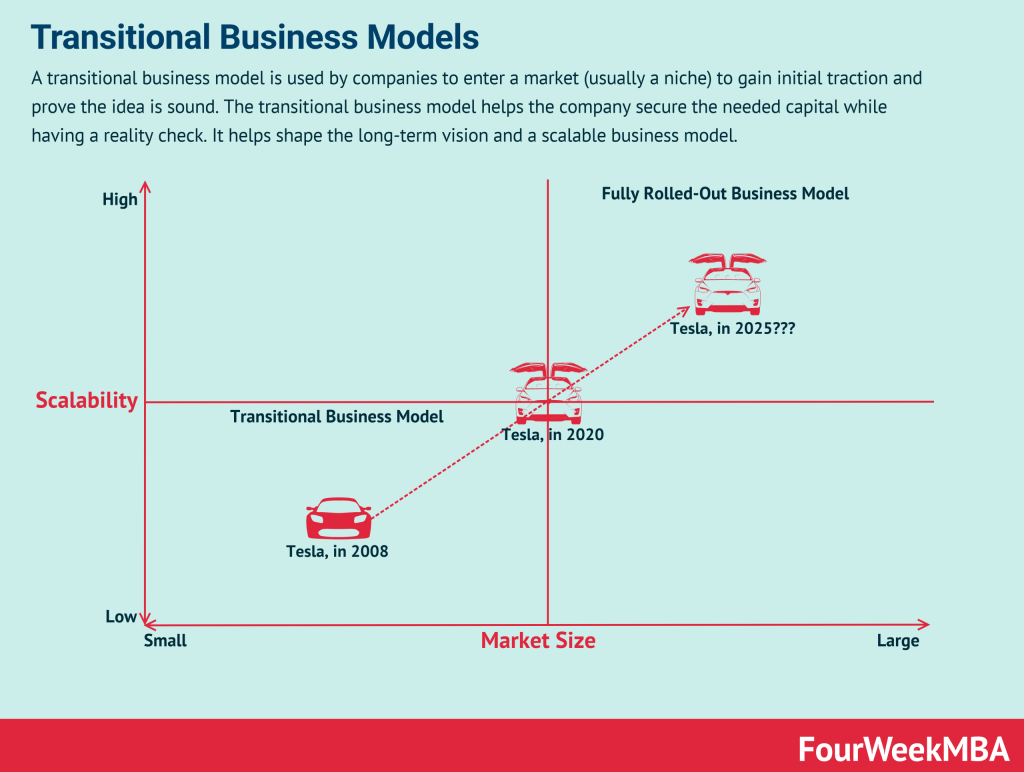
A transitional business model is used by companies to enter a market (usually a niche) to gain initial traction and prove the idea is sound. The transitional business model helps the company secure the needed capital while having a reality check. It helps shape the long-term vision and a scalable businessmodel.
The minimum viable audience (MVA) represents the smallest possible audience that can sustain your business as you get it started from a microniche (the smallest subset of a market). The main aspect of the MVA is to zoom into existing markets to find those people which needs are unmet by existing players.
Business scaling is the process of transformation of a business as the product is validated by wider and wider market segments. Business scaling is about creating traction for a product that fits a small market segment. As the product is validated it becomes critical to build a viable businessmodel. And as the product is offered at wider and wider market segments, it’s important to align product, businessmodel, and organizational design, to enable wider and wider scale.
The market expansion consists in providing a product or service to a broader portion of an existing market or perhaps expanding that market. Or yet, market expansions can be about creating a whole new market. At each step, as a result, a company scales together with the market covered.
In the FourWeekMBA growth matrix, you can apply growth for existing customers by tackling the same problems (gain mode). Or by tackling existing problems, for new customers (expand mode). Or by tackling new problems for existing customers (extend mode). Or perhaps by tackling whole new problems for new customers (reinvent mode).
In the FourWeekMBA Revenue Streams Matrix, revenue streams are classified according to the kind of interactions the business has with its key customers. The first dimension is the “Frequency” of interaction with the key customer. As the second dimension, there is the “Ownership” of the interaction with the key customer.
Revenue model patterns are a way for companies to monetize their business models. A revenue model pattern is a crucial building block of a business model because it informs how the company will generate short-term financial resources to invest back into the business. Thus, the way a company makes money will also influence its overall businessmodel.
A pricingstrategy or model helps companies find the pricing formula in fit with their business models. Thus aligning the customer needs with the product type while trying to enable profitability for the company. A good pricing strategy aligns the customer with the company’s long term financial sustainability to build a solid businessmodel.
Gennaro is the creator of FourWeekMBA, which reached about four million business people, comprising C-level executives, investors, analysts, product managers, and aspiring digital entrepreneurs in 2022 alone | He is also Director of Sales for a high-tech scaleup in the AI Industry | In 2012, Gennaro earned an International MBA with emphasis on Corporate Finance and Business Strategy.