In a flat organizational structure, there is little to no middle management between employees and executives. Therefore it reduces the space between employees and executives to enable an effective communication flow within the organization, thus being faster and leaner.
Structure Type
Type of Structure
Structure Details
Advantages
Drawbacks
Functional Structure
Bureaucratic
Organized by functions or departments (e.g., marketing, finance, and production). Advantages include specialization and efficiency within functions, but it may hinder cross-functional collaboration.
– Specialization and efficiency within functions. – Clear lines of authority.
– Limited cross-functional collaboration. – May hinder innovation and adaptability.
Divisional Structure
Divisional
Organized by divisions or business units, each with its own resources and functions. It allows for autonomy but may result in duplication of resources.
– Autonomy for divisions. – Tailored approach to diverse markets.
– Potential duplication of resources. – May hinder coordination between divisions.
Matrix Structure
Dual Reporting
Combines elements of functional and divisional structures. Employees report to both functional and project or product managers. Offers flexibility but can lead to complex reporting relationships.
– Flexibility to work on multiple projects or products. – Efficient resource utilization.
– Complex reporting relationships. – Potential for conflicts and role ambiguity.
Network Structure
Collaborative
Collaborative and flexible, emphasizing partnerships and alliances with external organizations. Accesses external resources and expertise but can be complex to manage relationships.
– Access to external resources and expertise. – Efficient knowledge sharing.
– Complex management of external relationships. – Dependency on external partners.
Hybrid Structure
Combination
Combines different organizational structures to meet specific needs. Offers flexibility and efficiency but can be complex to manage.
– Flexibility to adapt to different areas of the organization.
– Complexity in managing different structural components. – Conflicts between elements.
Holacracy Structure
Self-Management
Decentralized and focused on self-management. Replaces traditional hierarchies with self-managed teams or circles. Enhances employee empowerment and autonomy but requires a cultural shift.
– Enhanced employee empowerment and autonomy. – Faster decision-making at the team level.
– Cultural shift and commitment to self-management principles required. – Role ambiguity possible. – Not suitable for all organizations.
Team-Based Structure
Collaborative
Emphasizes self-managed teams responsible for specific tasks or projects. Enhances teamwork and collaboration but requires skilled team leadership.
– Enhanced collaboration and teamwork. – Empowerment of team members.
– Requires skilled team leadership. – Potential for team conflicts. – May not suit all organizational functions.
Circular Structure
Circularity
Organized around circular, self-managing teams known as “circles.” Promotes empowerment and adaptability at the circle level but requires a shift in organizational culture.
– Empowerment of circle members. – Flexibility and adaptability at the circle level. – Enhanced communication and collaboration.
– Requires a shift in organizational culture and mindset. – Potential challenges in managing inter-circle relationships. – May not fit all contexts.
Flat Structure
Reduced Hierarchy
Reduces the number of hierarchical levels. Enhances communication and decision-making speed but may lack clear career advancement paths.
– Enhanced communication and decision-making speed.
– May lack clear career advancement paths. – Potential for limited hierarchy-related specialization.
Tall Structure
Multiple Hierarchy Levels
Has multiple hierarchical levels. Provides clear career paths but can result in slow decision-making and communication.
– Provides clear career paths. – Specialization and expertise at different levels.
– May result in slow decision-making and communication. – Potential for bureaucracy.
Centralized Structure
Concentrated Authority
Concentrates decision-making authority at the top of the hierarchy. Ensures consistency and control but may hinder adaptability.
– Ensures consistency and control. – Clear lines of authority.
– May hinder adaptability and innovation. – Potential for bureaucracy.
Decentralized Structure
Distributed Authority
Distributes decision-making authority across the organization. Enhances adaptability and innovation but requires strong communication and coordination.
– Enhances adaptability and innovation. – Empowers employees at various levels.
– Requires strong communication and coordination. – Potential for confusion without clear guidelines.
Virtual or Networked Structure
Technology-Driven
Employs technology to connect employees across locations. Reduces the need for physical offices but may challenge traditional management practices.
– Reduces the need for physical offices. – Enables remote work and collaboration.
– May challenge traditional management practices. – Requires effective use of technology.
Boundaryless Structure
Elimination of Boundaries
Eliminates traditional boundaries within and outside the organization. Promotes innovation and collaboration but requires a culture of trust and transparency.
– Promotes innovation and collaboration. – Encourages a culture of trust and transparency.
– Requires a significant cultural shift. – May face resistance to boundary elimination.
Lean Structure
Streamlined and Efficient
Emphasizes efficiency and cost reduction by eliminating unnecessary layers and processes. Increases efficiency but may strain resources.
– Increases efficiency and cost-effectiveness. – Streamlines processes.
– May strain resources in the pursuit of efficiency. – Potential for overemphasis on cost reduction at the expense of other factors.
Mechanistic Structure
Rigid Hierarchy
Characterized by a rigid hierarchy and strict control. Ensures clear lines of authority but may hinder adaptability.
– Ensures clear lines of authority. – Efficient decision-making within established processes.
– May hinder adaptability and innovation. – Potential for bureaucracy and slow decision-making.
Organic Structure
Flexible and Decentralized
Flexible and adaptable, with decentralized decision-making. Encourages innovation but may lead to ambiguity in roles and responsibilities.
– Encourages innovation and adaptability. – Empowers employees to make decisions.
– May lead to ambiguity in roles and responsibilities. – Requires strong communication and coordination.
M-Form (Multidivisional) Structure
Divisional and Autonomous
Divides the organization into semi-autonomous divisions or subsidiaries, each with its own leadership. Suitable for complex organizations but may require effective corporate-level coordination.
– Provides autonomy to divisions or subsidiaries. – Tailored approach to diverse markets. – Specialization within divisions.
– Requires effective corporate-level coordination. – May lead to variations in strategies and practices across divisions.
A flat organizational structure has significantly fewer management layers than a traditional, hierarchical structure.
The structure is characterized by large teams reporting to a single manager. This scenario reduces the capacity for control over task execution and subsequent micromanagement.
In some businesses, there is a complete absence of middle management with frontline employees reporting directly to executives.
This creates a collaborative and interconnected work environment well suited to start-ups or any organization wishing to adopt a more modern management approach.
Gaming company Valve is perhaps the most extreme example of a flat organizational structure. Valve employees do not hold titles and they are not issued with directives by middle or upper management.
Instead, the company has adopted a visible, collaborative approach. Every employee can see what projects are being worked on and join the team of any project that takes their fancy.
Valve employees can also start their own projects provided they can secure funding and build a competent team.
Strengths and weaknesses of a flat organizational structure
Companies such as Valve are the exception rather than the rule.
With that in mind, let’s take a look at the strengths and weaknesses of the flat structure to get an idea of where it may be best suited.
Strengths
Lower operating costs
When employees are given more freedom to make decisions, there is little need for mid-level management.
This saves the business a significant amount of money on wages that can be directed elsewhere.
Improved communication
In a hierarchical structure, information moves slowly up the chain as it works its way through various levels of management.
In a flatter structure, communication does not need to go through several intermediaries and becomes more efficient as a result.
The quality of communication also increases because there is less potential for facts to be distorted or misinterpreted.
Increased employee motivation and satisfaction
Autonomous employees tend to be more motivated to produce desirable results for the company.
This increases morale and productivity while also decreasing employee turnover.
Weaknesses
Unsuitable for large organizations
The flat structure is most suited to start-ups and smaller businesses with a manageable number of employees.
In larger organizations, the ratio of employees to managers can become disproportionate.
Management may be unaware of unmotivated or poorly behaving employees.
They may also lack the required support to effect important decisions.
Hinders employee retention
While some employees will be content to work under a flat structure indefinitely, others will want to climb the corporate ladder.
Given that there is little scope for promotion, aspiring employees may seek work elsewhere.
Creates power struggles
When employees do not have the overarching presence of a superior, power struggles can develop.
This creates confusion and disharmony and also causes a loss of productivity.
Flat organizational structure examples
For the remainder of this article, we’ll take a look at some companies employing the flat structure.
Buurtzorg
Buurtzorg is a Dutch healthcare organization founded in 2006 by Jos de Blok.
The company was created because de Blok felt that the ability to deliver proper healthcare was hindered by excessive bureaucracy and little employee autonomy.
Buurtzorg now employs over 15,000 nurses in 950 teams to deliver at-home care across the Netherlands with a customer-centric focus.
Each team is self-managing, with each member of the team sharing decision-making responsibility and deciding how the work is organized.
Reaktor
Reaktor is a Finnish tech company with a core focus on the design and development of digital products and services.
Reaktor consists of autonomous teams which the company claims helps it attract the most talented individuals and provides an environment conducive to personal growth, excellence, mutual respect, and shared responsibility.
The company is comprised of 95% seniors and 5% juniors, but there is no association between seniority and competence. “Anyone can claim responsibility and leadership, provided they have the means to do it”, according to Reaktor Creative Director Hannu Oksa.
Gumroad
Gumroad is an online marketplace for self-publishers of books, memberships, courses, and other products. It was founded in 2011 by Sahil Lavingia and Sachin Khanna.
Lavingia believes that the people who define decisions in a company are more important than the people who make the decisions.
He uses the flat organizational structure to convey the importance of a unified purpose and access to similar toolsets.
One-on-one communication via email is also discouraged in favor of public communication mediums such as Asana and HipChat.
The Morning Star Company
The Morning Star Company is an American agribusiness and food processing company that started life as a trucking firm in 1970.
There are absolutely no managers of any kind, with employees instead reporting to each other based on a colleague letter of understanding (CLOU) that they create.
Each CLOU outlines a personal commercial mission (PCM) which details how an individual will contribute to the company via activities, KPIs, and an estimated time commitment.
Zappos
Shoe company Zappos did away with its hierarchical structure in 2014 and replaced it with a holacracy.
Within these circles, employees could have multiple roles and since there were no managers or job titles, personal accountability and company-wide transparency increased.
Hsieh noted at one point that the flatter structure of holacracy enabled productivity to increase as Zappos expanded – indeed, the reverse is often true in companies with a hierarchical structure and many layers of management. It also made Zappos more resilient and flexible.
A holacracy is a management strategy and an organizational structure where the power to make important decisions is distributed throughout an organization. It differs from conventional management hierarchies where power is in the hands of a select few. The core principle of a holacracy is self-organization where employees organize into several teams and then work in a self-directed fashion toward a common goal.
In a Yahoo! Finance article dated January 2020, however, reports claimed the company had phased out some aspects of its flat structure.
Zappos executive John Bunch explained that holacracy had made the company too internally focused, with some managerial positions reinstated to ensure employees remained focused on the customer.
W. L. Gore & Associates, also known as WL Gore, is best known as the manufacturer of waterproof Gore-Tex fabrics.
On the company’s website, it describes a flatter organizational structure in the context of its fundamental beliefs and use of the term “Associates” to denote employees:
“We believe in the individual and each Associate’s potential to help Gore grow and succeed. We also believe in the power of small teams, and through Gore’s lattice structure, Associates can communicate freely to assemble talents and diverse perspectives to quickly make good decisions and produce quality work that helps us deliver on our promises to our customers.”
Under this lattice structure, Gore’s multi-disciplined teams are self-managing with no clearly defined communication channels and management or leadership positions.
Associates are also afforded the autonomy to grow their knowledge, skill, and scope of responsibility.
WL Gore then explains that all Associates have a vested interest in the company’s success.
This means they share in Gore’s risks and rewards and are incentivized to stay committed to the company’s long-term success.
For founder Jason Fried, Basecamp’s core focus is more on getting things done and less on what titles people possess or what they wear to work.
Unlike some of its competitors, every decision made within the company’s walls is about maintaining simplicity and a calm environment.
What’s more, small but flexible teams work on projects based on employee interests for a six-week period.
There is no project manager as such, with the product designer serving as team leader and also working closely with the programmers on all tasks.
Over the aforementioned six-week period, hours are not tracked and it is up to the team to decide how the work is organized.
Project updates and related communications are centralized in one tool so that any employee can view project progress.
Key takeaways:
A flat organizational structure describes any business with a lack of middle management between employees and executives. The structure is often associated with gaming company Valve, where autonomous employees without titles work on any project of their choosing. Provided they can secure the funding and manpower, they can also start their own projects.
A flat organizational structure lowers wage costs significantly, allowing many start-ups and smaller companies to remain viable. Larger businesses will find the flat structure unsuitable as the ratio of employees to managers becomes untenable.
Examples of companies with such a structure include Danish healthcare organization Buurtzorg and Finnish tech company Reaktor, where no correlation is made between seniority and competence.
Online marketplace Gumroad is another company that enjoys the benefits of a flat organizational structure. Tomato producer The Morning Star Company is devoid of management staff with employees accountable to each other with a personal contract that defines a personal mission, action plan, and key performance indicators.
Key Highlights of a Flat Organizational Structure:
Reduced Management Layers: In a flat organizational structure, there are fewer management layers compared to traditional hierarchical structures.
Direct Communication: This structure encourages direct communication between employees and executives, leading to faster and more efficient information flow.
Collaborative Environment: It creates a collaborative and interconnected work environment, particularly suited for startups and modern management approaches.
Valve Example: Gaming company Valve is an extreme example, where employees have autonomy, no titles, and can work on projects of their choice.
Strengths:
Lower Operating Costs: Fewer management positions result in cost savings.
Improved Communication: Communication is more efficient due to fewer intermediaries.
Increased Employee Motivation: Autonomous employees are more motivated, leading to higher morale and productivity.
Weaknesses:
Unsuitable for Large Organizations: Flat structure may become impractical in larger organizations.
Employee Retention: Limited promotion opportunities may lead to turnover.
Power Struggles: Absence of clear hierarchy can lead to power struggles and confusion.
Examples of Companies with Flat Structures:
Buurtzorg: Dutch healthcare organization with self-managing teams of nurses.
Reaktor: Finnish tech company with autonomous teams emphasizing personal growth and shared responsibility.
Gumroad: Online marketplace with a focus on unified purpose and communication.
The Morning Star Company: Agribusiness with no managers; employees report to each other based on personal contracts.
Zappos: Transitioned to a holacracy, distributing decision-making power throughout the organization.
W. L. Gore & Associates: Known for Gore-Tex fabrics, it operates with small self-managing teams.
Basecamp: Web application company emphasizing simplicity, flexibility, and team-based decisions.
Key Takeaways:
Flat structure reduces middle management, enhancing communication and collaboration.
Examples like Valve, Buurtzorg, Reaktor, and others showcase successful implementations.
Flat structure has strengths in cost reduction, improved communication, and employee motivation.
However, it may not be suitable for larger organizations and can lead to retention and power struggles.
Case Study
Strategy
Outcome
Valve Corporation
Flat Organization: Operates with no formal hierarchy, allowing employees to choose their projects and collaborate freely.
Encouraged creativity, rapid innovation, and high employee satisfaction, leading to successful game development and platform growth.
Gore & Associates
Flat Organization: Structured with a minimal hierarchy, promoting self-managed teams and open communication.
Increased innovation, employee engagement, and agility, driving strong market performance and product development.
Zappos
Flat Organization: Adopted Holacracy, a system of self-management with distributed authority among small teams.
Enhanced employee empowerment, innovation, and customer satisfaction, driving strong brand loyalty and sales growth.
Morning Star
Flat Organization: Operates with a self-management model where employees set their own roles and responsibilities.
Improved operational efficiency, employee engagement, and innovation, becoming a leader in the food processing industry.
Spotify
Flat Organization: Uses a squad model where small, cross-functional teams operate independently but align with broader company goals.
Enhanced agility, innovation, and product development, driving strong user growth and market leadership.
Buurtzorg
Flat Organization: Implemented a model where small, self-managing teams of nurses operate independently.
Improved patient care, employee satisfaction, and operational efficiency, becoming a model for decentralized healthcare delivery.
GitHub
Flat Organization: Operates with a minimal hierarchy, promoting autonomy and collaboration among employees.
Increased innovation, employee satisfaction, and product development, driving growth and market leadership in software development.
Medium
Flat Organization: Adopted Holacracy to foster a self-managing and collaborative work environment.
Improved organizational flexibility, employee engagement, and innovation, driving platform growth and content quality.
Semco
Flat Organization: Operates with small, self-managing teams and a highly decentralized structure.
Enhanced innovation, employee satisfaction, and adaptability, driving growth and resilience in diverse markets.
Netflix
Flat Organization: Promotes a culture of freedom and responsibility with minimal hierarchy.
Enhanced innovation, speed to market, and employee satisfaction, driving strong growth in subscribers and market presence.
Treehouse
Flat Organization: Uses a flat structure to promote autonomy and collaboration among employees.
Increased employee satisfaction, innovation, and agility, driving growth and leadership in online education.
W.L. Gore & Associates
Flat Organization: Operates with small, autonomous teams that work on specific projects.
Increased innovation, employee engagement, and product development, driving market leadership in advanced materials.
Basecamp
Flat Organization: Promotes a flat structure with minimal hierarchy, fostering autonomy and collaboration.
Enhanced innovation, employee satisfaction, and product development, driving growth and leadership in project management software.
Valve Corporation
Flat Organization: Operates with no formal hierarchy, allowing employees to choose their projects and collaborate freely.
Encouraged creativity, rapid innovation, and high employee satisfaction, leading to successful game development and platform growth.
Riot Games
Flat Organization: Promotes a flat structure with minimal hierarchy, fostering autonomy and collaboration.
Enhanced innovation, employee satisfaction, and game development, driving success in the gaming industry.
IDEO
Flat Organization: Uses a project-based flat structure to promote creativity and collaboration.
Increased innovation, employee engagement, and client satisfaction, driving growth and leadership in design consulting.
Buffer
Flat Organization: Operates with a transparent and minimal hierarchy, promoting autonomy and collaboration.
Enhanced employee satisfaction, innovation, and operational efficiency, driving growth and leadership in social media management.
Haier
Flat Organization: Implemented a microenterprise structure where small autonomous teams operate independently.
Increased innovation, agility, and market responsiveness, driving strong growth and competitive advantage.
Patagonia
Flat Organization: Integrated sustainability into all aspects of the business with a focus on collaborative decision-making.
Enhanced brand loyalty, increased customer satisfaction, and achieved strong growth by aligning business practices with environmental values.
FAVI
Flat Organization: Adopted a flat structure with self-managed teams responsible for their own production units.
Increased productivity, quality, and employee engagement, driving competitiveness in the automotive industry.
In a functional organizational structure, groups and teams are organized based on function. Therefore, this organization follows a top-down structure, where most decision flows from top management to bottom. Thus, the bottom of the organization mostly follows the strategy detailed by the top of the organization.
In a flat organizational structure, there is little to no middle management between employees and executives. Therefore it reduces the space between employees and executives to enable an effective communication flow within the organization, thus being faster and leaner.
Project portfolio management (PPM) is a systematic approach to selecting and managing a collection of projects aligned with organizational objectives. That is a business process of managing multiple projects which can be identified, prioritized, and managed within the organization. PPM helps organizations optimize their investments by allocating resources efficiently across all initiatives.
Harvard Business School professor Dr. John Kotter has been a thought-leader on organizational change, and he developed Kotter’s 8-step change model, which helps business managers deal with organizational change. Kotter created the 8-step model to drive organizational transformation.
The Nadler-Tushman Congruence Model was created by David Nadler and Michael Tushman at Columbia University. The Nadler-Tushman Congruence Model is a diagnostic tool that identifies problem areas within a company. In the context of business, congruence occurs when the goals of different people or interest groups coincide.
McKinsey’s Seven Degrees of Freedom for Growth is a strategy tool. Developed by partners at McKinsey and Company, the tool helps businesses understand which opportunities will contribute to expansion, and therefore it helps to prioritize those initiatives.
Mintzberg’s 5Ps of Strategy is a strategy development model that examines five different perspectives (plan, ploy, pattern, position, perspective) to develop a successful business strategy. A sixth perspective has been developed over the years, called Practice, which was created to help businesses execute their strategies.
The COSO framework is a means of designing, implementing, and evaluating control within an organization. The COSO framework’s five components are control environment, risk assessment, control activities, information and communication, and monitoring activities. As a fraud risk management tool, businesses can design, implement, and evaluate internal control procedures.
The TOWS Matrix is an acronym for Threats, Opportunities, Weaknesses, and Strengths. The matrix is a variation on the SWOT Analysis, and it seeks to address criticisms of the SWOT Analysis regarding its inability to show relationships between the various categories.
Lewin’s change management model helps businesses manage the uncertainty and resistance associated with change. Kurt Lewin, one of the first academics to focus his research on group dynamics, developed a three-stage model. He proposed that the behavior of individuals happened as a function of group behavior.
OpenAI is an artificial intelligence research laboratory that transitioned into a for-profit organization in 2019. The corporate structure is organized around two entities: OpenAI, Inc., which is a single-member Delaware LLC controlled by OpenAI non-profit, And OpenAI LP, which is a capped, for-profit organization. The OpenAI LP is governed by the board of OpenAI, Inc (the foundation), which acts as a General Partner. At the same time, Limited Partners comprise employees of the LP, some of the board members, and other investors like Reid Hoffman’s charitable foundation, Khosla Ventures, and Microsoft, the leading investor in the LP.
Airbnb follows a holacracy model, or a sort of flat organizational structure, where teams are organized for projects, to move quickly and iterate fast, thus keeping a lean and flexible approach. Airbnb also moved to a hybrid model where employees can work from anywhere and meet on a quarterly basis to plan ahead, and connect to each other.
The Amazon organizational structure is predominantly hierarchical with elements of function-based structure and geographic divisions. While Amazon started as a lean, flat organization in its early years, it transitioned into a hierarchical organization with its jobs and functions clearly defined as it scaled.
The Coca-Cola Company has a somewhat complex matrix organizational structure with geographic divisions, product divisions, business-type units, and functional groups.
Costco has a matrix organizational structure, which can simply be defined as any structure that combines two or more different types. In this case, a predominant functional structure exists with a more secondary divisional structure.
Costco’s geographic divisions reflect its strong presence in the United States combined with its expanding global presence. There are six divisions in the country alone to reflect its standing as the source of most company revenue.
Compared to competitor Walmart, for example, Costco takes more a decentralized approach to management, decision-making, and autonomy. This allows the company’s stores and divisions to more flexibly respond to local market conditions.
Dell has a functional organizational structure with some degree of decentralization. This means functional departments share information, contribute ideas to the success of the organization and have some degree of decision-making power.
eBay was until recently a multi-divisional (M-form) organization with semi-autonomous units grouped according to the services they provided. Today, eBay has a single division called Marketplace, which includes eBay and its international iterations.
Facebook is characterized by a multi-faceted matrix organizational structure. The company utilizes a flat organizational structure in combination with corporate function-based teams and product-based or geographic divisions. The flat organization structure is organized around the leadership of Mark Zuckerberg, and the key executives around him. On the other hand, the function-based teams are based on the main corporate functions (like HR, product management, investor relations, and so on).
Goldman Sachs has a hierarchical structure with a clear chain of command and defined career advancement process. The structure is also underpinned by business-type divisions and function-based groups.
Google (Alphabet) has a cross-functional (team-based) organizational structure known as a matrix structure with some degree of flatness. Over the years, as the company scaled and it became a tech giant, its organizational structure is morphing more into a centralized organization.
IBM has an organizational structure characterized by product-based divisions, enabling its strategy to develop innovative and competitive products in multiple markets. IBM is also characterized by function-based segments that support product development and innovation for each product-based division, which include Global Markets, Integrated Supply Chain, Research, Development, and Intellectual Property.
McDonald’s has a divisional organizational structure where each division – based on geographical location – is assigned operational responsibilities and strategic objectives. The main geographical divisions are the US, internationally operated markets, and international developmental licensed markets. And on the other hand, the hierarchical leadership structure is organized around regional and functional divisions.
McKinsey & Company has a decentralized organizational structure with mostly self-managing offices, committees, and employees. There are also functional groups and geographic divisions with proprietary names.
Microsoft has a product-type divisional organizational structure based on functions and engineering groups. As the company scaled over time it also became more hierarchical, however still keeping its hybrid approach between functions, engineering groups, and management.
Nestlé has a geographical divisional structure with operations segmented into five key regions. For many years, Swiss multinational food and drink company Nestlé had a complex and decentralized matrix organizational structure where its numerous brands and subsidiaries were free to operate autonomously.
Nike has a matrix organizational structure incorporating geographic divisions. Nike’s matrix structure is also present at the regional and sub-regional levels. Managerial responsibility is segmented according to business unit (apparel, footwear, and equipment) and function (human resources, finance, marketing, sales, and operations).
Patagonia has a particular organizational structure, where its founder, Chouinard, disposed of the company’s ownership in the hands of two non-profits. The Patagonia Purpose Trust, holding 100% of the voting stocks, is in charge of defining the company’s strategic direction. And the Holdfast Collective, a non-profit, holds 100% of non-voting stocks, aiming to re-invest the brand’s dividends into environmental causes.
Samsung has a product-type divisional organizational structure where products determine how resources and business operations are categorized. The main resources around which Samsung’s corporate structure is organized are consumer electronics, IT, and device solutions. In addition, Samsung leadership functions are organized around a few career levels grades, based on experience (assistant, professional, senior professional, and principal professional).
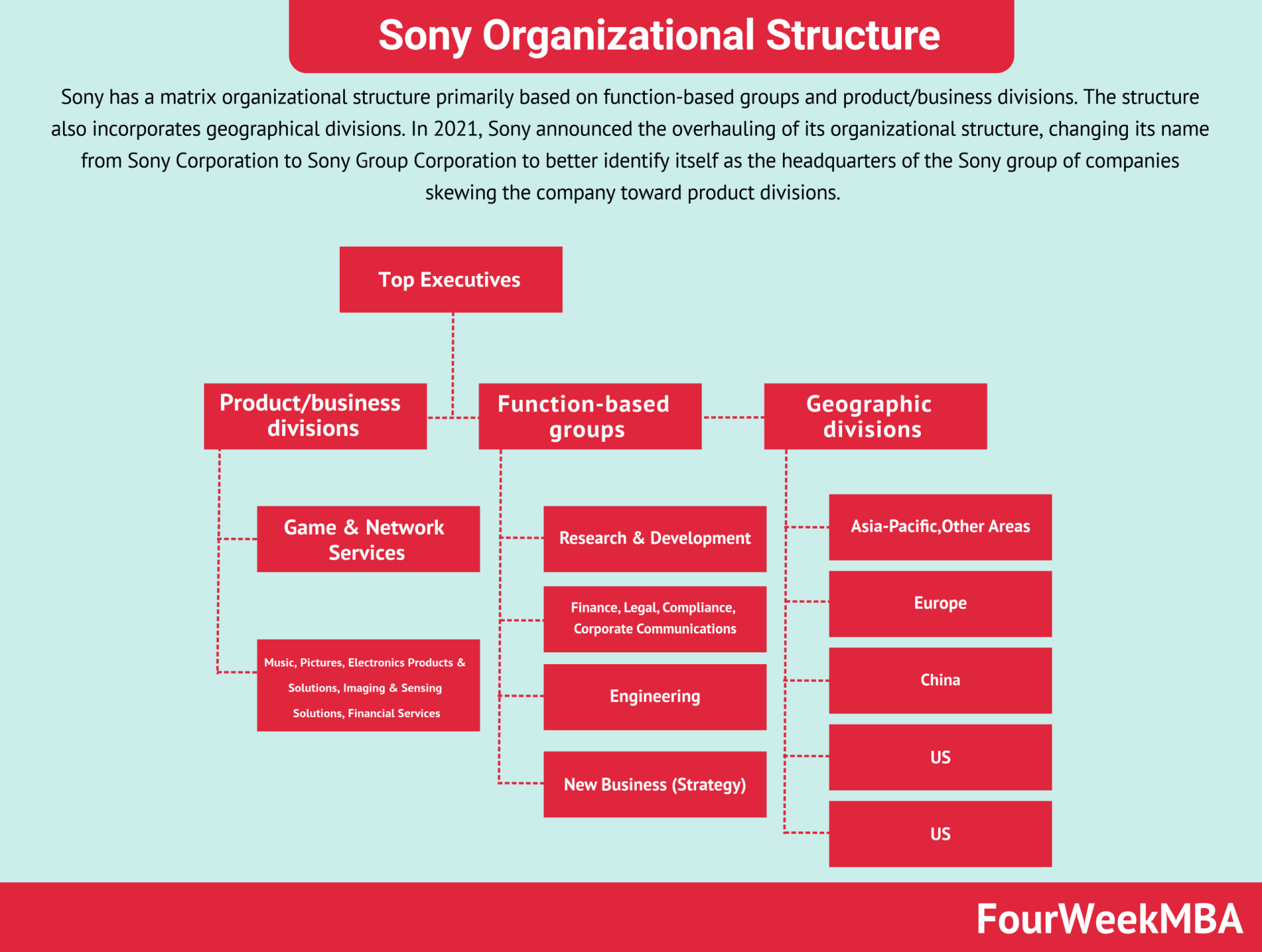
Sony has a matrix organizational structure primarily based on function-based groups and product/business divisions. The structure also incorporates geographical divisions. In 2021, Sony announced the overhauling of its organizational structure, changing its name from Sony Corporation to Sony Group Corporation to better identify itself as the headquarters of the Sony group of companies skewing the company toward product divisions.
Starbucks follows a matrix organizational structure with a combination of vertical and horizontal structures. It is characterized by multiple, overlapping chains of command and divisions.
Tesla is characterized by a functional organizational structure with aspects of a hierarchical structure. Tesla does employ functional centers that cover all business activities, including finance, sales, marketing, technology, engineering, design, and the offices of the CEO and chairperson. Tesla’s headquarters in Austin, Texas, decide the strategic direction of the company, with international operations given little autonomy.
Toyota has a divisional organizational structure where business operations are centered around the market, product, and geographic groups. Therefore, Toyota organizes its corporate structure around global hierarchies (most strategic decisions come from Japan’s headquarter), product-based divisions (where the organization is broken down, based on each product line), and geographical divisions (according to the geographical areas under management).
Walmart has a hybrid hierarchical-functional organizational structure, otherwise referred to as a matrix structure that combines multiple approaches. On the one hand, Walmart follows a hierarchical structure, where the current CEO Doug McMillon is the only employee without a direct superior, and directives are sent from top-level management. On the other hand, the function-based structure of Walmart is used to categorize employees according to their particular skills and experience.
Gennaro is the creator of FourWeekMBA, which reached about four million business people, comprising C-level executives, investors, analysts, product managers, and aspiring digital entrepreneurs in 2022 alone | He is also Director of Sales for a high-tech scaleup in the AI Industry | In 2012, Gennaro earned an International MBA with emphasis on Corporate Finance and Business Strategy.