Design Thinking Case Studies

CompanyDesign Thinking ApproachUser-Centered DesignOutcome
NetflixEnhancing user experience and content recommendations.Collects vast amounts of user data to personalize content recommendations and develop original content based on viewer feedback.Improved user satisfaction and engagement.
SpaceXRevolutionizing space exploration and travel.Uses iterative design processes and values input from astronauts and engineers to refine spacecraft design and safety features.Achieved significant advancements in reusable rocket technology.
Procter & Gamble (P&G)Innovating consumer products.Conducts in-depth research to understand consumer needs, encouraging cross-functional collaboration for product development.Created successful products like Swiffer and Tide Pods.
Warby ParkerDisrupting the eyewear industry.Involves customers in the design process and offers a try-before-you-buy program to test frames at home.Provided stylish and affordable eyewear, enhancing customer satisfaction.
NASASpace exploration and technology development.Designs spacecraft with human factors in mind, conducting extensive prototyping and testing for reliability.Advanced human spaceflight missions and Mars exploration initiatives.
IDEO.orgTackling social and humanitarian challenges.Collaborates with communities to create human-centered solutions, emphasizing empathy and rapid prototyping.Developed impactful innovations like water purification systems and healthcare delivery models.
Ford Smart MobilityAddressing urban mobility challenges.Conducts user research to understand commuter pain points, developing bike-sharing and ride-sharing services.Improved urban mobility solutions, enhancing commuter experiences.
AirbusAircraft design and passenger experience.Designs aircraft interiors focusing on passenger comfort and eco-friendly innovations to reduce emissions.Developed fuel-efficient aircraft and improved passenger amenities.
GoogleEnhancing products and user interfaces.Prioritizes user feedback and usability testing, developing technologies like Google Glass and self-driving cars.Created innovative and accessible products, improving user experiences.
AirbnbEnhancing user experience and trust.Uses design thinking to understand guest and host needs, improving platform usability and safety features.Increased user trust and platform growth.
AppleInnovating user-friendly products.Focuses on simplicity and user experience, employing extensive prototyping and user testing for product development.Launched successful products like the iPhone and Apple Watch.
IKEAImproving home furnishing solutions.Conducts home visits to understand customer needs, developing functional and affordable furniture solutions.Increased customer satisfaction and market dominance.
TeslaInnovating electric vehicles and user experience.Uses iterative design and feedback from users to refine vehicle features and autonomous driving technology.Achieved significant advancements in electric vehicle technology and user adoption.
SamsungEnhancing consumer electronics.Employs design thinking to understand user preferences, developing innovative and user-friendly devices.Created successful products like the Galaxy series and smart home devices.
LEGOInnovating toys and play experiences.Involves children in the design process to understand play preferences, developing engaging and educational toys.Increased market share and customer loyalty.
MicrosoftImproving software and hardware products.Uses user-centered design and feedback to enhance product usability and features, developing technologies like Surface and Azure.Improved product adoption and user satisfaction.
StarbucksEnhancing customer experience.Uses design thinking to improve store layouts, product offerings, and digital experiences based on customer feedback.Increased customer loyalty and sales.
NikeInnovating athletic footwear and apparel.Involves athletes in the design process to understand performance needs, developing advanced materials and technologies.Created successful product lines like Nike Air and Flyknit.
AdobeEnhancing creative software tools.Uses user feedback and iterative design to refine software features, developing tools like Adobe Creative Cloud.Increased user adoption and market leadership in creative software.
GE HealthcareInnovating medical equipment and solutions.Uses design thinking to understand healthcare provider and patient needs, developing user-friendly and efficient medical devices.Improved healthcare outcomes and customer satisfaction.

From The Business Engineer’s Issue.

FourWeekMBA Business Toolbox

Business Engineering

business-engineering-manifesto

Tech Business Model Template

business-model-template
A tech business model is made of four main components: value model (value propositions, missionvision), technological model (R&D management), distribution model (sales and marketing organizational structure), and financial model (revenue modeling, cost structure, profitability and cash generation/management). Those elements coming together can serve as the basis to build a solid tech business model.

Web3 Business Model Template

vbde-framework
A Blockchain Business Model according to the FourWeekMBA framework is made of four main components: Value Model (Core Philosophy, Core Values and Value Propositions for the key stakeholders), Blockchain Model (Protocol Rules, Network Shape and Applications Layer/Ecosystem), Distribution Model (the key channels amplifying the protocol and its communities), and the Economic Model (the dynamics/incentives through which protocol players make money). Those elements coming together can serve as the basis to build and analyze a solid Blockchain Business Model.

Asymmetric Business Models

asymmetric-business-models
In an asymmetric business model, the organization doesn’t monetize the user directly, but it leverages the data users provide coupled with technology, thus have a key customer pay to sustain the core asset. For example, Google makes money by leveraging users’ data, combined with its algorithms sold to advertisers for visibility.

Business Competition

business-competition
In a business world driven by technology and digitalization, competition is much more fluid, as innovation becomes a bottom-up approach that can come from anywhere. Thus, making it much harder to define the boundaries of existing markets. Therefore, a proper business competition analysis looks at customer, technology, distribution, and financial model overlaps. While at the same time looking at future potential intersections among industries that in the short-term seem unrelated.

Technological Modeling

technological-modeling
Technological modeling is a discipline to provide the basis for companies to sustain innovation, thus developing incremental products. While also looking at breakthrough innovative products that can pave the way for long-term success. In a sort of Barbell Strategy, technological modeling suggests having a two-sided approach, on the one hand, to keep sustaining continuous innovation as a core part of the business model. On the other hand, it places bets on future developments that have the potential to break through and take a leap forward.

Transitional Business Models

transitional-business-models
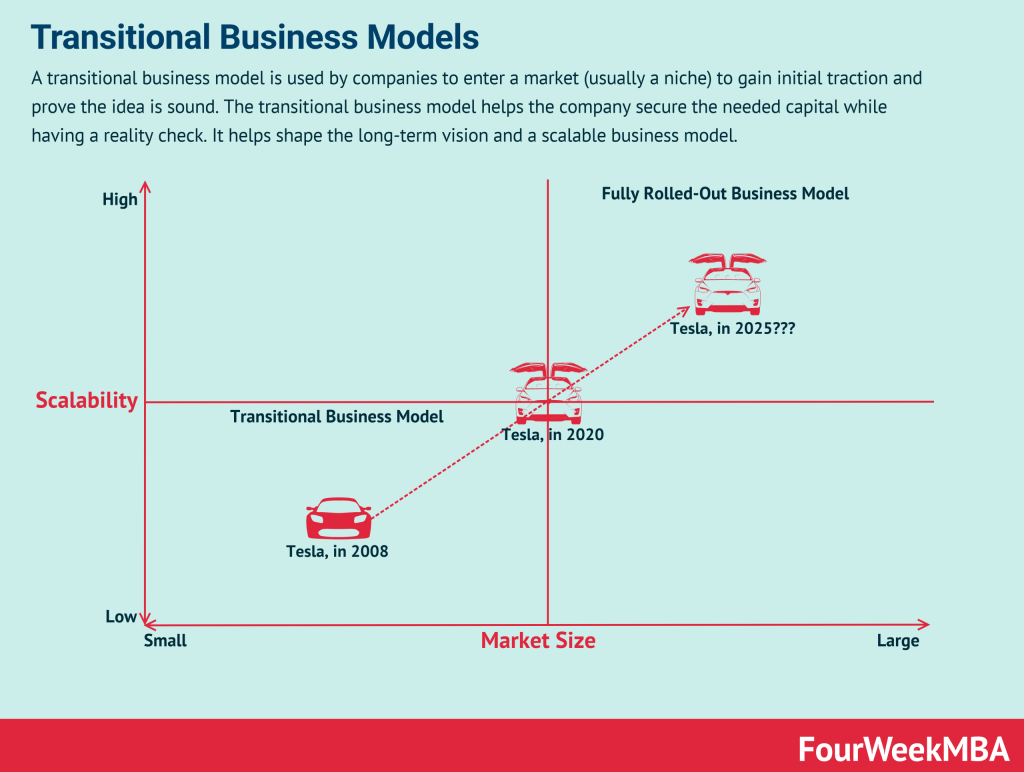
A transitional business model is used by companies to enter a market (usually a niche) to gain initial traction and prove the idea is sound. The transitional business model helps the company secure the needed capital while having a reality check. It helps shape the long-term vision and a scalable business model.

Minimum Viable Audience

minimum-viable-audience
The minimum viable audience (MVA) represents the smallest possible audience that can sustain your business as you get it started from a microniche (the smallest subset of a market). The main aspect of the MVA is to zoom into existing markets to find those people which needs are unmet by existing players.

Business Scaling

business-scaling
Business scaling is the process of transformation of a business as the product is validated by wider and wider market segments. Business scaling is about creating traction for a product that fits a small market segment. As the product is validated it becomes critical to build a viable business model. And as the product is offered at wider and wider market segments, it’s important to align product, business model, and organizational design, to enable wider and wider scale.

Market Expansion Theory

market-expansion
The market expansion consists in providing a product or service to a broader portion of an existing market or perhaps expanding that market. Or yet, market expansions can be about creating a whole new market. At each step, as a result, a company scales together with the market covered.

Speed-Reversibility

decision-making-matrix

Asymmetric Betting

asymmetric-bets

Growth Matrix

growth-strategies
In the FourWeekMBA growth matrix, you can apply growth for existing customers by tackling the same problems (gain mode). Or by tackling existing problems, for new customers (expand mode). Or by tackling new problems for existing customers (extend mode). Or perhaps by tackling whole new problems for new customers (reinvent mode).

Revenue Streams Matrix

revenue-streams-model-matrix
In the FourWeekMBA Revenue Streams Matrix, revenue streams are classified according to the kind of interactions the business has with its key customers. The first dimension is the “Frequency” of interaction with the key customer. As the second dimension, there is the “Ownership” of the interaction with the key customer.

Revenue Modeling

revenue-model-patterns
Revenue model patterns are a way for companies to monetize their business models. A revenue model pattern is a crucial building block of a business model because it informs how the company will generate short-term financial resources to invest back into the business. Thus, the way a company makes money will also influence its overall business model.

Pricing Strategies

pricing-strategies
A pricing strategy or model helps companies find the pricing formula in fit with their business models. Thus aligning the customer needs with the product type while trying to enable profitability for the company. A good pricing strategy aligns the customer with the company’s long term financial sustainability to build a solid business model.

Other business resources:

Scroll to Top

Discover more from FourWeekMBA

Subscribe now to keep reading and get access to the full archive.

Continue reading

FourWeekMBA