Design strategy is a framework applying the tactical thinking of a business strategy to the needs of the user to create the most effective products and services.
Aspect
Explanation
Design Strategy
Design Strategy is an approach that organizations use to integrate design thinking and user-centered design principles into their overall business strategy.
Purpose
The primary purpose of design strategy is to leverage design as a strategic asset to drive innovation, differentiation, and competitive advantage.
User-Centered
At its core, design strategy places the user or customer at the center of decision-making processes, ensuring that products and services meet their needs effectively.
Cross-Functional
It often involves cross-functional collaboration between design teams, marketing, product development, and other business units to align design with organizational goals.
Research and Data
Design strategy relies on user research, market analysis, and data-driven insights to inform design decisions and ensure that solutions are tailored to user needs.
Design Thinking
Design thinking is a key component of design strategy, emphasizing empathy, ideation, and iteration to solve complex problems and create user-centered solutions.
Innovation Driver
Design strategy is a driver of innovation within organizations, fostering a culture of creativity and continuous improvement to stay competitive in the market.
Brand and Identity
It considers how design can reinforce brand identity, creating a consistent and memorable brand experience that resonates with customers.
Sustainability
In recent years, sustainability has become an integral part of design strategy, focusing on environmental impact and ethical considerations in product and service design.
Examples
– Apple: Apple’s design strategy, led by designers like Jony Ive, is known for its focus on aesthetics, functionality, and user experience. – Tesla: Tesla’s electric vehicles combine innovative technology with sleek design.
Measuring Success
Success in design strategy is often measured through metrics like user satisfaction, customer retention, brand loyalty, and market share growth.
Iterative Process
Design strategy is an iterative process, with continuous feedback and adaptation to evolving user needs and market dynamics.
Conclusion
Design strategy is a strategic approach that harnesses the power of design thinking and user-centered design to drive innovation, enhance brand identity, and create products and services that resonate with users and customers.
Design strategy involves the creation of a guiding set of principles that articulate the company mission and vision with the design of its products and services.
Put differently, design strategy is a way of translating the intent of a business, product, or service into the experience of that business, product, or service. To that end, the strategy occupies the crucial middle ground between what the business wants and what the people need. It’s important to note that both business goals and user needs must also be aligned with existing technical constraints to develop competitive products.
What success means (and for whom) and how success will be measured. How can both the business and the company win?
The problem the company is addressing and why it needs to be solved. How is the company making customer lives easier?
The unique value proposition (UVP). What is the company’s competitive advantage?
A set of design principles, which we touched on earlier.
Why does design strategy matter?
On the surface, it may appear design strategy has very little to do with actual design. However, there are tangible links between design strategy and successful design.
How exactly does design strategy add value to a business? Consultancy firm McKinsey and Company decided to find out. After conducting comprehensive and rigorous studies on the subject, they found that:
The companies with the best design strategies increased their revenue at nearly twice the rate of industry competitors. The same can also be said for shareholder returns.
There was a strong correlation between high design scores and superior business performance. Businesses were better able to achieve short and long-term goals.
The notion of superior design leading to superior business performance is consistent across different industries.
The user/customer marketplace disproportionately rewards brands with good design habits. These habits use familiar language to increase trust, brand recall, brand recognition, user satisfaction, and the customer experience.
The three core benefits of design strategy
As an addendum to the McKinsey and Company study, let’s now take a look at benefits that help business operations more generally.
Cost-effectiveness
Design strategy enables the organization to clearly define who its target audience is, what they need, and how it can create value for them. Products based on these insights tend to be more successful when released to the market and can easily be improved with subsequent iterations.
Ultimately, the right product is a cost-effective product backed by robust research. Due diligence during the development stage helps the organization avoid a scenario where it has to spend time and money attempting to rescue a failed product. However, as Peter Thiel intimated in his book Zero to One, no amount of iteration will remedy a product that should not have been built in the first place.
Direction
Organizations that have clear and understandable goals tend to perform better because employees are empowered and engaged to achieve them.
A good design strategy removes the trivial decision-making that can sometimes plague product development. This means the design team has more time to focus on meaningful issues that matter to the customer or increase productivity.
Prioritization
Many businesses proclaim they are user-oriented, but a design team with too much of a user focus can end up developing features that are costly, time-intensive, and only result in modest gains.
In theory, design strategy helps a user-oriented organization focus on product features that strike the best balance between low effort and high reward. This helps the team create the most value for the largest cohort of their target audience and is a far more sustainable approach than the alternative.
Design strategy examples
Now let’s take a look at two hypothetical examples of how design strategy can be applied.
Landing page optimization
Consider a company with a client who wants their landing page redesigned as part of a major website overhaul.
The current landing page is not meeting KPIs and requires a refresh.
To start, the sales and content team would collaborate to identify each feature, benefit, and advantage of the company’s product to be included in the copy.
The copy itself is then written and sent to the design team and project manager who craft the design strategy.
Some of the key components of this strategy may include:
Target audience – demographics, use cases, and personas.
Goals the landing page should achieve – for instance: buy a product, generate ad revenue via web traffic, book a demo, etc.
Industry comparisons – where competitors are excelling and what could be adapted for the company’s own purposes.
Landing page copy – including indicators for headings, sub-headings, and formatting.
Branding guidelines or assets – to provide guardrails for the project.
Task designation and overall project deadline – who is responsible for what and when should it be completed?
UX/UI and graphic designers then take over to create the visual assets and design the page in such a way that traffic and conversions are increased.
Note that in a normal design thinking scenario, the design team would send out a user questionnaire and then go back and forth with the user to iterate until they were satisfied.
In design strategy, however, the team works far more collaboratively with the client and probes them with deeper questions such as:
Why would you like a new landing page?
What percentage of total sales are driven by the website?
To what extent do you hope to see sales, traffic, or leads increase after the project is complete?
When performed correctly, both parties agree on the particular tasks that will achieve the user’s objectives and how outcomes will be measured.
Each aspect of the design process is carried out with an eye on these objectives at all times.
Company rebranding
Design strategy can also be employed to manage the often risky process of rebranding.
This process may be necessitated to fuel international growth, repair a damaged brand, or be instituted because of new management.
In this example, the company looking to rebrand should start a discussion about what it needs to improve or change and why the rebrand is necessary.
Customer personas – of course, these must be representative of who the company believes its new brand will attract. In theory, the customer should inspire the business to be the best version of itself.
Color psychology research – the color red, for example, evokes passion, energy, and power, while blue is associated with trust, loyalty, and serenity.
Goals of the rebrand – in other words, the why. Marvel Comics was on the brink of bankruptcy in the late 1990s before a rebrand saw the company reinvent itself as a movie producer.
Competitor logo list – this should be done so the rebranding effort can stand out.
Collateral damage – in the vast majority of instances, a rebranding initiative is expensive. Letterheads, titles, advertising campaigns, and anything else bearing the company’s old name or logo must be updated.
Rebrand brief – containing the new brand’s core values, mission, vision, or promise.
Task designation – or the designers assigned to various tasks.
Project deadline – with timelines and schedules to ensure adequate progress is made.
For the complex rebranding process to be effective, it will be important to involve as many teams as possible.
Case Studies
Smartphone Design:
Problem: A tech company wants to create a new smartphone to target millennials.
Design Strategy Components:
User Persona: Millennials who prioritize camera quality and battery life.
Unique Value Proposition (UVP): A smartphone with a 48MP camera, optimized for low light conditions, and a two-day battery life.
Design Principles: Sleek, minimalistic design with an intuitive UI.
Success Metrics: Increase in sales by 15% in the target demographic within a year.
Eco-friendly Packaging for a Coffee Shop:
Problem: A coffee chain wants to reduce its carbon footprint by introducing eco-friendly packaging.
Design Strategy Components:
User Persona: Environmentally conscious coffee drinkers.
UVP: Biodegradable cups and packaging that decompose in 90 days.
Design Principles: Use of green and earthy tones to emphasize eco-friendliness; clear messaging about the benefits of the packaging.
Success Metrics: 25% reduction in non-biodegradable waste within a year; positive customer feedback on sustainability initiatives.
Online Learning Platform:
Problem: An edtech company aims to introduce an online platform for remote learning tailored to working professionals.
Design Strategy Components:
User Persona: Working professionals aged 25-40 looking to upskill.
UVP: Flexible course timings with industry-recognized certifications.
Design Principles: User-friendly dashboard, easy navigation, and a progress tracker.
Success Metrics: 10,000 registrations in the first 6 months; 90% course completion rate.
Elderly-Friendly Health Monitoring Device:
Problem: A health tech startup wants to design a wearable device for the elderly to monitor vital signs.
Design Strategy Components:
User Persona: Elderly individuals aged 65 and above with health concerns.
UVP: Continuous heart rate, blood pressure, and fall detection with immediate emergency alerts.
Success Metrics: 20% market share in the targeted demographic within a year; positive reviews regarding ease of use.
Urban Electric Vehicle (EV):
Problem: An automobile company wants to introduce an EV tailored for urban commuting.
Design Strategy Components:
User Persona: Urban residents who commute short distances daily and are environmentally conscious.
UVP: Compact design, fast charging, and a range sufficient for daily city commutes.
Design Principles: Sleek design with a focus on maneuverability; integrated tech for easy navigation in city traffic.
Success Metrics: Capture 10% of the urban EV market within two years; positive feedback on driving experience and charging convenience.
Key takeaways:
Design strategy is a framework applying the tactical thinking of business strategy to the needs of the user to create the most effective products and services. The strategy occupies the crucial middle ground between what the business wants and what the people need.
Design strategies should detail what success looks like for the business and the customer. They should also detail what the problem is and why it needs to be solved. Lastly, it should detail the unique value proposition that gives the business a competitive advantage.
Design strategy has many benefits for organizations. In a study conducted by McKinsey and Company, design strategy was linked with increased revenue, superior business performance, and increased consumer trust. More generally speaking, design strategy facilitates cost-effective product development, smarter resource allocation, and feature prioritization.
Key Insights
Definition: Design strategy is the application of tactical thinking from business strategy to the user’s needs, aiming to create effective products and services. It involves creating guiding principles that align the company’s mission and vision with the design of its offerings.
Components: A well-defined design strategy must include details on what success means for both the business and the user, the problem the company aims to address, the unique value proposition, and a set of design principles.
Importance: Design strategy plays a crucial role in successful design and business performance. Companies with strong design strategies have experienced increased revenue and shareholder returns. It aligns business goals with user needs and technical constraints, resulting in cost-effective products.
Benefits: Design strategy brings cost-effectiveness, direction, and prioritization to business operations. By clearly defining target audiences and goals, it helps teams focus on meaningful issues and avoid costly mistakes.
Examples: Two hypothetical examples of design strategy application are provided. One is for landing page optimization, where the strategy includes target audience, goals, industry comparisons, and branding guidelines. The other example involves company rebranding, where the strategy involves customer personas, color psychology research, rebrand goals, competitor analysis, and task designation.
Example
Description
Implications
Apple’s Product Design
Apple’s design strategy places a strong emphasis on sleek, user-friendly, and visually appealing product design, resulting in iconic products like the iPhone and MacBook.
– Apple’s design approach has set industry standards for user experience and aesthetics, contributing to its brand loyalty and market success.
IKEA’s Flat-Pack Furniture
IKEA’s design strategy focuses on affordable, flat-pack furniture that is easy to assemble. This approach reduces shipping costs and environmental impact while making design accessible to a wide audience.
– IKEA’s design philosophy aligns with sustainability goals and affordability, appealing to budget-conscious consumers.
Tesla’s Electric Vehicles
Tesla’s design strategy centers on electric vehicles that blend cutting-edge technology with sleek aesthetics, challenging conventional automotive design.
– Tesla’s innovative approach has disrupted the automotive industry, driving interest in sustainable transportation and electric vehicles.
Airbnb’s User-Centric Design
Airbnb’s design strategy prioritizes user-centered design principles to create a platform that offers a seamless booking and travel experience for hosts and guests.
– Airbnb’s design thinking emphasizes empathy for users, resulting in a more intuitive and user-friendly platform.
Google’s Material Design
Google’s design strategy, known as Material Design, provides a consistent visual language and user experience across its products, promoting clarity and familiarity for users.
– Material Design enhances user engagement and brand recognition by offering a unified and intuitive design across Google’s ecosystem.
LEGO’s Creative Play
LEGO’s design strategy revolves around the idea of creative play, offering a versatile building system that sparks imagination and encourages hands-on learning in children and adults.
– LEGO’s design philosophy fosters creativity, problem-solving skills, and brand loyalty among its customers.
Coca-Cola’s Packaging Design
Coca-Cola’s design strategy involves iconic branding and packaging design that evokes emotions and has a strong visual presence on store shelves.
– Coca-Cola’s design strategy contributes to its brand recognition and emotional connection with consumers, impacting purchasing decisions.
Nike’s Athlete-Inspired Footwear
Nike’s design strategy draws inspiration from athletes and sports performance, resulting in innovative footwear that enhances athletic performance and style.
– Nike’s design approach aligns with its brand positioning as a leader in sports and athletic fashion, attracting athletes and enthusiasts alike.
Starbucks’ Store Design
Starbucks’ design strategy focuses on creating inviting and comfortable store environments, enhancing the coffeehouse experience for customers.
– Starbucks’ store design strategy fosters customer loyalty and encourages customers to spend more time in its stores.
IDEO’s Human-Centered Design
IDEO, a design and innovation consultancy, employs a human-centered design approach to solve complex problems and create innovative solutions across various industries.
– IDEO’s design thinking methodology emphasizes empathy, creativity, and collaboration, leading to user-centric and innovative solutions.
A Blockchain Business Model according to the FourWeekMBA framework is made of four main components: Value Model (Core Philosophy, Core Values and Value Propositions for the key stakeholders), Blockchain Model (Protocol Rules, Network Shape and Applications Layer/Ecosystem), Distribution Model (the key channels amplifying the protocol and its communities), and the Economic Model (the dynamics/incentives through which protocol players make money). Those elements coming together can serve as the basis to build and analyze a solid Blockchain Business Model.
In an asymmetric business model, the organization doesn’t monetize the user directly, but it leverages the data users provide coupled with technology, thus have a key customer pay to sustain the core asset. For example, Google makes money by leveraging users’ data, combined with its algorithms sold to advertisers for visibility.
In a business world driven by technology and digitalization, competition is much more fluid, as innovation becomes a bottom-up approach that can come from anywhere. Thus, making it much harder to define the boundaries of existing markets. Therefore, a proper business competition analysis looks at customer, technology, distribution, and financial model overlaps. While at the same time looking at future potential intersections among industries that in the short-term seem unrelated.
Technological modeling is a discipline to provide the basis for companies to sustain innovation, thus developing incremental products. While also looking at breakthrough innovative products that can pave the way for long-term success. In a sort of Barbell Strategy, technological modeling suggests having a two-sided approach, on the one hand, to keep sustaining continuous innovation as a core part of the business model. On the other hand, it places bets on future developments that have the potential to break through and take a leap forward.
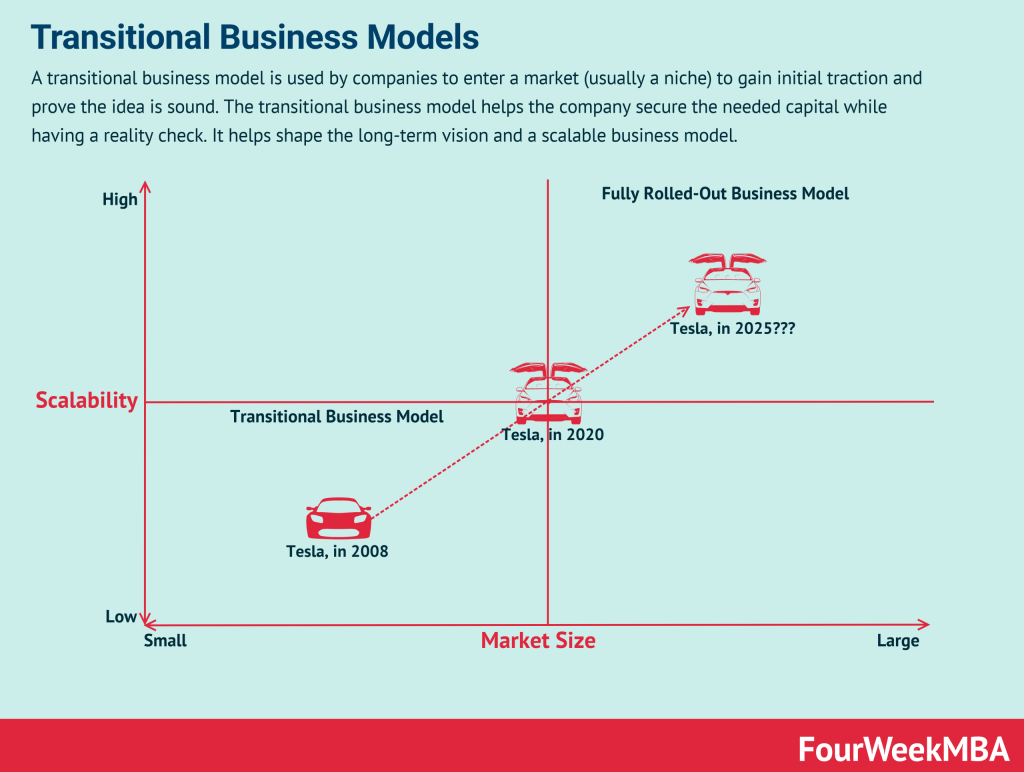
A transitional business model is used by companies to enter a market (usually a niche) to gain initial traction and prove the idea is sound. The transitional business model helps the company secure the needed capital while having a reality check. It helps shape the long-term vision and a scalable business model.
The minimum viable audience (MVA) represents the smallest possible audience that can sustain your business as you get it started from a microniche (the smallest subset of a market). The main aspect of the MVA is to zoom into existing markets to find those people which needs are unmet by existing players.
Business scaling is the process of transformation of a business as the product is validated by wider and wider market segments. Business scaling is about creating traction for a product that fits a small market segment. As the product is validated it becomes critical to build a viable business model. And as the product is offered at wider and wider market segments, it’s important to align product, business model, and organizational design, to enable wider and wider scale.
The market expansion consists in providing a product or service to a broader portion of an existing market or perhaps expanding that market. Or yet, market expansions can be about creating a whole new market. At each step, as a result, a company scales together with the market covered.
In the FourWeekMBA growth matrix, you can apply growth for existing customers by tackling the same problems (gain mode). Or by tackling existing problems, for new customers (expand mode). Or by tackling new problems for existing customers (extend mode). Or perhaps by tackling whole new problems for new customers (reinvent mode).
In the FourWeekMBA Revenue Streams Matrix, revenue streams are classified according to the kind of interactions the business has with its key customers. The first dimension is the “Frequency” of interaction with the key customer. As the second dimension, there is the “Ownership” of the interaction with the key customer.
Revenue model patterns are a way for companies to monetize their business models. A revenue model pattern is a crucial building block of a business model because it informs how the company will generate short-term financial resources to invest back into the business. Thus, the way a company makes money will also influence its overall business model.
A pricing strategy or model helps companies find the pricing formula in fit with their business models. Thus aligning the customer needs with the product type while trying to enable profitability for the company. A good pricing strategy aligns the customer with the company’s long term financial sustainability to build a solid business model.
Gennaro is the creator of FourWeekMBA, which reached about four million business people, comprising C-level executives, investors, analysts, product managers, and aspiring digital entrepreneurs in 2022 alone | He is also Director of Sales for a high-tech scaleup in the AI Industry | In 2012, Gennaro earned an International MBA with emphasis on Corporate Finance and Business Strategy.