Corporate culture refers to the collective values, beliefs, attitudes, behaviors, and norms that characterize an organization and its members. It serves as the organization's personality and defines how employees interact, make decisions, and perceive their roles within the company. Corporate culture is often considered the "unwritten rules" that guide behavior and shape the overall work environment.
Key Components
Impact of Corporate Culture
Corporate culture exerts a profound impact on organizations in several ways:
Strategies for Cultivating Corporate Culture
Creating and nurturing a positive and effective corporate culture requires deliberate effort and strategies:
Challenges and Considerations
Cultivating and maintaining a positive corporate culture can be challenging:
Conclusion
Corporate culture is a dynamic and integral aspect of organizations that profoundly influences their success. It shapes the behavior and attitudes of employees, impacting engagement, performance, and the overall work environment.
Strengths
—
Limitations
✗Cultivating and maintaining a positive corporate culture can be challenging:
✗Maintaining an ethical culture and addressing ethical dilemmas are ongoing challenges.
Real-World Examples
AirbnbAmazonAppleCoca-ColaCostcoEbay
Quick Answers
What is Impact of Corporate Culture?
Corporate culture exerts a profound impact on organizations in several ways:
What are the strategies for cultivating corporate culture?
Creating and nurturing a positive and effective corporate culture requires deliberate effort and strategies:
What are the challenges and considerations?
Cultivating and maintaining a positive corporate culture can be challenging:
Key Insight
Corporate culture is a dynamic and integral aspect of organizations that profoundly influences their success. It shapes the behavior and attitudes of employees, impacting engagement, performance, and the overall work environment. A positive and effective culture is not only a competitive advantage but also a driver of long-term sustainability and growth.
Exec Package + Claude OS Master Skill | Business Engineer Founding Plan
FourWeekMBA x Business Engineer | Updated 2026
Corporate culture refers to the collective values, beliefs, attitudes, behaviors, and norms that characterize an organization and its members. It serves as the organization’s personality and defines how employees interact, make decisions, and perceive their roles within the company. Corporate culture is often considered the “unwritten rules” that guide behavior and shape the overall work environment.
Key elements of corporate culture include:
Values: The core principles and beliefs that guide the organization’s actions and decision-making. Values often reflect what the organization deems important.
Norms: The unwritten rules and expectations that govern employee behavior and interactions within the workplace.
Leadership: The behavior and attitudes of organizational leaders greatly influence and shape the corporate culture.
Communication: How information is shared, the tone of communication, and the transparency of messages all contribute to the culture.
Work Environment: The physical workspace, as well as the social and emotional environment, play a role in shaping culture.
Components of Corporate Culture:
Mission and Vision: The organization’s purpose (mission) and its long-term aspirations (vision) are foundational elements that define its direction and values.
Values Statement: A clear statement of the organization’s core values helps align employee behavior with the company’s principles.
Behavioral Expectations: Companies often outline expected behaviors and ethical standards through codes of conduct or employee handbooks.
Leadership Style: The leadership style of top executives and managers can set the tone for the entire organization.
Symbols and Rituals: Corporate symbols (logos, mascots) and rituals (meetings, celebrations) reinforce cultural elements.
Impact of Corporate Culture
Corporate culture exerts a profound impact on organizations in several ways:
1. Employee Engagement:
A positive and inclusive culture fosters higher employee engagement, satisfaction, and retention.
2. Performance:
Culture can significantly influence employee performance, innovation, and productivity.
3. Decision-Making:
Corporate culture shapes the decision-making processes within an organization, influencing how risk is managed and how problems are addressed.
4. Reputation:
Culture plays a role in shaping an organization’s reputation, which can affect customer trust, loyalty, and market competitiveness.
5. Talent Attraction:
Organizations with a strong and appealing culture can attract top talent in a competitive job market.
6. Adaptability:
A culture that values adaptability and change is more likely to thrive in rapidly evolving industries.
Strategies for Cultivating Corporate Culture
Creating and nurturing a positive and effective corporate culture requires deliberate effort and strategies:
1. Leadership Alignment:
Ensure that top leadership aligns with the desired culture and consistently models its values and behaviors.
2. Values Communication:
Communicate the organization’s values clearly and regularly to employees at all levels.
3. Employee Involvement:
Involve employees in shaping the culture by seeking their input, listening to their concerns, and encouraging feedback.
4. Hiring and Onboarding:
Incorporate cultural fit assessments into the hiring process and introduce new employees to the culture during onboarding.
5. Training and Development:
Provide ongoing training and development opportunities that reinforce the desired cultural norms and values.
6. Recognition and Rewards:
Implement recognition and reward systems that celebrate behaviors aligned with the corporate culture.
7. Open Communication:
Foster an environment of open and transparent communication where employees feel safe expressing their ideas and concerns.
8. Evaluation and Feedback:
Regularly assess the culture through surveys, feedback mechanisms, and key performance indicators (KPIs) related to culture.
Challenges and Considerations
Cultivating and maintaining a positive corporate culture can be challenging:
1. Resistance to Change:
Employees and leaders may resist cultural changes that deviate from established norms.
2. Culture vs. Strategy:
Balancing culture and strategic goals can be challenging, as they may sometimes appear to be in conflict.
3. Remote Work:
The rise of remote work presents challenges in maintaining a cohesive culture among dispersed teams.
4. Cultural Alignment:
Mergers and acquisitions can introduce cultural misalignment, which must be addressed to ensure a smooth transition.
5. Ethical Considerations:
Maintaining an ethical culture and addressing ethical dilemmas are ongoing challenges.
6. Measurement:
Assessing the effectiveness and impact of corporate culture initiatives can be complex.
Conclusion
Corporate culture is a dynamic and integral aspect of organizations that profoundly influences their success. It shapes the behavior and attitudes of employees, impacting engagement, performance, and the overall work environment. A positive and effective culture is not only a competitive advantage but also a driver of long-term sustainability and growth. Organizations that prioritize the cultivation and maintenance of a strong culture are better equipped to navigate challenges, attract top talent, and thrive in a rapidly evolving business landscape. In an era where values and culture play an increasingly significant role, understanding, nurturing, and evolving corporate culture remains paramount for organizations of all sizes and industries.
Key Highlights
Corporate Culture Definition:
Corporate culture encompasses shared values, beliefs, norms, and behaviors within an organization.
It defines the organization’s identity, influences decision-making, and shapes the work environment.
Key Elements:
Values, norms, leadership, communication, and the work environment are central components of corporate culture.
Components:
Mission, values statement, behavioral expectations, leadership style, and symbols and rituals are key components of corporate culture.
Cultivating corporate culture involves leadership alignment, values communication, employee involvement, hiring practices, training, recognition, open communication, and evaluation.
Challenges:
Challenges include resistance to change, balancing culture with strategy, remote work, cultural alignment in M&A, ethical considerations, and measuring culture.
Conclusion:
Corporate culture is crucial for organizational success, requiring proactive efforts to nurture a positive and effective culture aligned with the organization’s values and goals.
Related Framework
Description
When to Apply
Corporate Culture
– Corporate Culture encompasses the shared values, beliefs, attitudes, and behaviors that characterize an organization, influencing its identity, cohesion, performance, and interactions with internal and external stakeholders. It reflects the organization’s norms and unwritten rules governing how things are done.
– Analyze and cultivate Corporate Culture to align organizational values, foster employee engagement, drive performance, enhance teamwork, and shape the organization’s reputation and brand.
Schein’s Organizational Culture Model
– Schein’s Model identifies three levels of Organizational Culture: artifacts (visible symbols, rituals, and structures), espoused values (stated beliefs and norms), and underlying assumptions (unconscious beliefs and perceptions). It emphasizes the importance of understanding deep-seated cultural elements.
– Utilize Schein’s Model to assess and transform organizational culture by probing beyond surface-level manifestations to uncover core values and assumptions, facilitating cultural change initiatives and improving organizational effectiveness.
Deal and Kennedy’s Cultural Model
– Deal and Kennedy propose four types of corporate cultures based on two dimensions: risk and speed. These cultures include tough guy/macho, work hard/play hard, process, and bet-the-company cultures. The model highlights the influence of risk-taking and pace on culture.
– Apply Deal and Kennedy’s Model to diagnose existing culture and align it with organizational goals, identify potential cultural barriers or strengths, and design strategies for fostering desired cultural traits and behaviors.
Cameron and Quinn’s Competing Values Framework
– The Competing Values Framework categorizes organizational cultures into four types: clan (collaborative and cohesive), adhocracy (innovative and dynamic), hierarchy (structured and stable), and market (results-driven and competitive). It emphasizes the interplay between internal and external focus and flexibility.
– Employ the Competing Values Framework to assess and transform organizational culture, identify cultural strengths and weaknesses, diagnose cultural fit with strategic objectives, and foster alignment between culture, strategy, and leadership.
Ouchi’s Theory Z
– Theory Z integrates aspects of Japanese and American management practices, emphasizing long-term employment, consensus decision-making, and collective responsibility. It underscores the importance of mutual trust, loyalty, and commitment in fostering organizational culture and performance.
– Consider Theory Z to cultivate a corporate culture based on employee involvement, collaboration, and shared values, promoting stability, loyalty, and organizational effectiveness, particularly in contexts emphasizing teamwork and employee development.
Denison’s Organizational Culture Model
– Denison’s Model assesses organizational culture based on four key traits: involvement (employee engagement), consistency (alignment of actions with values), adaptability (ability to change), and mission (clarity of purpose). It provides a comprehensive framework for understanding and managing culture.
– Utilize Denison’s Model to evaluate and enhance organizational culture, diagnose cultural strengths and weaknesses, identify areas for improvement or change, and align culture with strategic goals and desired outcomes.
Edgar Schein’s Levels of Culture
– Edgar Schein’s Levels of Culture model delineates three levels of culture: artifacts (visible manifestations), espoused beliefs and values (expressed aspirations and norms), and basic underlying assumptions (unconscious beliefs and perceptions). It emphasizes the need to address deep-rooted assumptions for meaningful cultural change.
– Apply Schein’s Levels of Culture to uncover hidden cultural dynamics, identify discrepancies between stated values and actual behaviors, and initiate cultural interventions that target underlying assumptions to foster authentic organizational change.
Corporate Storytelling
– Corporate storytelling involves the strategic use of narratives to convey organizational values, history, vision, and purpose. It engages stakeholders emotionally, fosters a sense of belonging and identity, and reinforces cultural norms and aspirations.
– Leverage Corporate Storytelling to communicate and reinforce desired cultural traits, share organizational values and successes, inspire employees, and build connections with customers, investors, and other stakeholders, enhancing organizational culture and reputation.
Organizational Socialization
– Organizational Socialization refers to the process through which individuals learn and internalize organizational culture, norms, roles, and expectations. It encompasses orientation programs, mentorship, training, and informal social interactions that shape newcomer experiences and assimilation into the organization.
– Employ Organizational Socialization strategies to onboard new employees effectively, integrate them into the organizational culture, transmit core values and norms, and facilitate cultural adaptation and alignment with organizational goals and expectations.
Employee Recognition Programs
– Employee Recognition Programs acknowledge and reward individuals and teams for demonstrating behaviors aligned with organizational values, goals, and culture. They reinforce desired behaviors, motivate performance, and foster a positive organizational climate.
– Implement Employee Recognition Programs to reinforce cultural norms and values, celebrate achievements, and promote a culture of appreciation, collaboration, and continuous improvement, enhancing employee engagement, morale, and retention.
In a functional organizational structure, groups and teams are organized based on function. Therefore, this organization follows a top-down structure, where most decision flows from top management to bottom. Thus, the bottom of the organization mostly follows the strategy detailed by the top of the organization.
In a flat organizational structure, there is little to no middle management between employees and executives. Therefore it reduces the space between employees and executives to enable an effective communication flow within the organization, thus being faster and leaner.
Project portfolio management (PPM) is a systematic approach to selecting and managing a collection of projects aligned with organizational objectives. That is a business process of managing multiple projects which can be identified, prioritized, and managed within the organization. PPM helps organizations optimize their investments by allocating resources efficiently across all initiatives.
Harvard Business School professor Dr. John Kotter has been a thought-leader on organizational change, and he developed Kotter’s 8-step change model, which helps business managers deal with organizational change. Kotter created the 8-step model to drive organizational transformation.
The Nadler-Tushman Congruence Model was created by David Nadler and Michael Tushman at Columbia University. The Nadler-Tushman Congruence Model is a diagnostic tool that identifies problem areas within a company. In the context of business, congruence occurs when the goals of different people or interest groups coincide.
McKinsey’s Seven Degrees of Freedom for Growth is a strategy tool. Developed by partners at McKinsey and Company, the tool helps businesses understand which opportunities will contribute to expansion, and therefore it helps to prioritize those initiatives.
Mintzberg’s 5Ps of Strategy is a strategy development model that examines five different perspectives (plan, ploy, pattern, position, perspective) to develop a successful business strategy. A sixth perspective has been developed over the years, called Practice, which was created to help businesses execute their strategies.
The COSO framework is a means of designing, implementing, and evaluating control within an organization. The COSO framework’s five components are control environment, risk assessment, control activities, information and communication, and monitoring activities. As a fraud risk management tool, businesses can design, implement, and evaluate internal control procedures.
The TOWS Matrix is an acronym for Threats, Opportunities, Weaknesses, and Strengths. The matrix is a variation on the SWOT Analysis, and it seeks to address criticisms of the SWOT Analysis regarding its inability to show relationships between the various categories.
Lewin’s change management model helps businesses manage the uncertainty and resistance associated with change. Kurt Lewin, one of the first academics to focus his research on group dynamics, developed a three-stage model. He proposed that the behavior of individuals happened as a function of group behavior.
OpenAI is an artificial intelligence research laboratory that transitioned into a for-profit organization in 2019. The corporate structure is organized around two entities: OpenAI, Inc., which is a single-member Delaware LLC controlled by OpenAI non-profit, And OpenAI LP, which is a capped, for-profit organization. The OpenAI LP is governed by the board of OpenAI, Inc (the foundation), which acts as a General Partner. At the same time, Limited Partners comprise employees of the LP, some of the board members, and other investors like Reid Hoffman’s charitable foundation, Khosla Ventures, and Microsoft, the leading investor in the LP.
Airbnb follows a holacracy model, or a sort of flat organizational structure, where teams are organized for projects, to move quickly and iterate fast, thus keeping a lean and flexible approach. Airbnb also moved to a hybrid model where employees can work from anywhere and meet on a quarterly basis to plan ahead, and connect to each other.
The Amazon organizational structure is predominantly hierarchical with elements of function-based structure and geographic divisions. While Amazon started as a lean, flat organization in its early years, it transitioned into a hierarchical organization with its jobs and functions clearly defined as it scaled.
The Coca-Cola Company has a somewhat complex matrix organizational structure with geographic divisions, product divisions, business-type units, and functional groups.
Costco has a matrix organizational structure, which can simply be defined as any structure that combines two or more different types. In this case, a predominant functional structure exists with a more secondary divisional structure.
Costco’s geographic divisions reflect its strong presence in the United States combined with its expanding global presence. There are six divisions in the country alone to reflect its standing as the source of most company revenue.
Compared to competitor Walmart, for example, Costco takes more a decentralized approach to management, decision-making, and autonomy. This allows the company’s stores and divisions to more flexibly respond to local market conditions.
Dell has a functional organizational structure with some degree of decentralization. This means functional departments share information, contribute ideas to the success of the organization and have some degree of decision-making power.
eBay was until recently a multi-divisional (M-form) organization with semi-autonomous units grouped according to the services they provided. Today, eBay has a single division called Marketplace, which includes eBay and its international iterations.
Facebook is characterized by a multi-faceted matrix organizational structure. The company utilizes a flat organizational structure in combination with corporate function-based teams and product-based or geographic divisions. The flat organization structure is organized around the leadership of Mark Zuckerberg, and the key executives around him. On the other hand, the function-based teams are based on the main corporate functions (like HR, product management, investor relations, and so on).
Goldman Sachs has a hierarchical structure with a clear chain of command and defined career advancement process. The structure is also underpinned by business-type divisions and function-based groups.
Google (Alphabet) has a cross-functional (team-based) organizational structure known as a matrix structure with some degree of flatness. Over the years, as the company scaled and it became a tech giant, its organizational structure is morphing more into a centralized organization.
IBM has an organizational structure characterized by product-based divisions, enabling its strategy to develop innovative and competitive products in multiple markets. IBM is also characterized by function-based segments that support product development and innovation for each product-based division, which include Global Markets, Integrated Supply Chain, Research, Development, and Intellectual Property.
McDonald’s has a divisional organizational structure where each division – based on geographical location – is assigned operational responsibilities and strategic objectives. The main geographical divisions are the US, internationally operated markets, and international developmental licensed markets. And on the other hand, the hierarchical leadership structure is organized around regional and functional divisions.
McKinsey & Company has a decentralized organizational structure with mostly self-managing offices, committees, and employees. There are also functional groups and geographic divisions with proprietary names.
Microsoft has a product-type divisional organizational structure based on functions and engineering groups. As the company scaled over time it also became more hierarchical, however still keeping its hybrid approach between functions, engineering groups, and management.
Nestlé has a geographical divisional structure with operations segmented into five key regions. For many years, Swiss multinational food and drink company Nestlé had a complex and decentralized matrix organizational structure where its numerous brands and subsidiaries were free to operate autonomously.
Nike has a matrix organizational structure incorporating geographic divisions. Nike’s matrix structure is also present at the regional and sub-regional levels. Managerial responsibility is segmented according to business unit (apparel, footwear, and equipment) and function (human resources, finance, marketing, sales, and operations).
Patagonia has a particular organizational structure, where its founder, Chouinard, disposed of the company’s ownership in the hands of two non-profits. The Patagonia Purpose Trust, holding 100% of the voting stocks, is in charge of defining the company’s strategic direction. And the Holdfast Collective, a non-profit, holds 100% of non-voting stocks, aiming to re-invest the brand’s dividends into environmental causes.
Samsung has a product-type divisional organizational structure where products determine how resources and business operations are categorized. The main resources around which Samsung’s corporate structure is organized are consumer electronics, IT, and device solutions. In addition, Samsung leadership functions are organized around a few career levels grades, based on experience (assistant, professional, senior professional, and principal professional).
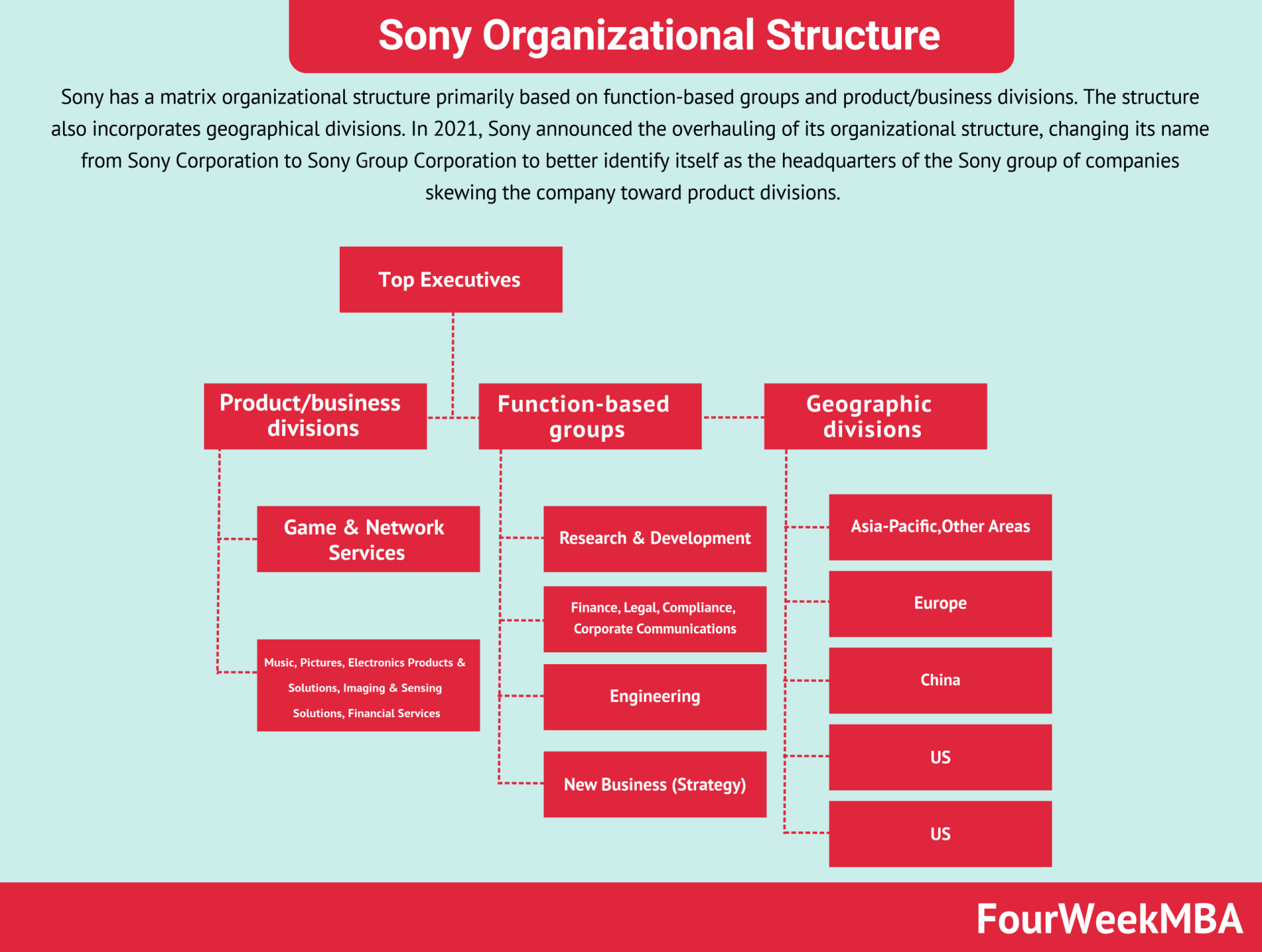
Sony has a matrix organizational structure primarily based on function-based groups and product/business divisions. The structure also incorporates geographical divisions. In 2021, Sony announced the overhauling of its organizational structure, changing its name from Sony Corporation to Sony Group Corporation to better identify itself as the headquarters of the Sony group of companies skewing the company toward product divisions.
Starbucks follows a matrix organizational structure with a combination of vertical and horizontal structures. It is characterized by multiple, overlapping chains of command and divisions.
Tesla is characterized by a functional organizational structure with aspects of a hierarchical structure. Tesla does employ functional centers that cover all business activities, including finance, sales, marketing, technology, engineering, design, and the offices of the CEO and chairperson. Tesla’s headquarters in Austin, Texas, decide the strategic direction of the company, with international operations given little autonomy.
Toyota has a divisional organizational structure where business operations are centered around the market, product, and geographic groups. Therefore, Toyota organizes its corporate structure around global hierarchies (most strategic decisions come from Japan’s headquarter), product-based divisions (where the organization is broken down, based on each product line), and geographical divisions (according to the geographical areas under management).
Walmart has a hybrid hierarchical-functional organizational structure, otherwise referred to as a matrix structure that combines multiple approaches. On the one hand, Walmart follows a hierarchical structure, where the current CEO Doug McMillon is the only employee without a direct superior, and directives are sent from top-level management. On the other hand, the function-based structure of Walmart is used to categorize employees according to their particular skills and experience.
Corporate culture refers to the collective values, beliefs, attitudes, behaviors, and norms that characterize an organization and its members. It serves as the organization's personality and defines how employees interact, make decisions, and perceive their roles within the company. Corporate culture is often considered the "unwritten rules" that guide behavior and shape the overall work environment.
What are the key components of Corporate Culture?
The key components of Corporate Culture include Impact of Corporate Culture, Strategies for Cultivating Corporate Culture, Challenges and Considerations, Conclusion. Impact of Corporate Culture: Corporate culture exerts a profound impact on organizations in several ways:
Gennaro Cuofano is a CRO and tech executive who has worked in AI since late 2015, starting with bringing NLP, natural-language generation, voice and chatbot products to the marketing industry. His background is in law and finance: he holds a Master's degree in Law and an International MBA with an emphasis on corporate finance (LUISS Business School and the University of San Diego, 2012), and worked as a financial analyst at a real-estate investment firm in San Diego and as an assistant controller. His work focuses on business model strategy, business engineering and, more broadly, structural analysis: how companies make money, read from their own filings. He created FourWeekMBA and leads research there and at The Business Engineer, his newsletter on AI and business strategy, with over 95,000 subscribers and more than 1,000 published analyses. His writing has also appeared on Entrepreneur (for example, How to Digitize a Family Business in Europe) and HackerNoon. Find him on LinkedIn and Substack. See how we source.
Scroll to Top
Discover more from FourWeekMBA
Subscribe now to keep reading and get access to the full archive.