Nvidia’s Vera Rubin NVL72 produced between 2.37 and 3.24 times as many Kimi K3 tokens per dollar of total cost of ownership as the GB300 NVL72, according to a SemiAnalysis InferenceX chart published on 27 October that labels the Rubin results an official preview.
SemiAnalysis wrote on X that Nvidia “just submitted its first Rubin NVL72 Kimi K3 submission, and it can reach over 850 tok/s/user, even at 2.8 Trillion parameters”, adding that it had “over 3x higher throughput” on vLLM, the open-source serving software.
Short explainer · Rubin on Kimi K3
A vertical news Short narrated from the published text of this piece and related FourWeekMBA pieces.
Business Pill · Tokens per watt explained
An evergreen Business Engineer explainer on tokens per watt, what an AI data centre actually produces. It explains the general idea and does not discuss Rubin or Kimi K3.
The key insight: As we read it, SemiAnalysis’s chart prices a Rubin chip-hour at $3.61 against $2.31 for GB300, and still prints Rubin at 2.37 to 3.24 times GB300’s Kimi K3 tokens per dollar at matched speeds, on results it labels an official preview.
The chart is titled “Kimi K3 2.8T Agentic Total Tokens per $1 TCO vs. P90 Interactivity” and is dated 2026-10-27. It compares two systems, both running Nvidia’s Dynamo with vLLM: Vera Rubin NVL72 and GB300 NVL72.
Tok/s/user, the unit SemiAnalysis quotes, is how many tokens per second a single user receives, in other words how fast an answer streams to one person. The chart measures it at P90, and puts total tokens per $1 of cost on the other axis.
At four matched speeds the chart prints the Rubin multiple over GB300: 2.37x at about 100 tok/s/user, 2.38x at about 150, 3.24x at about 280 and 3.07x at about 400, reading the speeds from the chart’s axis.
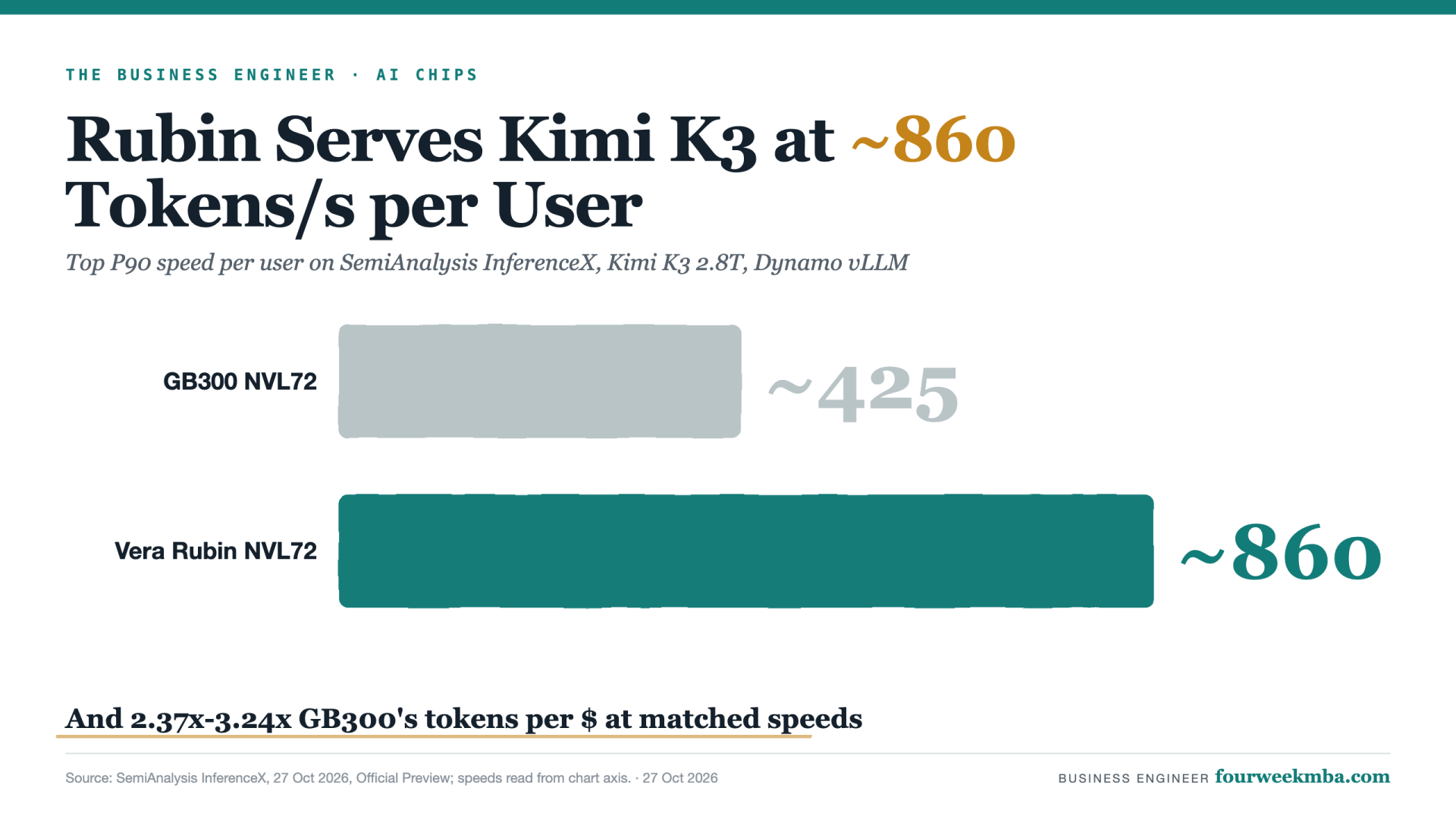
The Rubin curve runs to about 860 tok/s/user, against about 425 for the last GB300 point, also read from the axis. On both curves, faster service per user comes with fewer total tokens per dollar.
Vera Rubin NVL72 tokens per $1 of total cost of ownership as a multiple of GB300 NVL72 on Kimi K3 2.8T, at four matched P90 speeds per user, as printed on SemiAnalysis’s InferenceX chart updated 27 Oct 2026 (Official Preview; results may change). Speeds read from the chart’s axis.Vera Rubin NVL72 vs GB300 NVL72 on Kimi K3, per SemiAnalysis InferenceX (27 Oct 2026, Official Preview): $3.61 per Rubin chip-hour against $2.31 for GB300; a top P90 speed of about 860 tokens per second per user against about 425 (read from the chart axis); a peak multiple of 3.24x GB300’s tokens per $1 TCO at matched speed.
A Pricier Chip-Hour, More Tokens
Top P90 speed per user on SemiAnalysis InferenceX, Kimi K3 2.8T, Dynamo vLLM: about 860 tokens per second for Vera Rubin NVL72 against about 425 for GB300 NVL72, read from the axis of the chart updated 27 Oct 2026 (Official Preview).
SemiAnalysis prices a VR200 chip at $3.61 per hour and a GB300 at $2.31, under a cost tier labelled “Owning at Large Hyperscaler Volume” and its July 2026 pricing surveys and AI Cloud TCO Model. By our arithmetic, the Rubin chip-hour costs about 56% more.
The tokens-per-dollar multiples on the chart already include that higher cost. The same InferenceX page lists chip-hour costs of $2.26 for B300, $1.50 for MI355X and $1.03 for TPU v7.
As we read it, the chart prints its largest Rubin multiples at the faster speeds: 3.24x at about 280 tokens per second per user and 3.07x at about 400, against 2.37x and 2.38x at about 100 and 150.
As we read it, the chart also shows the trade-off inside each system: on both curves, more speed per user comes with fewer total tokens per dollar.
As we read it, SemiAnalysis frames the result as Nvidia’s first Rubin NVL72 submission on Kimi K3, a 2.8 trillion parameter model, run on Dynamo with vLLM on both systems.
SemiAnalysis on X, 27 October 2026
“it can reach over 850 tok/s/user, even at 2.8 Trillion parameters”
Three Implications
FOR AI CHIP BUYERS SemiAnalysis prices a Rubin chip-hour about 56% above GB300 by our arithmetic, and its chart prints 2.37x to 3.24x the tokens per dollar.
FOR INFERENCE PROVIDERS SemiAnalysis’s chart puts Rubin’s top speed at about 860 tokens per second per user, against about 425 for GB300, read from its axis.
FOR BENCHMARK READERS SemiAnalysis labels the Rubin results an official preview and says they may change as validation and publication continue.
The framework puts it this way: “Inference is a revenue engine: continuous, distributed across millions of applications and agents, incurring marginal cost with every query.”
As we read it, SemiAnalysis’s chart prices that inference work as tokens per dollar of total cost of ownership, which includes the cost of owning the hardware. The framework was written before this result and does not discuss Rubin or Kimi K3.
What Is Not Established
The Rubin results carry the label “InferenceX Official Preview: Results may change as validation and publication continue.” The tokens-per-dollar multiples depend on SemiAnalysis’s own costmodel, and the speeds quoted here are read from the chart’s axis rather than printed values.
The post does not say what the “over 3x higher throughput” is measured against, and the InferenceX page notes that disaggregated setups count throughput per decode or prefill chip, so they are not an apples-to-apples comparison with other setups. We did not see a statement from Nvidia.
This Week In The AI Supercycle
Execution Fault Lines, Concentrated Demand, and Geopolitical Firewalls
This week’s issue: the AI build is not short of demand for its parts. It is short of cheap money, and its end revenue rests on a narrow base of large, often venture-funded buyers.
On SemiAnalysis’s preview chart, Rubin costs more per chip-hour than GB300 yet returns 2.37 to 3.24 times the Kimi K3 tokens per dollar at matched speeds, and its curve extends to about twice GB300’s top per-user speed, by our arithmetic.
A note on sourcing. All benchmark figures are from SemiAnalysis: its post on X on 27 October 2026, the InferenceX chart attached to it (updated 2026-10-27, labelled an official preview) and its InferenceX Kimi K3 page. Multiples and costs are as printed on the chart; per-user speeds marked “about” are read from its axis. We did not see a statement from Nvidia. This is not investment advice.
Gennaro Cuofano is a CRO and tech executive who has worked in AI since late 2015, starting with bringing NLP, natural-language generation, voice and chatbot products to the marketing industry. His background is in law and finance: he holds a Master's degree in Law and an International MBA with an emphasis on corporate finance (LUISS Business School and the University of San Diego, 2012), and worked as a financial analyst at a real-estate investment firm in San Diego and as an assistant controller. His work focuses on business model strategy, business engineering and, more broadly, structural analysis: how companies make money, read from their own filings. He created FourWeekMBA and leads research there and at The Business Engineer, his newsletter on AI and business strategy, with over 95,000 subscribers and more than 1,000 published analyses. His writing has also appeared on Entrepreneur (for example, How to Digitize a Family Business in Europe) and HackerNoon. Find him on LinkedIn and Substack. See how we source.