Elon Musk disputed Ukrainian President Volodymyr Zelenskyy’s account of speed limits on Starshield at the New York Times DealBook Summit, CNBC reported. Musk said Starshield is the US military’s call, while Starlink is commercial.
Asked about Zelenskyy’s claims that Starshield had been slowed down, Musk said: “That’s false … I don’t want to blow your mind, but Zelenskyy is not always truthful”. Ukraine’s foreign ministry did not respond to CNBC, and the president’s office could not immediately be reached.
Business Pill · Sovereign AI Explained
An evergreen Business Engineer explainer on who controls technology infrastructure. It teaches the general idea only and does not discuss Starlink, Starshield or Ukraine.
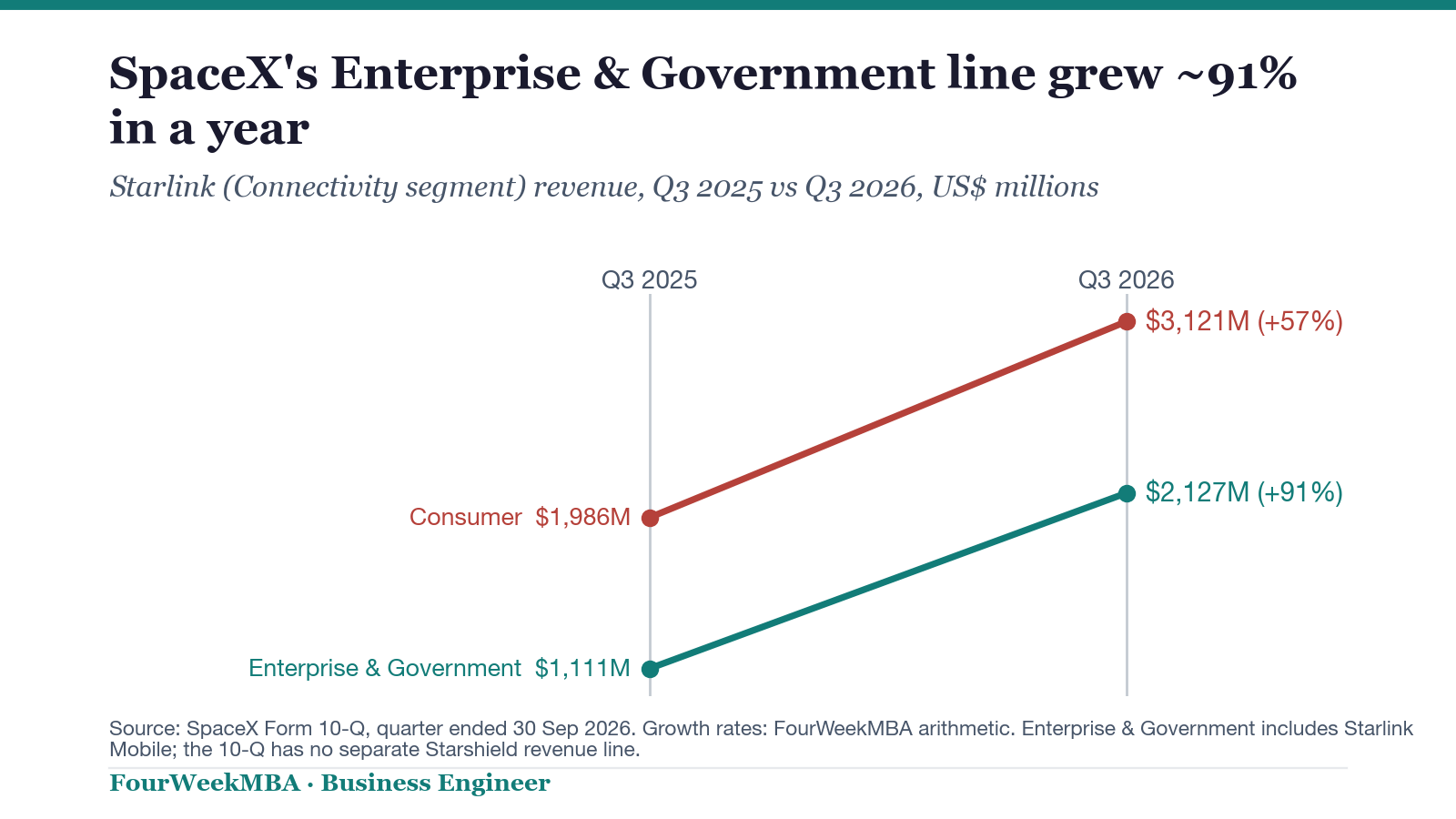
The key insight: Musk says Starshield’s limits are the US military’s call and Starlink is a commercial service not meant for offensive operations; Zelenskyy says restrictions remain and hamper air defence, and the Wall Street Journal reported Musk ordered the slowdown. SpaceX’s Enterprise & Government line grew about 91% in a year, by our arithmetic.
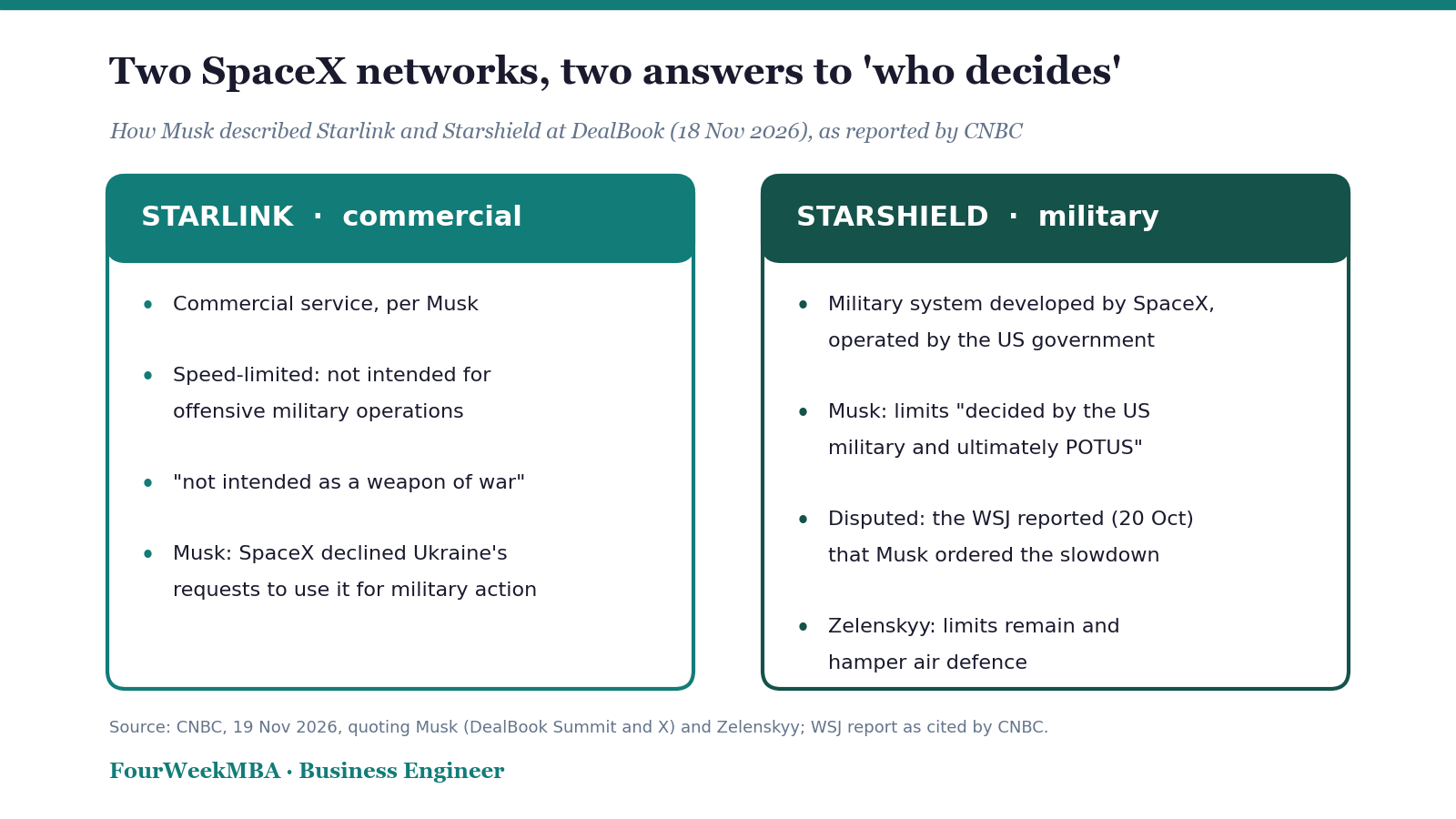
Musk drew a line between two SpaceX networks. Starlink is the commercial service; Starshield is a military system developed by SpaceX and operated by the US government, as CNBC described it.
“Any action taken by Starshield is up to the War Department. Starlink is commercial and is not intended as a weapon of war”, Musk said, per CNBC. He said Starlink is speed-limited because it is not meant for offensive operations, which should use Starshield instead.
He added: “Zelenskyy is actually asking to use the Starlink commercial satellites for events of military actions, and we have declined to do so”.
SpaceX’s Starlink Enterprise & Government revenue rose to $2.127 billion in Q3 2026 from $1.111 billion, about 91%; Consumer rose about 57% (our arithmetic). The 10-Q does not break out Starshield.
What Zelenskyy Said
Zelenskyy said on Wednesday that speed restrictions remained in place on Starshield, hampering Ukraine’s ability to intercept Russian missile and drone strikes, CNBC reported. “We are discussing this with the American side”, he said.
How Musk described the two networks at DealBook, as reported by CNBC: Starlink commercial and speed-limited; Starshield limits, he says, set by the US military. The WSJ reported Musk ordered the slowdown.
The October Record
In October, Musk wrote on X that “Starshield systems are owned and controlled by the U.S. government. Any limits on speed or usage are decided by the US military and ultimately POTUS” (Musk on X).
The Wall Street Journal later reported, on 20 October, that Musk had ordered the slowdown, citing US officials and people familiar with the matter, according to CNBC. Musk’s account and the Journal’s report conflict; we have not seen documents that settle it.
On 24 October, Musk said SpaceX had restricted Ukraine’s Starlink access for offensive drone strikes, a claim Ukrainian officials disputed, CNBC reported. “That loophole was closed last week”, he wrote on X (Musk on X; our report).
What the 10-Q Shows
SpaceX’s quarterly filing does not report Starshield as its own line. It says SpaceX recognises revenue over time “for certain contracts related to our Starshield business that are multi-year in nature” (SpaceX 10-Q).
Its Connectivity segment splits Starlink revenue into Consumer and Enterprise & Government. Enterprise & Government revenue was $2.127 billion in the third quarter, up from $1.111 billion a year earlier: about 91% growth, by our arithmetic.
Consumer revenue rose to $3.121 billion from $1.986 billion, about 57%. Enterprise & Government was about 41% of Connectivity revenue in the quarter, by our arithmetic. The filing says that line includes Starlink Mobile.
Starlink consumer subscribers reached 13.6 million at 30 September, from 7.2 million a year earlier, the filing says. For the full SpaceX revenue mix, see How SpaceX Makes Money.
The Structural Read
As we read it, the dispute is as much about who owns the decision as about speed: Musk places it with the US military, Ukraine’s account places the effect on its air defence.
As we read the 10-Q, the commercial and government sides of Starlink already sit on separate revenue lines, which makes the split Musk described a business distinction as well as a policy one.
“Any action taken by Starshield is up to the War Department. Starlink is commercial and is not intended as a weapon of war.”
Three Implications
FOR GOVERNMENTS BUYING SATELLITE LINKS Musk says Starshield limits are decided by the US military, while Starlink is commercial and speed-limited.
FOR SPACEX INVESTORS Enterprise & Government revenue was $2.127 billion in Q3, about 41% of Connectivity revenue (our arithmetic).
FOR UKRAINE Zelenskyy says the restrictions hamper interception of Russian missile and drone strikes and are under discussion with the US.
What Is Not Established
Who ordered or approved the Starshield limits is disputed: Musk says the US military, while the Journal reported Musk ordered the slowdown. Ukraine had not responded to CNBC. The 10-Q does not break out Starshield revenue or name Ukraine-related contracts.
This Week In The AI Supercycle
AI Lost Its Central Banker, the Lab Oligopoly, and the Future of Open Source
This week’s issue: the Nvidia leadership change, read as the AI build-out losing its central banker: who now finances the GPU landlords, backstops the data centres and sponsors open models, and why two labs are becoming the bank.
At DealBook, Musk said Starshield limits are up to the US military and that Starlink is not a weapon of war, calling Zelenskyy not always truthful. In SpaceX’s books, the Enterprise & Government line that sits beside consumer Starlink grew about 91% in a year, by our arithmetic.
A note on sourcing. Musk’s DealBook remarks, his X posts, Zelenskyy’s statement, the Wall Street Journal’s 20 October report and the requests for comment are as reported by CNBC on 19 November; we did not read the Journal’s article. The revenue, subscriber and Starshield revenue-recognition lines are from SpaceX’s 10-Q for the quarter ended 30 September 2026. The 91%, 57% and 41% are our arithmetic.
Gennaro Cuofano is a CRO and tech executive who has worked in AI since late 2015, starting with bringing NLP, natural-language generation, voice and chatbot products to the marketing industry. His background is in law and finance: he holds a Master's degree in Law and an International MBA with an emphasis on corporate finance (LUISS Business School and the University of San Diego, 2012), and worked as a financial analyst at a real-estate investment firm in San Diego and as an assistant controller. His work focuses on business model strategy, business engineering and, more broadly, structural analysis: how companies make money, read from their own filings. He created FourWeekMBA and leads research there and at The Business Engineer, his newsletter on AI and business strategy, with over 95,000 subscribers and more than 1,000 published analyses. His writing has also appeared on Entrepreneur (for example, How to Digitize a Family Business in Europe) and HackerNoon. Find him on LinkedIn and Substack. See how we source.