US export rules on AI chips now cover renting them, not just buying them. A Commerce Department rule in force since 19 November 2026 requires a licence for data centres anywhere that give large amounts of computing power to companies headquartered in China, Macau or other countries in Country Group D:5, as we reported.
It also requires a licence to ship advanced AI chips to Indonesia, Malaysia, Singapore, Thailand or Brazil. This explainer covers what the rules control, who they reach, how chips allegedly slip through, and the dates to watch.
We track where AI data centres are being built, and the fights around them, on our AI data centre map.
Business Pill: Sovereign AI Explained
An evergreen Business Engineer explainer on who controls technology infrastructure. It teaches the general idea only and does not discuss this rule.
The key insight: Since 19 November 2026 a US licence is needed for data centres anywhere that give more than 12,000,000 aggregate TPP of computing to companies headquartered in China, Macau or other D:5 countries, and for advanced-chip shipments to Indonesia, Malaysia, Singapore, Thailand and Brazil, per the Federal Register.
The US limits who can receive its most advanced AI chips. The rules are written by the Commerce Department’s Bureau of Industry and Security (BIS) and set out in the Export Administration Regulations.
Until this month, the main question was where a chip was shipped. BIS says cloud computing has made it “increasingly possible to access advanced American computing capabilities remotely, including through data centers located outside countries subject to U.S. export restrictions”, in its press release.
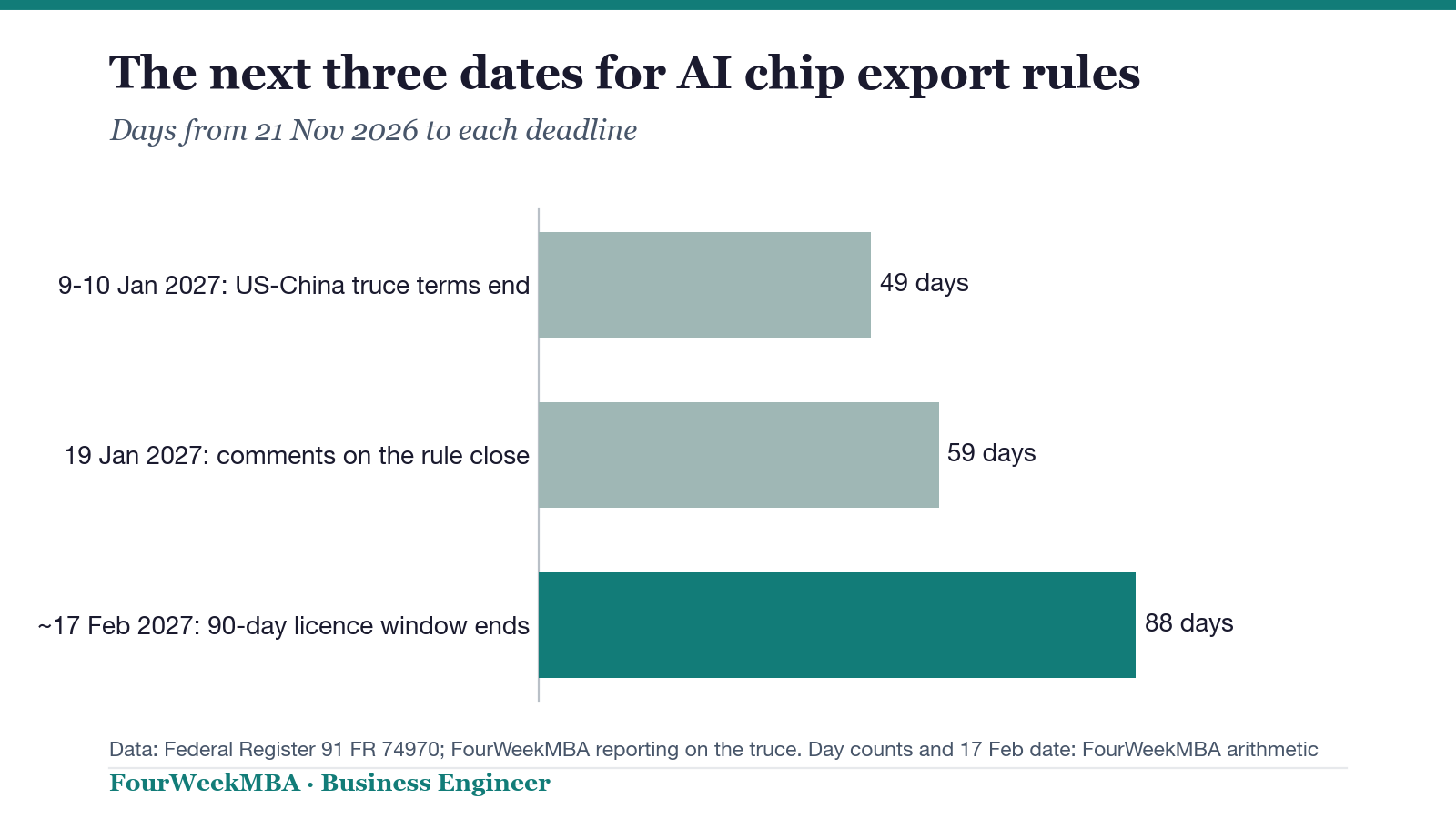
Days from 21 November 2026 to the truce terms ending (9 or 10 January), the rule’s comment deadline (19 January) and the end of the 90-day licence window for existing operators (about 17 February), our arithmetic.
What Changed on 19 November 2026?
The new interim final rule, published in the Federal Register as 91 FR 74970, does two main things.
First, it covers remote access. The rule bars knowingly supplying covered chips, without a licence, to a data centre anywhere in the world that provides more than 12,000,000 “aggregate TPP” of access to companies headquartered in Macau or a Country Group D:5 destination, including China. TPP, total processing performance, is the rule’s measure of chip power, and the total counts linked data centres together.
Second, it adds a licence requirement for shipping advanced chips to Indonesia, Malaysia, Singapore, Thailand and Brazil, which the rule calls countries with “a higher-than-normal risk of diversion”.
Who Is Exempt?
The licence for the five countries does not apply to chips going to companies headquartered in the United States, or whose ultimate parent is, provided the exporter files the required reports, including monthly reports to BIS.
The remote-access licence does not apply to “commercial recommender systems”, such as those used by online retailers and social media companies, the rule says.
What About Data Centres Already Renting to Chinese Firms?
Operators that were already supplying large volumes of computing to such companies before the rule must obtain a licence within 90 days of 19 November or face future export restrictions, the rule says. That is 17 February 2027, by our arithmetic.
What Is the Entity List?
The Entity List names companies that need a US licence to receive controlled items. The server maker Inspur Group was added effective 2 March 2023, and six Inspur subsidiaries were added on 28 March 2025, the Federal Register shows.
How Do Restricted Chips Allegedly Reach China?
The Financial Times traced an alleged route through Inspur’s renamed US arm, a Singapore-based buyer called Megaspeed and a sanctioned Cambodian network, as we reported. Megaspeed’s Malaysian unit declared about $4.6 billion of imports in a year, the FT reported, and Nvidia said it had put Megaspeed on its block list in 2025. Megaspeed says it runs a lawful business.
Trade data point the same way, but do not prove it. China recorded $3.75 billion of server imports from Malaysia between April 2024 and June 2025, while Malaysia recorded $0.6 billion of exports to China, Epoch AI found. Epoch says the gap is “consistent with” smuggling, but that trade data “alone does not prove smuggling”.
Who Is Affected Already?
Malaysian data-centre firms MN Holdings and Critical Holdings fell nearly 20% on 17 November after the rule was announced, Reuters reported, and a Thai industry group said Chinese users had stopped renting computing power there.
China’s Moonshot AI scrapped a $150 million deal to rent Nvidia Blackwell chips through a data centre in Indonesia after the rule, The Information reported.
What Dates Matter Next?
Four key terms of the US-China trade truce end on 9 or 10 January 2027, as we reported. Comments on the new rule close on 19 January 2027, according to the Federal Register. The 90-day licence window for existing operators ends around 17 February 2027, by our arithmetic.
The Structural Read
As we read it, the rule moves the border from the port to the server: what matters now is who uses the computing, not only where the chip sits.
As we read it, the 90-day window makes 17 February 2027 the practical deadline for data centres in the region that rent to Chinese firms.
BIS press release, 16 Nov 2026
“This IFR addresses this evolving technological landscape by further aligning protections governing remote access to advanced computing capabilities with existing controls on the physical shipment of sensitive American technology.”
Three Implications
FOR DATA-CENTRE OPERATORS Renting large volumes of computing to companies headquartered in China, Macau or other D:5 countries now needs a licence, per the rule.
FOR CHIP BUYERS IN FIVE COUNTRIES Advanced-chip shipments to Indonesia, Malaysia, Singapore, Thailand and Brazil need a licence, unless the buyer is US-headquartered and reports.
FOR INVESTORS The rule names 19 January 2027 for comments, and existing operators have 90 days to get licensed.
What Is Not Established
The rule is an interim final rule, open for comment, and BIS can change it. How many data centres and how much computing it covers has not been published, and the smuggling accounts rest on reporting and trade data, not court findings.
This Week In The AI Supercycle
A World Without an Order, and an AI Central Bank Without a Successor
This week’s issue: the week AI memory stayed largely sold out while the people holding the shares paid: why the AI Supercycle is not a dot-com replay, read through geopolitics, macro and technology, with the gap between building and financing the widest we’ve recorded.
Since 19 November 2026, US export rules cover renting AI chips as well as buying them: data centres serving companies headquartered in China, Macau or other D:5 countries above 12,000,000 aggregate TPP need a licence, and shipments to five countries need one too.
Since 19 November 2026, a US licence is needed to supply advanced AI chips to data centres anywhere that give more than 12,000,000 aggregate TPP of computing to companies headquartered in China, Macau or other Country Group D:5 countries. Shipments of advanced chips to Indonesia, Malaysia, Singapore, Thailand and Brazil also need a licence.
Who is exempt?
The licence for the five countries does not apply to chips for companies headquartered in the United States, or whose ultimate parent is, if the exporter files the required reports, including monthly reports. The remote-access rule does not apply to commercial recommender systems.
What happens to data centres already renting to Chinese firms?
Operators already supplying large volumes of computing to such companies before the rule must obtain a licence within 90 days of 19 November 2026, or face future export restrictions. That is about 17 February 2027.
What is the Entity List?
It is a US list of companies that need a licence to receive controlled items. Inspur Group was added effective 2 March 2023, and six Inspur subsidiaries were added on 28 March 2025, according to the Federal Register.
A note on sourcing. The rule’s terms, exemptions, 90-day window and comment deadline are from the Federal Register text and BIS. The Inspur listings are from the Federal Register. The alleged smuggling route is the FT’s reporting, the trade gap is Epoch AI’s analysis, the market moves are Reuters’ and the Moonshot deal is The Information’s, each as we reported them. The 17 February 2027 date is our arithmetic.
Gennaro Cuofano is a CRO and tech executive who has worked in AI since late 2015, starting with bringing NLP, natural-language generation, voice and chatbot products to the marketing industry. His background is in law and finance: he holds a Master's degree in Law and an International MBA with an emphasis on corporate finance (LUISS Business School and the University of San Diego, 2012), and worked as a financial analyst at a real-estate investment firm in San Diego and as an assistant controller. His work focuses on business model strategy, business engineering and, more broadly, structural analysis: how companies make money, read from their own filings. He created FourWeekMBA and leads research there and at The Business Engineer, his newsletter on AI and business strategy, with over 95,000 subscribers and more than 1,000 published analyses. His writing has also appeared on Entrepreneur (for example, How to Digitize a Family Business in Europe) and HackerNoon. Find him on LinkedIn and Substack. See how we source.