An organizational structure is the formal design of a company: how work is split into units, who reports to whom, and where decisions are made. The three common forms are functional (grouped by expertise), divisional (grouped by product, customer or region) and matrix (both at once, with two reporting lines). The research goes back to Tom Burns and G. M. Stalker, whose 1961 study contrasted rigid “mechanistic” firms with flexible “organic” ones, and to Henry Mintzberg, who grouped real structures into five configurations.
Every structure first splits the job into specialised tasks, then groups those tasks into teams and units.
02
Choose the grouping
Group by function for depth and efficiency, by product or region for speed close to the customer, or both in a matrix when the company needs depth and speed at once.
03
Coordinate the units
Units are joined by supervision, shared rules and direct contact between peers. Mintzberg's five configurations differ mainly in which of these does the work.
04
Match it to uncertainty
Burns and Stalker found that stable markets suit mechanistic, rule-based firms, while fast-changing ones suit organic firms with looser roles and more lateral contact.
Where you see it today
Fewer layers at Amazon
In a memo of 16 September 2024, Andy Jassy asked each senior-team organisation to raise its ratio of individual contributors to managers by at least 15% by the end of Q1 2025, to remove layers. In June 2025 he wrote that generative AI should reduce Amazon’s total corporate workforce over the next few years.
AI labs folded into one unit
In April 2023 Google merged the Brain team from Google Research with DeepMind into a single unit, Google DeepMind. In March 2024 Microsoft created a new organisation, Microsoft AI, led by Mustafa Suleyman and reporting to the CEO. Both moves pulled scattered AI work into one line of command.
AI as a teammate
A field experiment with professionals at Procter & Gamble (Dell’Acqua et al., 2025) found that individuals working with AI matched the performance of two-person teams without it, and that AI helped R&D and commercial staff produce more balanced ideas. The authors read this as AI cutting across functional silos.
Information, not boxes
Galbraith (1974) argued that a structure exists to process information under uncertainty: firms either reduce the information they need or add capacity through information systems and lateral links. AI assistants and agents add that capacity, which is one reason companies are revisiting how many managers they need to pass information along.
Organizational structures compared
Functional
Grouped byExpertise (sales, engineering, finance)
Best whenOne main product and a stable market
Divisional
Grouped byProduct, customer or region
Best whenSeveral businesses that need their own P&L
Matrix
Grouped byFunction and product at once, two bosses
Best whenProjects need both deep skills and speed
Flat
Grouped byFew or no middle layers
Best whenSmall teams that must decide fast
Network / lattice
Grouped byDirect lines between people and teams
Best whenWork is project-based and changes often
How to use it
Write down the three decisions that matter most to your strategy, then check which box on the chart actually makes each one.
Count the hops a customer request takes to reach the person who can act on it; every hop is a candidate for removal.
Use a matrix only if you also write down who breaks ties between the two bosses.
Before cutting a management layer, list the information those managers pass along and decide what will carry it instead, a system, an AI tool or a peer link.
Review the structure when strategy changes, not on a fixed calendar.
The Business Engineer lens
AI lowers the cost of moving information inside a company, and much of middle management existed to move information. The Business Engineer reads the current wave of flattening as structure catching up with that cost change, not as a fashion.
What are the main types of organizational structure?
The common types are functional, divisional and matrix, with flat and network (lattice) structures as further variants. Most large companies mix them.
What is the difference between a functional and a divisional structure?
A functional structure groups people by expertise, such as marketing or engineering; a divisional structure groups them by product, customer or region, each with its own functions.
Which organizational structure is best?
None is best in general. Burns and Stalker's research suggests rule-based structures suit stable markets and looser, more lateral ones suit fast-changing markets.
How is AI changing organizational structure?
Companies such as Amazon have cut management layers and Google and Microsoft have pulled AI work into single units; experiments also suggest AI can do part of the work of a teammate.
Correction (10 Oct 2026): an earlier section on this page showed unsourced figures; it has been removed.
Last Updated: April 2026
An organizational structure allows companies to shape their business model according to several criteria (like products, segments, geography, and so on) that would enable information to flow through the organizational layers for better decision-making, cultural development, and goal alignment across employees, managers, and executives.
Functional, divisional and matrix structures are the three primary organizational frameworks that define how companies arrange teams, reporting relationships, and workflow. Functional structures group employees by expertise, divisional structures organize by product or market, and matrix structures combine both approaches with dual reporting lines.
Introduction to organizational design
Understanding the organizational structure of a company allows an understanding of how decisions are made. It is also a powerful tool for executives to shape their organization toward desired goals and long-term objectives.
For that sake, designing a proper organizational structure also allows the execution of a company’s business model. Based on the organizational structure the company will also have a different shape.
For instance, some organizations are typically hierarchic, which implies a top-down approach of information flow and definition of roles.
Key Highlights:
Organizational Structure’s Importance: An organizational structure allows companies to design their business model based on criteria such as products, segments, and geography. It enables information flow, decision-making, culture development, and goal alignment across employees, managers, and executives.
Understanding Decision-Making: Organizational structure provides insights into how decisions are made within a company and aids executives in shaping their organization toward desired goals and long-term objectives.
Impact on Business Model Execution: A proper organizational structure enables the execution of a company’s businessmodel, leading to various organizational shapes.
Benefits of Organizational Structure: Organizational structure is critical for defining roles, aligning goals, developing culture, optimizing productivity, efficient resource allocation, and facilitating information flow for better decision-making.
Consequences of Lacking Structure: Absence of a proper organizational structure can hinder efficient growth, lead to employee confusion about roles, impede top-level understanding of the company, and create accountability issues.
Centralized vs. Decentralized Structures: Organizations can be centralized or decentralized. Centralized structures involve top-down information flow, while decentralized structures aim for agility and flexibility through nonlinear information flow.
Types of Organizational Structures: Different organizational structures include functional (bureaucratic), divisional (based on projects or products), matrix (blending functional and divisional), flatarchy (reduced middle management), and others that balance hierarchy and flexibility.
Holacracy: Holacracy is a managementstrategy where decision-making power is distributed throughout an organization, emphasizing self-organization and collaborative work toward common goals.
Flattening Structures: Flattening organizational structures, as seen in startups, can enhance communication and agility. However, as companies grow, they often transition back to more hierarchical structures to manage scale effectively.
Business Model Alignment: Aligning organizational structure and business model is crucial for building a culture aligned with long-term goals and ensuring business model viability.
Moonshot Thinking: Encouraging innovation through “moonshot thinking” involves pursuing ambitious, unconventional goals, even if they don’t align with the core businessmodel. Small innovation units can explore these opportunities.
Intrapreneurship: Intrapreneurship involves empowering employees to act as entrepreneurs within the organization, fostering innovation and creative solutions.
Centralization vs. Decentralization Debate: Organizations often adopt a hybrid approach, centralizing certain aspects while decentralizing others to strike a balance between efficient operations and flexibility.
INTERACTIVE MAPFree Tool
The AI Ecosystem Map — May 2026
AI is reshaping how companies organize. Explore the interactive map showing how the 7-layer AI stack forces new structures.
Description. Organizes employees based on their functional roles and expertise. Departments are specialized, and decision-making is centralized.
Example.IBM uses a functional structure with distinct divisions for sales, marketing, research, and development, led by experts in each field.
Divisional Structure
Description. Groups employees into self-contained divisions, each responsible for its own functions, products, or geographic regions.
Example.Procter & Gamble (P&G) employs a divisional structure with divisions for beauty, grooming, healthcare, and other product categories.
Matrix Structure
Description. Combines functional and divisional structures, allowing employees to work under multiple managers and across different projects or teams.
Example.Microsoft utilizes a matrix structure, with employees reporting to both functional managers and project managers.
Flat Structure
Description. Has few or no middle managers, with a focus on employee empowerment and decision-making authority pushed to lower levels.
Example.Zappos, an Amazon subsidiary, employs a flat structure, encouraging employees to self-organize and make decisions collectively.
Network Structure
Description. Relies on strategic alliances and partnerships with external organizations to perform key functions. The core organization is small and focuses on coordination.
Example.Alibaba Group operates using a network structure, connecting a vast network of businesses and partners through its platforms.
Team-Based Structure
Description. Teams or self-managed workgroups are central to the organization, and employees collaborate to achieve common goals.
Example. In a team-based structure, employees work in self-managing teams without formal hierarchy.
Holacracy
Description. Employs a decentralized approach with self-organizing teams and no traditional managers. Instead, roles and responsibilities are defined by “circles.”
Example.Buffer, a social media management company, adopted holacracy to promote transparency and employee empowerment.
Hybrid Structure
Description. Combines elements of multiple organizational structures to meet specific needs, often resulting in a unique design.
Example.General Electric (GE) has experimented with hybrid structures, blending elements of functional, divisional, and matrix structures.
Connected · Organizational Structure of a Company
Where to go next from Organizational Structure of a Company
Picked for this page by topic. Every link checked live.
The topic field in your request is empty—there’s nothing between “article about” and the period. Could you tell me what business strategy topic this section should address? For example: pricing strategy, supply chain, competitive moats, go-to-market, M&A, etc.
Once you share the topic, I’ll write a specific 100-150 word section with a concrete example or trend rather than generic AI commentary.
Management functions within startups are critical to scale up the team and enable the company to find a businessmodel/market fit at wider and wider scales through planning, management, and leading the organizations toward those goals.
Market orientation is an approach to business where the company focuses more on the behaviors, wants, and needs of customers in its market. A company will first target a niche market to prove a commercial use case. And from there, it will create options to scale.
Project portfolio management (PPM) is a systematic approach to selecting and managing a collection of projects aligned with organizational objectives. That is a business process of managing multiple projects which can be identified, prioritized, and managed within the organization. PPM helps organizations optimize their investments by allocating resources efficiently across all initiatives.
Critical differences between project management and program management comprise:
1. Scope: as project managers focus on specific projects, program managers coordinate a portfolio of projects.
2. Objectives: where project managers focus on delivering a project timeline, the program manager optimizes for the achievement of multiple projects at a time.
3: stakeholders: project manager work with specific stakeholders to deliver the project. While program managers might work with multiple stakeholders.
4 Timeframe: project managers might be focused on short-term goals, whereas program managers might be more aligned on long-term objectives as they have to ensure success on multiple projects.
Product management has become a key role within most organizations and startups as it combines product development with experimentation to create a successful product in the market. Product management requires a combination of strategic thinking, problem-solving skills, and a relentless focus on customer needs and delivering the right product at the right time. Top product managers use a customer obsession approach to build and launch successful products.
Harvard Business School professor Dr. John Kotter has been a thought-leader on organizational change, and he developed Kotter’s 8-step change model, which helps business managers deal with organizational change. Kotter created the 8-step model to drive organizational transformation.
The Nadler-Tushman Congruence Model was created by David Nadler and Michael Tushman at Columbia University. The Nadler-Tushman Congruence Model is a diagnostic tool that identifies problem areas within a company. In the context of business, congruence occurs when the goals of different people or interest groups coincide.
McKinsey’s Seven Degrees of Freedom for Growth is a strategy tool. Developed by partners at McKinsey and Company, the tool helps businesses understand which opportunities will contribute to expansion, and therefore it helps to prioritize those initiatives.
Mintzberg’s 5Ps of Strategy is a strategy development model that examines five different perspectives (plan, ploy, pattern, position, perspective) to develop a successful business strategy. A sixth perspective has been developed over the years, called Practice, which was created to help businesses execute their strategies.
The COSO framework is a means of designing, implementing, and evaluating control within an organization. The COSO framework’s five components are control environment, risk assessment, control activities, information and communication, and monitoring activities. As a fraud risk management tool, businesses can design, implement, and evaluate internal control procedures.
The TOWS Matrix is an acronym for Threats, Opportunities, Weaknesses, and Strengths. The matrix is a variation on the SWOT Analysis, and it seeks to address criticisms of the SWOT Analysis regarding its inability to show relationships between the various categories.
Lewin’s change management model helps businesses manage the uncertainty and resistance associated with change. Kurt Lewin, one of the first academics to focus his research on group dynamics, developed a three-stage model. He proposed that the behavior of individuals happened as a function of group behavior.
Porter’s Five Forces is a model that helps organizations to gain a better understanding of their industries and competition. Published for the first time by Professor Michael Porter in his book “Competitive Strategy” in the 1980s. The model breaks down industries and markets by analyzing them through five forces
You can use the Ansoff Matrix as a strategic framework to understand what growthstrategy is more suited based on the market context. Developed by mathematician and business manager Igor Ansoff, it assumes a growthstrategy can be derived by whether the market is new or existing, and the product is new or existing.
The Blitzscaling business model canvas is a model based on the concept of Blitzscaling, which is a particular process of massive growth under uncertainty, and that prioritizes speed over efficiency and focuses on market domination to create a first-scaler advantage in a scenario of uncertainty.
Business analysis is a research discipline that helps drive change within an organization by identifying the key elements and processes that drive value. Business analysis can also be used in Identifying new business opportunities or how to take advantage of existing business opportunities to grow your business in the marketplace.
A gap analysis helps an organization assess its alignment with strategic objectives to determine whether the current execution is in line with the company’s mission and long-term vision. Gap analyses then help reach a target performance by assisting organizations to use their resources better. A good gap analysis is a powerful tool to improve execution.
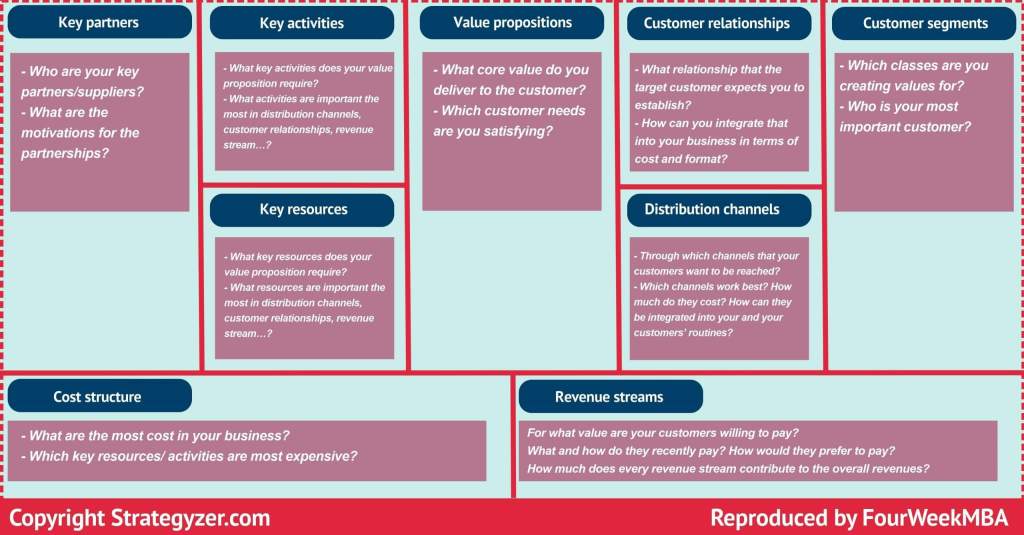
The business model canvas is a framework proposed by Alexander Osterwalder and Yves Pigneur in Busines Model Generation enabling the design of business models through nine building blocks comprising: key partners, key activities, value propositions, customer relationships, customer segments, critical resources, channels, cost structure, and revenue streams.
The lean startup canvas is an adaptation by Ash Maurya of the business model canvas by Alexander Osterwalder, which adds a layer that focuses on problems, solutions, key metrics, unfair advantage based, and a unique value proposition. Thus, starting from mastering the problem rather than the solution.
A digital channel is a marketing channel, part of a distributionstrategy, helping an organization reach its potential customers via electronic means. There are several digital marketing channels, usually divided into organic and paid channels. Some organic channels are SEO, SMO, and email marketing. And some paid channels comprise SEM, SMM, and display advertising.
A blue ocean is a strategy where the boundaries of existing markets are redefined, and new uncontested markets are created. At its core, there is valueinnovation, for which uncontested markets are created, where competition is made irrelevant. And the cost-value trade-off is broken. Thus, companies following a blue ocean strategy offer much more value at a lower cost for the end customers.
Gennaro Cuofano is a CRO and tech executive who has worked in AI since late 2015, starting with bringing NLP, natural-language generation, voice and chatbot products to the marketing industry. His background is in law and finance: he holds a Master's degree in Law and an International MBA with an emphasis on corporate finance (LUISS Business School and the University of San Diego, 2012), and worked as a financial analyst at a real-estate investment firm in San Diego and as an assistant controller. His work focuses on business model strategy, business engineering and, more broadly, structural analysis: how companies make money, read from their own filings. He created FourWeekMBA and leads research there and at The Business Engineer, his newsletter on AI and business strategy, with over 95,000 subscribers and more than 1,000 published analyses. His writing has also appeared on Entrepreneur (for example, How to Digitize a Family Business in Europe) and HackerNoon. Find him on LinkedIn and Substack. See how we source.



 The Business Engineer readThe Great AI Flattening We are witnessing the most significant transformation in organizational structure since the Industrial Revolution.Read on businessengineer.ai →