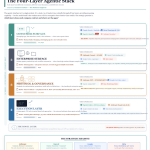
In every technological revolution, there comes a moment when the core innovation—no matter how groundbreaking—becomes familiar enough to commoditize. In AI, that moment is arriving faster than anyone anticipated. Foundation models, once the most defensible layer of the stack, are beginning to flatten. Model quality converges. Benchmarks compress. Frontier breakthroughs matter less to users than availability, reliability, and cost.
When the intelligence layer commoditizes, the fight naturally shifts toward the pipes: the infrastructure layer. Inference, deployment, routing, optimization, hardware access, and latency engineering—these become the new arenas of competitive advantage.
This isn’t a theory. It’s visible everywhere across the 2025 unicorn landscape. In fact, the entire shift aligns perfectly with the broader structural analysis I published in This Week in Business AI: The 2025 Market Structure Edition (https://businessengineer.ai/p/this-week-in-business-ai-the-2025), where infrastructure emerges as the most strategically important layer in the stack.
Here’s the deeper, more mechanical explanation of why infrastructure is becoming the new battleground—and what happens next.
1. Why Infrastructure Suddenly Matters More Than Models
The infrastructure layer benefits from three compounding forces that foundation models cannot escape.
1. Models are commoditizing faster than anyone expected
We are already seeing convergence:
Open-source LLMs increasingly match closed models on core reasoning
Fine-tuning narrows gaps even further
Benchmarks lose relevance as real-world behavior becomes the evaluation standard
Once foundation models hit diminishing returns, differentiation shifts downward to the layers responsible for reliability and cost.
2. Inference costs grow 10× faster than training costs over time
This is the overlooked economic truth. Training is expensive. But inference is relentless.
Every query incurs marginal cost. At global scale, inference becomes the dominant cost center—by an order of magnitude.
This is why the infrastructure players like Fireworks, Baseten, Modal, and Modular are suddenly commanding multi-billion-dollar valuations. They are attacking the place where customers actually feel the economic pressure.
3. Whoever controls the pipes controls the margins
This is the same dynamic that played out in cloud computing. AWS, Azure, and GCP didn’t win because they built the best software—they won because they controlled resource allocation, deployment primitives, and compute economics.
Infrastructure is power because infrastructure is dependency.
And dependency compounds.
2. The Stakes: A $50B+ Inference Market with 70% Margins
By 2027, the inference market alone will exceed $50B+, with gross margins as high as 70% for the players who win developer adoption and enterprise workloads.
This is not an incremental shift. It is a migration of value away from the intelligence layer and toward the operational layer.
The “new cloud wars” are happening right now—just with different primitives:
Not virtual machines, but GPU clusters
Not storage buckets, but token throughput
Not autoscaling groups, but model routing
Not SLAs for uptime, but SLAs for responsiveness and hallucination control
The firms that master these primitives will control the economics of AI.
3. The Infrastructure Battleground: Three Power Centers
The infrastructure battleground breaks into three domains, each with its own competitive logic.
1. Inference Providers
These are the companies optimizing:
Throughput
Latency
Cost per token
Dynamic routing
Multi-model ensembles
Players like Fireworks, Baseten, Modal, and Together AI are invading territory once protected by hyperscalers.
2. GPU Access and Allocation
This is where power consolidates. Whoever controls the GPUs controls the economics.
The GPU bottleneck is not just a short-term supply issue. It’s structural:
Pick your niche and move before consolidation hits. You won’t outscale hyperscalers—but you can build a wedge around:
inference optimization
GPU scheduling
latency engineering
routing
observability
Specialization beats generalization.
For Hyperscalers:
Acquire or be disrupted at the edges. The infrastructure challengers are moving too fast. Unless you integrate vertically and price more aggressively, you risk losing developers to specialized providers.
For Enterprises:
Multicloud AI is inevitable—plan now. Infrastructure failure is not theoretical. Enterprises need redundancy across:
clouds
GPUs
inference providers
model endpoints
It’s not about cost optimization—it’s about resilience.
The Bottom Line: Infrastructure Is the New Economic Engine of AI
The intelligence layer may attract the headlines. But the infrastructure layer will determine the winners.
Who controls the pipes controls the margins. And who controls the margins controls the future of the AI economy.
Gennaro is the creator of FourWeekMBA, which reached about four million business people, comprising C-level executives, investors, analysts, product managers, and aspiring digital entrepreneurs in 2022 alone | He is also Director of Sales for a high-tech scaleup in the AI Industry | In 2012, Gennaro earned an International MBA with emphasis on Corporate Finance and Business Strategy.