While a product manager focuses on ensuring a product fits the company’s overall business goals. A project manager ensures that the various projects within the organization are aligned with the business goals. Product and project managers often work hand in hand, however, with different goals, as the product manager oversees product development, whereas project managers oversee projects within the organization.
Scenario
Project Management
Product Management
Scope Definition
Focuses on defining the project scope, objectives, and deliverables to meet a specific goal or outcome.
Concentrates on defining the product vision, features, and roadmap to create a valuable and marketable product.
Time Management
Emphasizes project schedules, timelines, and milestones to ensure timely project completion.
Prioritizes feature development and release schedules to meet product launch and market deadlines.
Resource Allocation
Allocates resources, including people, budget, and materials, to complete the project on time and within budget.
Allocates resources, such as development teams, designers, and marketing, to create and market the product effectively.
Risk Assessment
Identifies and mitigates risks associated with project execution, such as scope changes or resource constraints.
Assesses risks related to product development, market competition, and changing customer needs.
Stakeholder Management
Manages project stakeholders, including clients, team members, and sponsors, to ensure their needs are met.
Collaborates with cross-functional teams, including engineering, design, and marketing, to deliver a successful product.
Project Documentation
Maintains project documentation, including project plans, Gantt charts, and progress reports.
Creates product documentation, such as product requirements, user stories, and feature specifications.
Quality Assurance
Ensures the project meets predefined quality standards and objectives through testing and validation.
Ensures the product aligns with quality standards and user expectations through testing and user feedback.
Change Management
Manages changes to the project scope or requirements, ensuring they are documented, evaluated, and approved.
Accommodates changes in product features, requirements, or priorities based on market feedback and evolving needs.
Project Closure
Closes the project upon completion, finalizing documentation, delivering results, and conducting post-project reviews.
Continuously evaluates and improves the product throughout its lifecycle, from inception to end-of-life.
Customer Feedback
May collect feedback from project stakeholders, but it primarily focuses on project-specific outcomes.
Actively gathers and incorporates customer feedback to enhance the product’s features, usability, and value.
Market Research
Typically involves minimal market research unless the project is part of a larger product development effort.
Conducts extensive market research to identify market opportunities, customer needs, and competitive landscape.
Product Strategy
Lacks a long-term product strategy, as the primary goal is to complete the project within defined constraints.
Develops and executes a comprehensive product strategy that guides the product’s direction and evolution over time.
Product Roadmap
Lacks a product roadmap, as the focus is on project-specific goals and milestones.
Maintains a product roadmap that outlines the product’s future direction, features, and enhancements.
Customer-Centric Approach
Primarily focuses on meeting the needs of project stakeholders and delivering the project successfully.
Prioritizes customer-centricity, aiming to create products that solve customer problems and deliver value.
Key Performance Indicators (KPIs)
Measures project success based on KPIs related to project completion, budget, and timeline adherence.
Measures product success based on KPIs related to user adoption, retention, revenue, and customer satisfaction.
Product Lifecycle
Not directly involved in the ongoing management of a product’s lifecycle beyond project completion.
Actively manages the entire product lifecycle, including planning, development, launch, and maintenance.
Market Launch
Typically does not oversee the market launch or go-to-market strategy of the project’s outcomes.
Leads the go-to-market strategy and product launch, including marketing, sales, and customer adoption efforts.
Role Specialization
Primarily involves project managers who specialize in overseeing project execution and delivery.
Involves product managers who specialize in defining and managing product strategy and development.
In the realm of business and product development, project management and product management are two distinct disciplines that play crucial roles in driving success. While they share some similarities in terms of goal orientation and stakeholder management, they differ significantly in their focus, scope, and methodologies. In this comprehensive analysis, we delve into the definitions, characteristics, key differences, and practical applications of project management and product management.
Project Management: Project management involves the application of knowledge, skills, tools, and techniques to deliver a unique product, service, or result within defined constraints. Projects are temporary endeavors undertaken to achieve specific objectives, such as creating a new product, implementing a system, or organizing an event. Project management encompasses various phases, including initiation, planning, execution, monitoring, and closure, to ensure successful project outcomes within constraints such as time, cost, quality, and scope.
Product Management: Product management focuses on the strategic planning, development, and lifecycle management of a product or service to meet customer needs and achieve business objectives. Product managers are responsible for defining the product vision, identifying market opportunities, prioritizing features, and guiding the product development process from conception to launch and beyond. Product management involves activities such as market research, product planning, roadmap development, and collaboration with cross-functional teams to deliver value to customers and drive businessgrowth.
Key Differences
Focus: Project management is focused on delivering a specific project with well-defined objectives, timelines, and deliverables. Product management, on the other hand, is concerned with managing the entire lifecycle of a product or service, from ideation to retirement, and involves ongoing iteration and improvement based on market feedback and business goals.
Scope: Project management deals with managing individual projects with defined scopes, budgets, and timelines. Product management, however, encompasses a broader scope that includes market analysis, product strategy, roadmap planning, feature prioritization, and ongoing product enhancements and updates.
Stakeholder Engagement: While both project management and product management involve stakeholder management, the focus differs. In project management, stakeholders are typically concerned with project delivery and outcomes. In product management, stakeholders include customers, users, executives, sales teams, and engineering teams, and the focus is on delivering value to customers and achieving strategic business objectives.
Outcome Orientation: Project management is outcome-oriented, with a focus on delivering specific project deliverables within constraints such as time, cost, and quality. Product management, on the other hand, is outcome-oriented in terms of delivering value to customers and achieving business objectives over the lifecycle of the product.
Constructing a building or infrastructure project.
Product Management Applications:
Developing a new software product or mobile application.
Managing an existing product portfolio and roadmap.
Conducting market research and customer interviews.
Defining product features, requirements, and priorities.
Conclusion
In conclusion, while project management and product management share some common goals and principles, they serve distinct purposes and operate at different levels of scope and complexity. Project management focuses on delivering specific projects within defined constraints, while product management is concerned with managing the entire lifecycle of a product or service to meet customer needs and achieve business objectives. By understanding the differences between project management and product management and applying the appropriate methodologies and practices to each context, organizations can effectively drive successful project and product outcomes and achieve strategic business goals in today’s competitive marketplace.
Related Frameworks, Models, Concepts
Description
When to Apply
Project Management
– The discipline of initiating, planning, executing, controlling, and closing the work of a team to achieve specific goals and meet specific success criteria. Typically used for temporary endeavors with defined beginnings and ends.
– Essential for managing discrete, time-bound initiatives like constructing a building, launching a new software, or organizing a marketing campaign.
Product Management
– A function within a business that involves planning, forecasting, production, or marketing of a product throughout its lifecycle. It focuses on delivering high-quality products that meet customer needs and achieve business goals.
– Applicable in businesses focused on product development and delivery, such as technology, consumer goods, or services, where ongoing product evolution and customer satisfaction are critical.
Program Management
– The coordinated management of multiple projects that are linked to the same overall strategic objective. It is broader than project management and aims to optimize resources across projects to achieve the business objectives.
– Suitable for organizations running multiple interconnected projects that need to be aligned with strategic goals, like software development or organizational change programs.
Portfolio Management
– The centralized management of one or more portfolios that include identifying, prioritizing, authorizing, managing, and controlling projects and programs to achieve strategic business objectives.
– Used by organizations to oversee all project and program efforts, ensuring they align with long-term business strategies and effectively use resources.
Agile Management
– An iterative approach to planning and guiding project processes. Agile methodologies involve continuous feedback and iterations at every stage of the project lifecycle.
– Effective in software development and other fields requiring flexibility, rapid iteration, and adaptiveness in planning and execution.
Operations Management
– The administration of business practices to create the highest level of efficiency possible within an organization. It involves managing the process that converts labor, materials, and energy into goods and services.
– Necessary for manufacturing, services, and other sectors where optimizing processes, maintaining quality, and improving efficiency are key to business performance.
Strategic Management
– The ongoing planning, monitoring, analysis, and assessment of all that is necessary for an organization to meet its goals and objectives.
– Critical in defining long-term goals, initiating corrective actions, and making cross-functional decisions that will achieve competitive advantage.
Change Management
– A systematic approach used to deal with the transition or transformation of an organization’s goals, processes, or technologies. The purpose is to implement strategies for effecting change, controlling change, and helping people adapt to change.
– Applied during times of significant change, such as post-merger integration, technology upgrades, or strategic pivots, to ensure smooth transitions.
Quality Management
– Ensuring that an organization, product, or service is consistent and efficient. It includes four main components: quality planning, quality assurance, quality control, and quality improvement.
– Utilized in industries where standards and procedures are in place to ensure products and services meet customer expectations reliably.
Risk Management
– The process of identifying, assessing, and controlling threats to an organization’s capital and earnings. These threats, or risks, could stem from a wide variety of sources, including financial uncertainty, legal liabilities, strategic management errors, accidents, and natural disasters.
– Essential in all sectors and at all levels of project and product development to anticipate potential threats and implement measures to mitigate them.
Project management is critical to any successful business venture, especially within startups. As the project manager, you will be responsible for developing and executing plans that ensure goals are met efficiently. You must also assess risks and anticipate issues to ensure projects move forward without interruption.
Product management has become a key role within most organizations and startups as it combines product development with experimentation to create a successful product in the market. Product management requires a combination of strategic thinking, problem-solving skills, and a relentless focus on customer needs and delivering the right product at the right time. Top product managers use a customer obsession approach to build and launch successful products.
Similarities between Product Management and Project Management:
Goal-Oriented: Both product management and project management are focused on achieving specific goals. While product managers aim to develop successful products that meet customer needs, project managers aim to ensure that projects are completed on time and within budget.
Cross-Functional Collaboration: Both roles require collaboration with various teams and stakeholders. Product managers work with engineering, design, marketing, and sales teams, while project managers collaborate with different teams involved in project execution.
Planning and Execution: Both roles involve planning and execution. Product managers create product roadmaps and strategies for product development, while project managers create project plans and execute them to achieve project objectives.
Risk Management: Both product and project managers need to identify and manage risks. Product managers assess market and customer risks, while project managers evaluate risks related to project timelines and resources.
Differences between Product Management and Project Management:
Focus and Scope: The primary focus of product management is on the product lifecycle, from ideation to launch and beyond. Product managers are concerned with product strategy, market fit, and customer needs. On the other hand, project management is focused on managing specific projects within the organization, ensuring they are completed successfully.
Time Horizon: Product management often involves longer time horizons, as it deals with the entire product lifecycle, including future updates and enhancements. Project management is more short-term and focused on achieving specific project milestones.
Metrics of Success: Product managers typically measure success based on product metrics such as customer satisfaction, user engagement, and revenue generated. Project managers, on the other hand, measure success based on completing projects on time, within budget, and meeting project-specific goals.
Decision-Making Authority: Product managers usually have more decision-making authority when it comes to product-related decisions. They have the responsibility to make strategic decisions about the product’s direction. Project managers, while having authority over project execution, may not have the same level of influence on broader product strategy decisions.
Customer Focus vs. Task Focus: Product managers have a strong customer focus and work to understand and address customer needs. They strive to create products that solve specific problems and add value for customers. Project managers, while concerned with successful project delivery, are more task-focused, ensuring that project tasks are completed efficiently.
Key Takeaway
In summary, both product management and project management play critical roles in achieving business objectives, but they have different focuses, responsibilities, and time horizons.
While product managers concentrate on the success of the product throughout its lifecycle, project managers focus on ensuring individual projects are completed successfully within their designated parameters.
Case Studies
Mobile App Development:
Product Manager: Identifies the need for a new fitness tracking feature in the app after analyzing market trends and user feedback. Decides on the overall vision and functionality of the feature.
Project Manager: Organizes a timeline for the development of this feature, ensuring that the design, development, testing, and launch phases happen seamlessly and on schedule.
Website Redesign:
Product Manager: Recognizes that the company website is outdated and not user-friendly. Envisions a new design and structure that aligns with modern UX principles and the company’s branding.
Project Manager: Coordinates with the design and web development teams to ensure the redesign is completed by the set deadline and stays within budget.
Product Line Expansion:
Product Manager: Notices a market demand for eco-friendly products and proposes adding a line of sustainable products to the company’s offerings.
Project Manager: Manages the sourcing, production, and launch timeline for the new product line, collaborating with multiple departments.
Software Update:
Product Manager: Determines the need for a software update to fix bugs and improve user experience based on feedback and analytics.
Project Manager: Plans the software development lifecycle, ensuring that updates are tested and rolled out without causing disruptions to users.
Event Planning for Product Launch:
Product Manager: Decides to host a launch event for the company’s new product, outlining the key messages and objectives of the event.
Project Manager: Takes charge of the event logistics, coordinating with vendors, creating a timeline, and ensuring all tasks are completed before the event date.
E-commerce Platform:
Product Manager: Wants to incorporate an AI-driven recommendation system on the website to enhance user experience and increase sales.
Project Manager: Works with the tech team to integrate the AI system, overseeing the timeline, and ensuring all components come together cohesively.
Manufacturing a New Gadget:
Product Manager: Comes up with a concept for a new smart home gadget that will cater to emerging consumer needs.
Project Manager: Manages the production process, liaising with suppliers, overseeing the manufacturing timeline, and ensuring the product is ready for launch as scheduled.
Customer Service Enhancement:
Product Manager: Identifies the need for a chatbot on the company website to answer customer queries in real-time and enhance customer service.
Project Manager: Coordinates the development, testing, and implementation of the chatbot, ensuring it’s up and running efficiently.
Key Highlights:
Product Manager:
Focuses on ensuring the product aligns with the company’s business goals.
Oversees product development from ideation to launch and beyond.
Works closely with cross-functional teams like engineering, design, and marketing.
Measures success based on product metrics such as user engagement, customer satisfaction, and revenue.
Has a long-term perspective, looking at the product’s entire lifecycle.
Project Manager:
Ensures projects within the organization align with business goals.
Manages individual projects, ensuring they’re completed on time and within budget.
Collaborates with various teams involved in the project execution.
Measures success based on project completion metrics like timeliness, staying within budget, and meeting project objectives.
Focuses on short-term milestones and specific project goals.
Similarities:
Both roles are goal-oriented.
Require cross-functional collaboration.
Involve planning, execution, and risk management.
Differences:
Product management is centered around product lifecycle, while project management is about managing specific projects.
Product managers have a more extended time horizon, focusing on the entire product lifecycle, whereas project managers concentrate on short-term project milestones.
Decision-making authority: Product managers typically make strategic product-related decisions, while project managers may not have the same level of influence on broader strategy but focus on project execution.
Summary:
Both roles are critical for a company’s success.
Product managers focus on the product’s success in the market, while project managers ensure individual projects achieve their objectives.
While they often collaborate, their scopes, responsibilities, and metrics of success differ.
A Blockchain Business Model according to the FourWeekMBA framework is made of four main components: Value Model (Core Philosophy, Core Values and Value Propositions for the key stakeholders), Blockchain Model (Protocol Rules, Network Shape and Applications Layer/Ecosystem), Distribution Model (the key channels amplifying the protocol and its communities), and the Economic Model (the dynamics/incentives through which protocol players make money). Those elements coming together can serve as the basis to build and analyze a solid Blockchain Business Model.
In an asymmetric businessmodel, the organization doesn’t monetize the user directly, but it leverages the data users provide coupled with technology, thus have a key customer pay to sustain the core asset. For example, Google makes money by leveraging users’ data, combined with its algorithms sold to advertisers for visibility.
In a business world driven by technology and digitalization, competition is much more fluid, as innovation becomes a bottom-up approach that can come from anywhere. Thus, making it much harder to define the boundaries of existing markets. Therefore, a proper business competition analysis looks at customer, technology, distribution, and financial model overlaps. While at the same time looking at future potential intersections among industries that in the short-term seem unrelated.
Technological modeling is a discipline to provide the basis for companies to sustain innovation, thus developing incremental products. While also looking at breakthrough innovative products that can pave the way for long-term success. In a sort of Barbell Strategy, technological modeling suggests having a two-sided approach, on the one hand, to keep sustaining continuous innovation as a core part of the businessmodel. On the other hand, it places bets on future developments that have the potential to break through and take a leap forward.
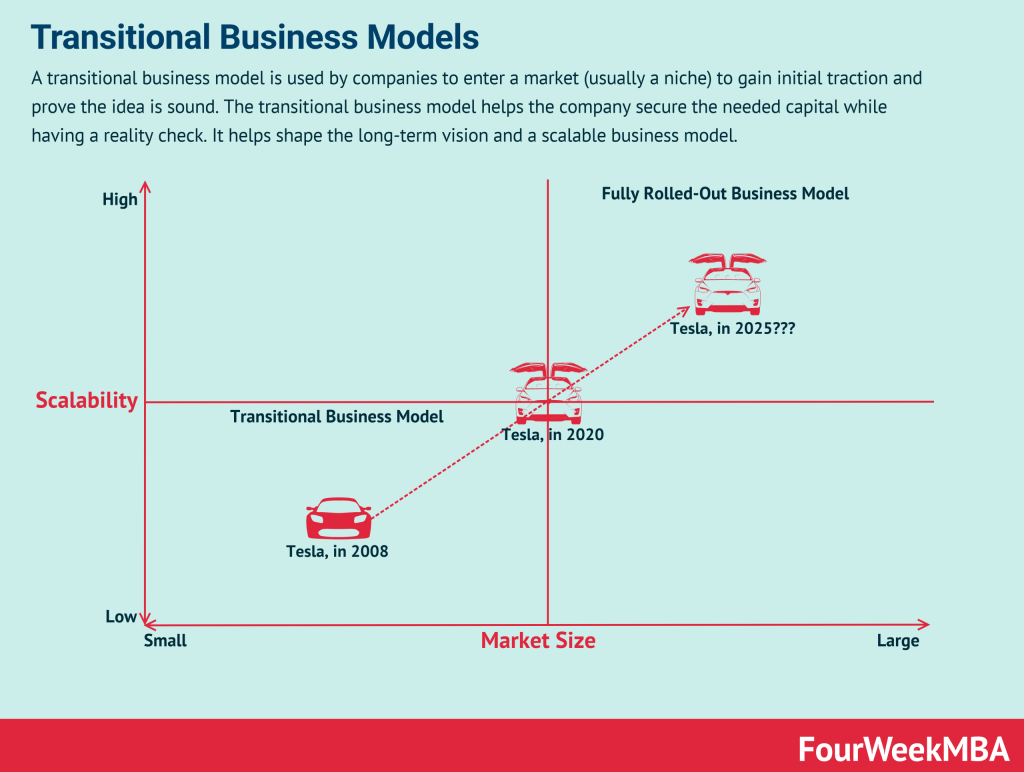
A transitional business model is used by companies to enter a market (usually a niche) to gain initial traction and prove the idea is sound. The transitional business model helps the company secure the needed capital while having a reality check. It helps shape the long-term vision and a scalable businessmodel.
The minimum viable audience (MVA) represents the smallest possible audience that can sustain your business as you get it started from a microniche (the smallest subset of a market). The main aspect of the MVA is to zoom into existing markets to find those people which needs are unmet by existing players.
Business scaling is the process of transformation of a business as the product is validated by wider and wider market segments. Business scaling is about creating traction for a product that fits a small market segment. As the product is validated it becomes critical to build a viable businessmodel. And as the product is offered at wider and wider market segments, it’s important to align product, businessmodel, and organizational design, to enable wider and wider scale.
The market expansion consists in providing a product or service to a broader portion of an existing market or perhaps expanding that market. Or yet, market expansions can be about creating a whole new market. At each step, as a result, a company scales together with the market covered.
In the FourWeekMBA growth matrix, you can apply growth for existing customers by tackling the same problems (gain mode). Or by tackling existing problems, for new customers (expand mode). Or by tackling new problems for existing customers (extend mode). Or perhaps by tackling whole new problems for new customers (reinvent mode).
In the FourWeekMBA Revenue Streams Matrix, revenue streams are classified according to the kind of interactions the business has with its key customers. The first dimension is the “Frequency” of interaction with the key customer. As the second dimension, there is the “Ownership” of the interaction with the key customer.
Revenue model patterns are a way for companies to monetize their business models. A revenue model pattern is a crucial building block of a business model because it informs how the company will generate short-term financial resources to invest back into the business. Thus, the way a company makes money will also influence its overall business model.
A pricing strategy or model helps companies find the pricing formula in fit with their business models. Thus aligning the customer needs with the product type while trying to enable profitability for the company. A good pricing strategy aligns the customer with the company’s long term financial sustainability to build a solid business model.
Gennaro is the creator of FourWeekMBA, which reached about four million business people, comprising C-level executives, investors, analysts, product managers, and aspiring digital entrepreneurs in 2022 alone | He is also Director of Sales for a high-tech scaleup in the AI Industry | In 2012, Gennaro earned an International MBA with emphasis on Corporate Finance and Business Strategy.