

McDonald’s finally transitioned to a heavily franchised business model in 2023, reaching its long-term objective of 95% of franchised restaurants vs. its total restaurants worldwide.
Approximately 95% of the restaurants at year-end 2023 were franchised, including 95% in the U.S., 89% in International Operated Markets, and 98% in the International Developmental Licensed Markets.
| Business Strategy | Description | Example | Implications | Integration |
|---|---|---|---|---|
| Global Brand Presence | McDonald’s maintains a strong global presence with thousands of restaurants in over 100 countries. | Operating in diverse international markets, including the United States, China, India, and more. | – Widespread brand recognition and market share. – Access to a diverse customer base. – Economies of scale and global supply chain. | McDonald’s global presence is integral to its strategy, allowing it to reach consumers worldwide and leverage its brand reputation on a global scale. It enables consistent branding and menu offerings across regions while adapting to local preferences where necessary. |
| Franchise Model | McDonald’s predominantly operates through a franchise model, allowing local entrepreneurs to own and operate individual restaurants. | Franchisees owning and running McDonald’s outlets worldwide. | – Rapid expansion with lower capital requirements. – Local ownership and entrepreneurship. – Revenue from franchise fees and royalties. | The franchise model is at the core of McDonald’s strategy, facilitating rapid expansion and community involvement through local ownership. It integrates with menu standardization and quality control to maintain consistency across franchises. |
| Standardization of Menu | McDonald’s emphasizes menu standardization, offering core products like the Big Mac, Happy Meal, and McNuggets worldwide. | Consistent menu items available across most locations globally. | – Efficient supply chain and inventory management. – Consistent brand experience for customers. – Streamlined kitchen operations. | Menu standardization is a key part of McDonald’s strategy, enabling consistent quality and customer experience across its vast network of restaurants. It integrates with franchise operations, ensuring uniformity in menu offerings and preparation processes. |
| Menu Localization | While maintaining core items, McDonald’s adapts menus to cater to local tastes and preferences in different regions. | Offering region-specific items like the McSpicy Paneer in India or the Teriyaki Burger in Japan. | – Appeals to diverse consumer palates. – Demonstrates cultural sensitivity and market adaptability. – Increases customer engagement. | Menu localization complements McDonald’s strategy by allowing it to connect with local communities and enhance the appeal of its brand in different regions. It integrates with menu standardization to provide variety while maintaining consistency. |
| Drive-Thru and Convenience | McDonald’s focuses on convenience through drive-thru services, extended operating hours, and mobile app orders. | Drive-thru lanes, 24-hour locations, and mobile app for easy ordering and payment. | – Speed and convenience for customers. – Increased sales during non-traditional hours. – Enhanced customer engagement through digital channels. | Convenience is integrated into McDonald’s strategy, offering customers flexible options for ordering and payment. It aligns with its digital transformation efforts and menu diversification, providing multiple ways for customers to access its products. |
| Menu Diversification | McDonald’s continually expands its menu to include healthier options, breakfast items, salads, and McCafé beverages. | Introducing items like oatmeal, fruit parfaits, and espresso drinks. | – Appeals to a broader customer base with diverse preferences. – Addresses health and dietary concerns. – Increases average transaction value. | Menu diversification is an integral part of McDonald’s strategy, allowing it to cater to evolving consumer preferences and dietary choices. It integrates with the core menu items and aligns with its commitment to offering a wide range of options to customers. |
| Marketing and Advertising | McDonald’s invests in extensive marketing campaigns, promotions, and sponsorships to maintain brand visibility. | Promotions like the “Monopoly Game” and sponsorships of major events like the Olympics. | – Builds and reinforces brand awareness. – Drives traffic to restaurants. – Encourages customer participation and loyalty. | Marketing and advertising are core components of McDonald’s strategy, promoting its products and enhancing brand recognition. They integrate with menu diversification and value menus, driving customer engagement and encouraging visits to its restaurants. |
| Sustainability Initiatives | McDonald’s is committed to sustainability, with efforts to source sustainable ingredients, reduce waste, and energy-efficient practices. | Initiatives like the Sustainable Beef Pilot Project and recyclable packaging. | – Addresses environmental concerns and consumer expectations. – Enhances corporate responsibility and reputation. – Aligns with evolving sustainability trends. | Sustainability initiatives are integrated into McDonald’s strategy, reflecting its commitment to responsible business practices. They align with menu diversification by offering more sustainable menu options and with drive-thru and mobile ordering by reducing packaging waste. |
| Digital Transformation | McDonald’s embraces digital technology for ordering, delivery, and enhancing the customer experience. | Mobile app for ordering and payment, self-order kiosks, and partnerships with delivery services. | – Enhances customer convenience and speed of service. – Increases digital engagement and data collection. – Expands delivery capabilities. | Digital transformation is at the forefront of McDonald’s strategy, enabling it to meet evolving customer expectations and streamline operations. It integrates with drive-thru and convenience services, making it easier for customers to access its products. |
| McDelivery Service | McDonald’s offers delivery services through partnerships with third-party delivery platforms. | Collaborations with Uber Eats, DoorDash, and other delivery providers. | – Expands market reach beyond traditional dine-in and drive-thru. – Meets customer demand for delivery options. – Increases sales and revenue streams. | McDelivery services complement McDonald’s strategy, allowing it to reach customers who prefer the convenience of delivery. They integrate with drive-thru and digital transformation efforts, providing multiple channels for customers to order and receive their meals. |
| Community Engagement | McDonald’s engages with local communities through charitable efforts, sponsorships, and Ronald McDonald House Charities. | Supporting local charities and events, including the McHappy Day fundraiser. | – Enhances brand reputation and goodwill. – Strengthens ties with local communities. – Demonstrates social responsibility. | Community engagement is integrated into McDonald’s strategy, fostering positive relationships with local communities where its restaurants operate. It aligns with the brand’s commitment to giving back and supporting causes that matter to its customers. |
| Quality and Safety Standards | McDonald’s maintains rigorous quality and safety standards for food preparation, sourcing, and restaurant cleanliness. | Food safety measures, quality inspections, and supplier audits. | – Ensures consistent food quality and safety. – Mitigates health and safety risks. – Builds customer trust and confidence. | Quality and safety standards are integral to McDonald’s strategy, ensuring that customers can trust the quality and safety of its food. They integrate with menu standardization, menu diversification, and community engagement by providing safe and high-quality products to customers. |
| Adaptation to Trends | McDonald’s adapts to changing consumer trends by introducing plant-based options, reducing antibiotics in poultry, and addressing health concerns. | Introducing the McPlant burger and other healthier menu options. | – Addresses evolving consumer preferences and dietary trends. – Demonstrates responsiveness to customer needs. – Increases menu appeal and variety. | Adaptation to trends is a fundamental aspect of McDonald’s strategy, allowing it to stay relevant and meet the changing needs of its customers. It integrates with menu diversification and sustainability initiatives, reflecting its commitment to evolving with consumer demands. |
| Value Menu | McDonald’s offers value menus to cater to price-conscious customers with affordable options. | Value meals, dollar menus, and limited-time promotions on budget-friendly items. | – Attracts budget-conscious customers. – Maintains competitive pricing. – Encourages upselling through combo options. | Value menus are integrated into McDonald’s strategy, providing affordable options for price-sensitive customers while also complementing menu diversification efforts by offering budget-friendly choices. They align with McDonald’s goal of catering to diverse customer segments. |




Key Highlights
- Franchised Business Model: In 2022, McDonald’s successfully completed its transition to a heavily franchised business model, achieving its long-term goal of having 95% of its restaurants worldwide operated under franchise agreements.
- Franchised Restaurant Percentage: By the end of 2022, approximately 95% of all McDonald’s restaurants were operated as franchises. This shift marks a significant change in the company’s operational structure.
- Global Distribution: McDonald’s franchise model was implemented globally, reflecting its commitment to this new approach in various markets around the world.
- United States: In the United States, McDonald’s reached its objective of having 95% of its restaurants operated by franchisees, indicating a substantial reliance on franchise partnerships for its domestic operations.
- International Markets: McDonald’s also achieved high levels of franchising in its international markets. Around 89% of restaurants in International Operated Markets and a staggering 98% in International Developmental Licensed Markets were franchised by the end of 2022.
- Strategic Shift: The transition to a heavily franchised model represents a strategic shift for McDonald’s, enabling the company to focus on core business functions such as branding, marketing, and innovation, while franchisees handle day-to-day operations.
- Operational Efficiency: Franchising allows McDonald’s to streamline operations and reduce costs, as franchisees are responsible for their own locations’ staffing, maintenance, and other operational aspects.
- Risk Distribution: The franchised model also distributes some business risks to individual franchisees, who have a vested interest in the success of their respective locations.
- Local Adaptation: Franchisees often have a better understanding of local customer preferences and cultural nuances, allowing for more effective adaptation of menus and marketing strategies.
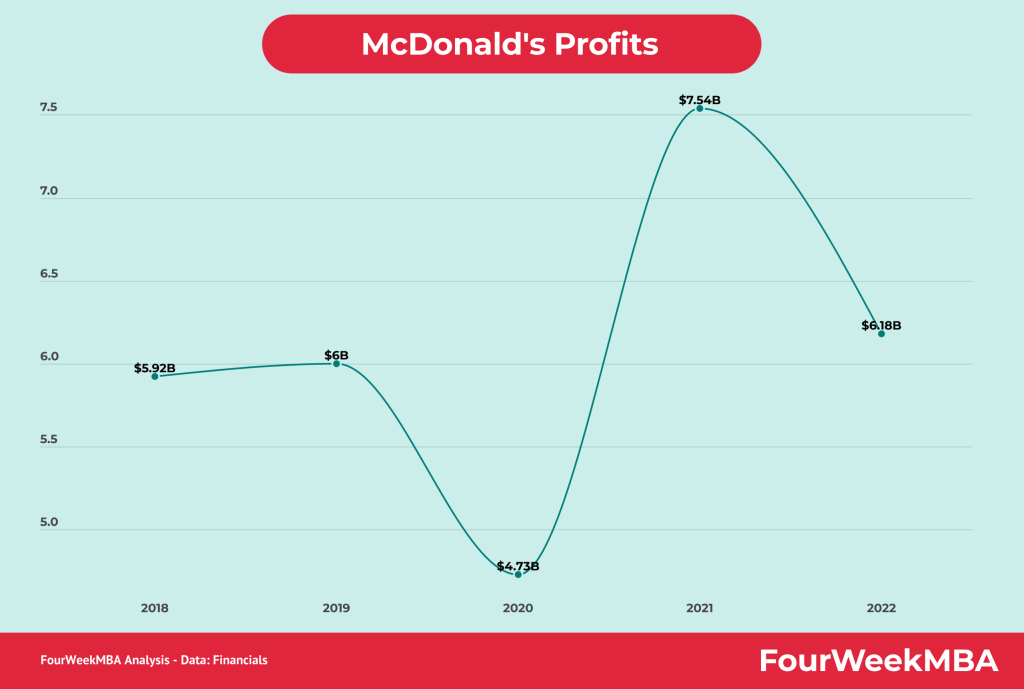
- Financial Impact: The shift to a heavily franchised model can have positive financial implications for McDonald’s, as it reduces the company’s capital requirements, enhances cash flow stability, and potentially increases profitability.
- Franchisee Relationships: Building and maintaining strong relationships with franchisees becomes crucial for McDonald’s continued success. Effective communication, support, and collaboration are essential in this model.
- Brand Consistency: While McDonald’s relies on franchisees to operate their restaurants, maintaining brand consistency across locations becomes a priority to uphold customer expectations and perceptions.
Related Visual Stories


McDonald’s EV/Revenue Multiple


McDonald’s Operates vs. Franchised Restaurants Margins


McDonald’s Organizational Structure


Read Also: McDonald’s Business Model, Coca-Cola Business Model, Coca-Cola Distribution Strategy.
What are the key components of McDonald's Strategy?
The key components of McDonald's Strategy include Global Brand Presence, Franchise Model, Standardization of Menu, Menu Localization, Drive-Thru and Convenience. Global Brand Presence: McDonald's maintains a strong global presence with thousands of restaurants in over 100 countries.


