Lean Enterprise, often referred to as Lean Thinking or Lean Management, is a systematic approach to creating value for customers while minimizing waste and optimizing processes across an entire organization. It builds upon the principles of Lean Manufacturing, which originated at Toyota in the 1950s and revolutionized the automotive industry. However, Lean Enterprise extends these principles beyond manufacturing to all aspects of an organization, including product development, marketing, human resources, and customer service.
Cost Reduction: By eliminating waste and optimizing resource allocation, organizations can significantly reduce operational costs.
Enhanced Quality: A focus on error prevention and continuous improvement leads to higher-quality products and services.
Customer Satisfaction: Meeting customer needs and delivering value results in greater customer satisfaction and loyalty.
Innovation: Lean fosters a culture of innovation by encouraging experimentation and adaptability.
Employee Engagement: Empowering employees to contribute to process improvement and decision-making increases engagement and job satisfaction.
The Evolution of Lean Enterprise
Lean Enterprise has evolved over the years to adapt to changing business landscapes and emerging technologies. Here are key milestones in its evolution:
1. Lean Manufacturing (1950s):
Originating at Toyota, Lean Manufacturing introduced concepts like Just-in-Time (JIT) inventory and the Toyota Production System (TPS).
2. Lean Product Development (1990s):
The focus expanded to product development processes, with Lean principles applied to reduce cycle times, eliminate waste, and improve innovation.
3. Lean Services (2000s):
Lean principles were adapted for service industries such as healthcare, finance, and hospitality, enhancing customer experiences and operational efficiency.
4. Lean Thinking (Present):
Today, Lean Thinking encompasses the entire organization, emphasizing cross-functional collaboration, agile methodologies, and customer-centricity.
Implementing Lean Enterprise
Effective implementation of Lean Enterprise involves several key steps:
Leadership Commitment: Leadership must champion the Lean journey and set the example for the organization.
Cultural Transformation: Shifting the organization’s culture toward one that values continuous improvement and customer focus.
Value Stream Mapping: Identifying value streams and mapping the flow of work to understand processes and opportunities for improvement.
Waste Identification: Identifying and eliminating the eight forms of waste: overproduction, waiting, unnecessary transportation, overprocessing, excess inventory, motion, defects, and underutilized talent.
Kaizen Events: Holding regular Kaizen (continuous improvement) events to address specific process improvements.
Employee Empowerment: Involving employees at all levels in problem-solving and decision-making.
Challenges of Lean Enterprise
While Lean Enterprise offers numerous benefits, it also presents challenges:
Cultural Resistance: Changing an organization’s culture can be met with resistance, especially in long-established companies.
Complex Implementation: Implementing Lean Enterprise across an entire organization can be complex and may require significant training and support.
Resource Allocation: Organizations may face resource constraints in terms of time, budget, and expertise.
Measurement and Metrics: Defining and measuring success in Lean Enterprise initiatives can be challenging.
Lean Enterprise in Action
Several organizations have successfully implemented Lean Enterprise principles:
General Electric (GE): GE’s Lean initiative, known as the “GE Workout,” led to significant cost reductions, streamlined processes, and improved competitiveness.
Amazon: Amazon’s relentless focus on customer value, continuous improvement, and efficient operations align with Lean Enterprise principles.
Ford Motor Company: Ford has integrated Lean principles into its manufacturing processes, resulting in reduced lead times and enhanced product quality.
Conclusion
Lean Enterprise represents a transformative approach to organizational management, emphasizing customer value, continuous improvement, and waste elimination. Its evolution from Lean Manufacturing to a holistic philosophy encompassing all facets of an organization reflects its adaptability and enduring relevance.
While implementing Lean Enterprise may pose challenges, the benefits of improved efficiency, cost reduction, enhanced quality, and greater customer satisfaction make it a compelling approach for organizations seeking to thrive in today’s competitive landscape. As Lean Thinking continues to evolve, it remains a powerful framework for organizations to achieve both efficiency and innovation simultaneously.
Key Highlights:
Definition: Lean Enterprise is a systematic approach to creating value for customers while minimizing waste and optimizing processes across an entire organization.
Key Principles:
Customer-Centric
Continuous Improvement
Waste Elimination
Respect for People
Flow
Pull Systems
Benefits:
Improved Efficiency
Cost Reduction
Enhanced Quality
Customer Satisfaction
Innovation
Employee Engagement
Evolution of Lean Enterprise:
Lean Manufacturing (1950s)
Lean Product Development (1990s)
Lean Services (2000s)
Lean Thinking (Present)
Implementing Lean Enterprise:
Leadership Commitment
Cultural Transformation
Value Stream Mapping
Waste Identification
Kaizen Events
Employee Empowerment
Challenges:
Cultural Resistance
Complex Implementation
Resource Allocation
Measurement and Metrics
Lean Enterprise in Action:
General Electric (GE)
Amazon
Ford Motor Company
Conclusion: Lean Enterprise represents a transformative approach to organizational management, emphasizing customer value, continuous improvement, and waste elimination. Despite challenges, its benefits make it a compelling framework for organizations seeking efficiency and innovation.
In a functional organizational structure, groups and teams are organized based on function. Therefore, this organization follows a top-down structure, where most decision flows from top management to bottom. Thus, the bottom of the organization mostly follows the strategy detailed by the top of the organization.
In a flat organizational structure, there is little to no middle management between employees and executives. Therefore it reduces the space between employees and executives to enable an effective communication flow within the organization, thus being faster and leaner.
Project portfolio management (PPM) is a systematic approach to selecting and managing a collection of projects aligned with organizational objectives. That is a business process of managing multiple projects which can be identified, prioritized, and managed within the organization. PPM helps organizations optimize their investments by allocating resources efficiently across all initiatives.
Harvard Business School professor Dr. John Kotter has been a thought-leader on organizational change, and he developed Kotter’s 8-step change model, which helps business managers deal with organizational change. Kotter created the 8-step model to drive organizational transformation.
The Nadler-Tushman Congruence Model was created by David Nadler and Michael Tushman at Columbia University. The Nadler-Tushman Congruence Model is a diagnostic tool that identifies problem areas within a company. In the context of business, congruence occurs when the goals of different people or interest groups coincide.
McKinsey’s Seven Degrees of Freedom for Growth is a strategy tool. Developed by partners at McKinsey and Company, the tool helps businesses understand which opportunities will contribute to expansion, and therefore it helps to prioritize those initiatives.
Mintzberg’s 5Ps of Strategy is a strategy development model that examines five different perspectives (plan, ploy, pattern, position, perspective) to develop a successful business strategy. A sixth perspective has been developed over the years, called Practice, which was created to help businesses execute their strategies.
The COSO framework is a means of designing, implementing, and evaluating control within an organization. The COSO framework’s five components are control environment, risk assessment, control activities, information and communication, and monitoring activities. As a fraud risk management tool, businesses can design, implement, and evaluate internal control procedures.
The TOWS Matrix is an acronym for Threats, Opportunities, Weaknesses, and Strengths. The matrix is a variation on the SWOT Analysis, and it seeks to address criticisms of the SWOT Analysis regarding its inability to show relationships between the various categories.
Lewin’s change management model helps businesses manage the uncertainty and resistance associated with change. Kurt Lewin, one of the first academics to focus his research on group dynamics, developed a three-stage model. He proposed that the behavior of individuals happened as a function of group behavior.
OpenAI is an artificial intelligence research laboratory that transitioned into a for-profit organization in 2019. The corporate structure is organized around two entities: OpenAI, Inc., which is a single-member Delaware LLC controlled by OpenAI non-profit, And OpenAI LP, which is a capped, for-profit organization. The OpenAI LP is governed by the board of OpenAI, Inc (the foundation), which acts as a General Partner. At the same time, Limited Partners comprise employees of the LP, some of the board members, and other investors like Reid Hoffman’s charitable foundation, Khosla Ventures, and Microsoft, the leading investor in the LP.
Airbnb follows a holacracy model, or a sort of flat organizational structure, where teams are organized for projects, to move quickly and iterate fast, thus keeping a lean and flexible approach. Airbnb also moved to a hybrid model where employees can work from anywhere and meet on a quarterly basis to plan ahead, and connect to each other.
The Amazon organizational structure is predominantly hierarchical with elements of function-based structure and geographic divisions. While Amazon started as a lean, flat organization in its early years, it transitioned into a hierarchical organization with its jobs and functions clearly defined as it scaled.
The Coca-Cola Company has a somewhat complex matrix organizational structure with geographic divisions, product divisions, business-type units, and functional groups.
Costco has a matrix organizational structure, which can simply be defined as any structure that combines two or more different types. In this case, a predominant functional structure exists with a more secondary divisional structure.
Costco’s geographic divisions reflect its strong presence in the United States combined with its expanding global presence. There are six divisions in the country alone to reflect its standing as the source of most company revenue.
Compared to competitor Walmart, for example, Costco takes more a decentralized approach to management, decision-making, and autonomy. This allows the company’s stores and divisions to more flexibly respond to local market conditions.
Dell has a functional organizational structure with some degree of decentralization. This means functional departments share information, contribute ideas to the success of the organization and have some degree of decision-making power.
eBay was until recently a multi-divisional (M-form) organization with semi-autonomous units grouped according to the services they provided. Today, eBay has a single division called Marketplace, which includes eBay and its international iterations.
Facebook is characterized by a multi-faceted matrix organizational structure. The company utilizes a flat organizational structure in combination with corporate function-based teams and product-based or geographic divisions. The flat organization structure is organized around the leadership of Mark Zuckerberg, and the key executives around him. On the other hand, the function-based teams are based on the main corporate functions (like HR, product management, investor relations, and so on).
Goldman Sachs has a hierarchical structure with a clear chain of command and defined career advancement process. The structure is also underpinned by business-type divisions and function-based groups.
Google (Alphabet) has a cross-functional (team-based) organizational structure known as a matrix structure with some degree of flatness. Over the years, as the company scaled and it became a tech giant, its organizational structure is morphing more into a centralized organization.
IBM has an organizational structure characterized by product-based divisions, enabling its strategy to develop innovative and competitive products in multiple markets. IBM is also characterized by function-based segments that support product development and innovation for each product-based division, which include Global Markets, Integrated Supply Chain, Research, Development, and Intellectual Property.
McDonald’s has a divisional organizational structure where each division – based on geographical location – is assigned operational responsibilities and strategic objectives. The main geographical divisions are the US, internationally operated markets, and international developmental licensed markets. And on the other hand, the hierarchical leadership structure is organized around regional and functional divisions.
McKinsey & Company has a decentralized organizational structure with mostly self-managing offices, committees, and employees. There are also functional groups and geographic divisions with proprietary names.
Microsoft has a product-type divisional organizational structure based on functions and engineering groups. As the company scaled over time it also became more hierarchical, however still keeping its hybrid approach between functions, engineering groups, and management.
Nestlé has a geographical divisional structure with operations segmented into five key regions. For many years, Swiss multinational food and drink company Nestlé had a complex and decentralized matrix organizational structure where its numerous brands and subsidiaries were free to operate autonomously.
Nike has a matrix organizational structure incorporating geographic divisions. Nike’s matrix structure is also present at the regional and sub-regional levels. Managerial responsibility is segmented according to business unit (apparel, footwear, and equipment) and function (human resources, finance, marketing, sales, and operations).
Patagonia has a particular organizational structure, where its founder, Chouinard, disposed of the company’s ownership in the hands of two non-profits. The Patagonia Purpose Trust, holding 100% of the voting stocks, is in charge of defining the company’s strategic direction. And the Holdfast Collective, a non-profit, holds 100% of non-voting stocks, aiming to re-invest the brand’s dividends into environmental causes.
Samsung has a product-type divisional organizational structure where products determine how resources and business operations are categorized. The main resources around which Samsung’s corporate structure is organized are consumer electronics, IT, and device solutions. In addition, Samsung leadership functions are organized around a few career levels grades, based on experience (assistant, professional, senior professional, and principal professional).
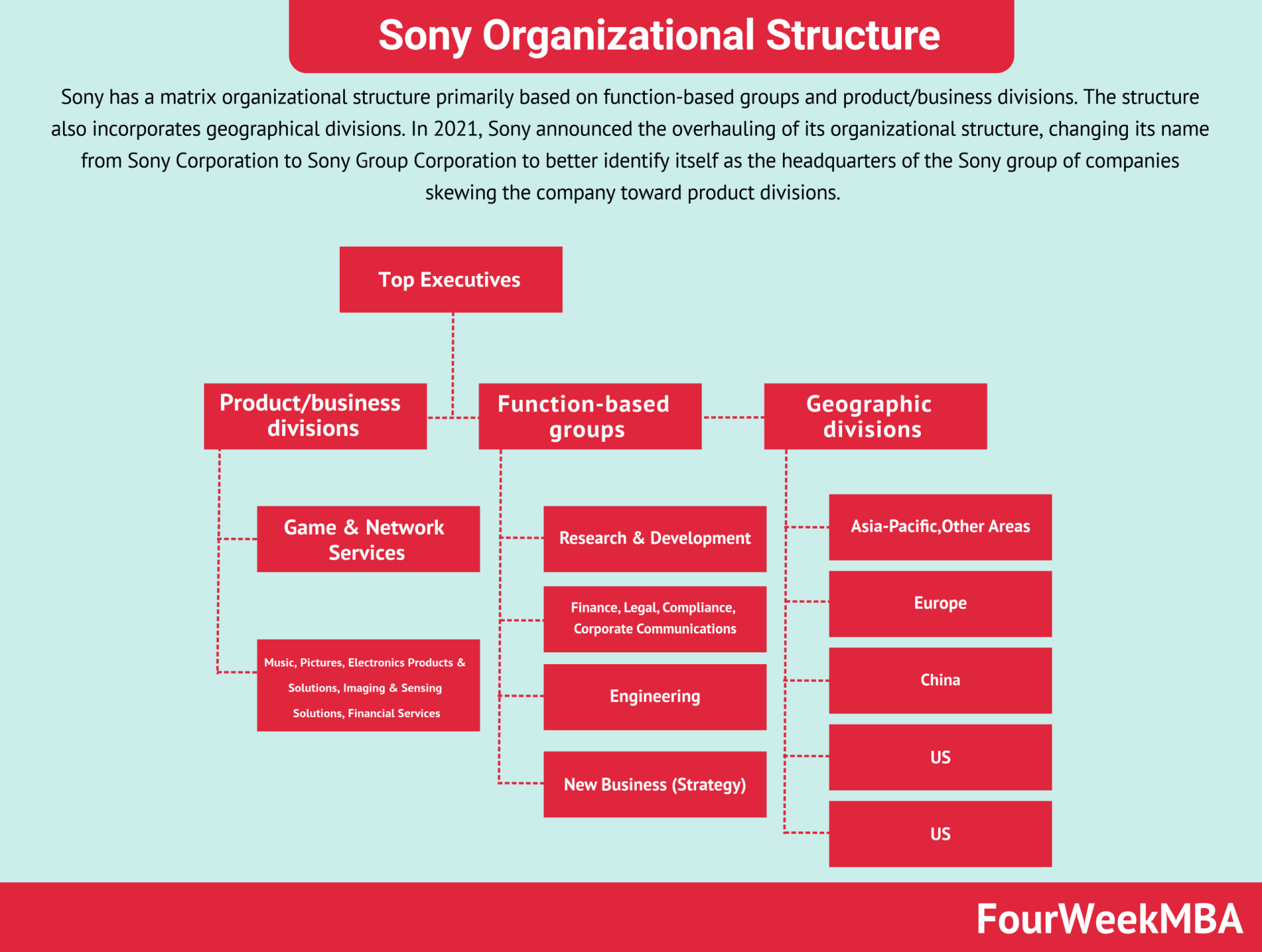
Sony has a matrix organizational structure primarily based on function-based groups and product/business divisions. The structure also incorporates geographical divisions. In 2021, Sony announced the overhauling of its organizational structure, changing its name from Sony Corporation to Sony Group Corporation to better identify itself as the headquarters of the Sony group of companies skewing the company toward product divisions.
Starbucks follows a matrix organizational structure with a combination of vertical and horizontal structures. It is characterized by multiple, overlapping chains of command and divisions.
Tesla is characterized by a functional organizational structure with aspects of a hierarchical structure. Tesla does employ functional centers that cover all business activities, including finance, sales, marketing, technology, engineering, design, and the offices of the CEO and chairperson. Tesla’s headquarters in Austin, Texas, decide the strategic direction of the company, with international operations given little autonomy.
Toyota has a divisional organizational structure where business operations are centered around the market, product, and geographic groups. Therefore, Toyota organizes its corporate structure around global hierarchies (most strategic decisions come from Japan’s headquarter), product-based divisions (where the organization is broken down, based on each product line), and geographical divisions (according to the geographical areas under management).
Walmart has a hybrid hierarchical-functional organizational structure, otherwise referred to as a matrix structure that combines multiple approaches. On the one hand, Walmart follows a hierarchical structure, where the current CEO Doug McMillon is the only employee without a direct superior, and directives are sent from top-level management. On the other hand, the function-based structure of Walmart is used to categorize employees according to their particular skills and experience.
Gennaro is the creator of FourWeekMBA, which reached about four million business people, comprising C-level executives, investors, analysts, product managers, and aspiring digital entrepreneurs in 2022 alone | He is also Director of Sales for a high-tech scaleup in the AI Industry | In 2012, Gennaro earned an International MBA with emphasis on Corporate Finance and Business Strategy.