Google’s Full-Stack AI Dominance — The Visual Breakdown
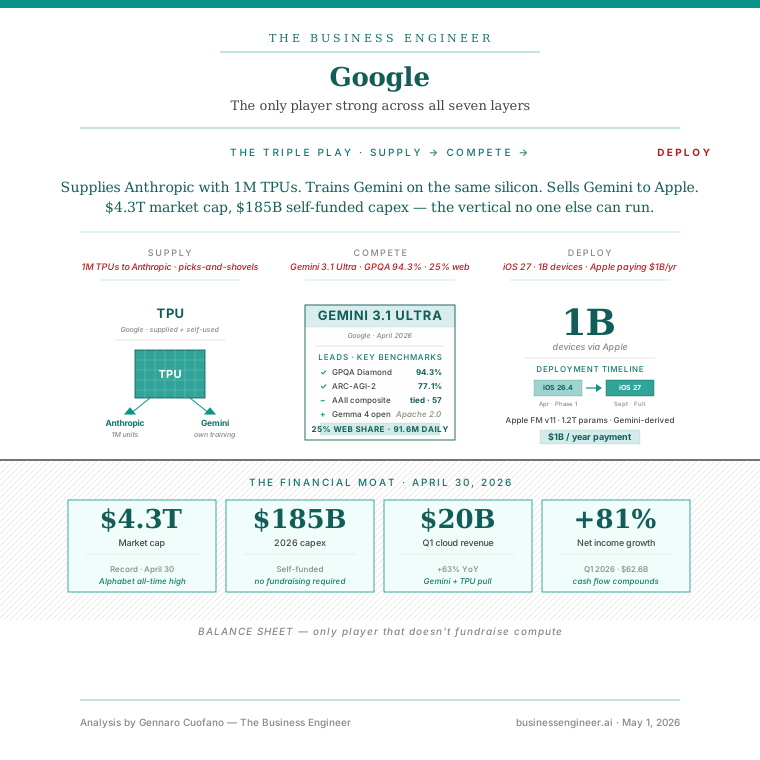
The visual below shows Google’s unprecedented control across all seven layers of the AI stack — the only Big Tech company to achieve true vertical integration from silicon to software.
Source: The Business Engineer — Map of AI, May 2026
At the foundation layer, Google designs its own TPU chips, giving it hardware advantages that competitors like Meta and OpenAI simply don’t have. This silicon-to-software control drives their $185 billion capital expenditure strategy.
In the model layer, Gemini represents Google’s answer to OpenAI’s GPT and Anthropic’s Claude. The visual demonstrates how Google’s model training benefits from their integrated TPU infrastructure — a competitive moat that pure AI companies lack.
At the application layer, Google Workspace integrates AI across Gmail, Docs, and Sheets for 3 billion users. Microsoft competes with Copilot integration, but the visual shows Google’s deeper stack integration advantage.
The interface — as explored in the interface layer wars reshaping consumer tech — layer highlights Android’s role as an AI delivery mechanism to 3 billion devices globally. Apple controls iOS but lacks Google’s cloud infrastructure depth, while Amazon’s Alexa remains device-limited.
This full-stack control creates compounding advantages that isolated AI companies cannot match. OpenAI relies on Microsoft’s Azure, while Anthropic depends on Amazon’s cloud — neither owns their complete destiny like Google.
What other hidden patterns emerge when you map the complete AI competitive landscape across all seven layers?
FREE NEWSLETTER
Get AI Strategy Intelligence Daily
Join 90,000+ strategists. Business modelanalysis, AI maps, and earnings deep dives — free.
Gennaro Cuofano is a CRO and tech executive who has worked in AI since late 2015, starting with bringing NLP, natural-language generation, voice and chatbot products to the marketing industry. His background is in law and finance: he holds a Master's degree in Law and an International MBA with an emphasis on corporate finance (LUISS Business School and the University of San Diego, 2012), and worked as a financial analyst at a real-estate investment firm in San Diego and as an assistant controller. His work focuses on business model strategy, business engineering and, more broadly, structural analysis: how companies make money, read from their own filings. He created FourWeekMBA and leads research there and at The Business Engineer, his newsletter on AI and business strategy, with over 95,000 subscribers and more than 1,000 published analyses. His writing has also appeared on Entrepreneur (for example, How to Digitize a Family Business in Europe) and HackerNoon. Find him on LinkedIn and Substack. See how we source.
Scroll to Top
Discover more from FourWeekMBA
Subscribe now to keep reading and get access to the full archive.