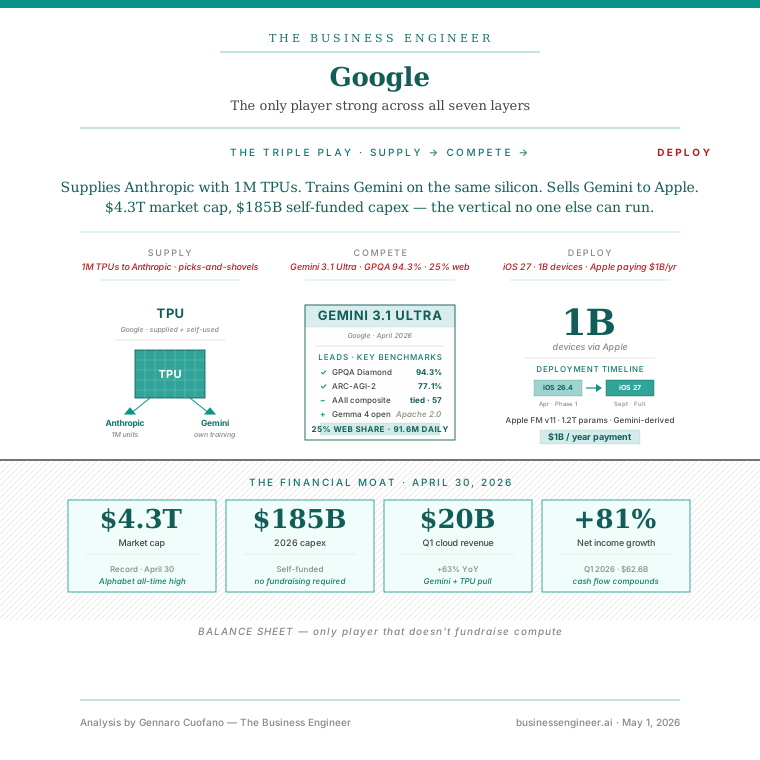
Microsoft and Google are waging a strategic battle for AI developer mindshare, with fundamentally different approaches to capturing the $650 billion enterprisesoftware market. Microsoft’s integrated stack strategy contrasts sharply with Google’s platform diversification model, creating distinct paths to developer lock-in.
Microsoft’s Vertical Integration Advantage
Microsoft controls 73% of the professional developer workflow through GitHub’s 100+ million developers, while Azure OpenAI Service powers 80% of Fortune 500 AI implementation — as explored in the growing gap between AI tools and AI strategy — s. This creates a seamless developer experience: code in GitHub, deploy with Copilot assistance, scale on Azure infrastructure using OpenAI models.
The business model generates compound revenue streams. GitHub subscriptions ($4-21/month per developer) feed into Azure consumption (average $2,400 monthly per enterprise customer), while Copilot adoption drives both platforms. Microsoft reports 1.3 million paid Copilot users, translating to $156 million annual recurring revenue from developer tools alone.
Enterprise customers face significant switching costs. Organizations using GitHub Enterprise, Azure DevOps, and Copilot integration report 40% faster development cycles, creating operational dependency that extends Microsoft’s customer lifetime value beyond 7 years.
Google’s Fragmented Ecosystem Challenge
Google’s approach spans multiple disconnected platforms: Gemini models, Android development ecosystem, and Google Cloud Platform. While Android reaches 71% of mobile developers globally, this doesn’t translate to enterprise AI workflow control.
Google Cloud holds just 11% market share versus Azure’s 25%, limiting enterprise penetration despite superior AI research capabilities. Vertex AI serves primarily Google Cloud customers, creating a smaller addressable market for enterprise AI adoption.
The business model relies heavily on advertising-adjacent revenue streams. Google’s developer tools generate estimated $3.2 billion annually, but primarily through Play Store commissions and advertising integrations rather than direct enterprise subscriptions.
Enterprise Lock-in Mechanics
Microsoft’s strategy creates technical debt advantages. Once enterprises adopt GitHub Copilot, transitioning to alternative AI coding assistants requires retraining developers and restructuring workflows. This generates 89% renewal rates for Microsoft’s developer tools suite.
Google’s consumer-first approach limits enterprise integration depth. While Gemini offers competitive performance, it lacks the workflow integration that drives daily developer usage patterns essential for platform stickiness.
Strategic Tradeoffs and Market Control
Microsoft sacrifices innovation speed for ecosystem control. By acquiring GitHub rather than building organically, Microsoft gained immediate developer mindshare but inherited technical debt and integration challenges.
Google maintains technological flexibility but loses ecosystem leverage. Superior AI research capabilities don’t translate to developer workflow dominance when distribution channels remain fragmented across consumer and enterprise segments.
The winner captures an estimated $47 billion AI development tools market by 2028. Microsoft’s integrated approach currently generates 3.2x higher revenue per developer than Google’s fragmented strategy, suggesting vertical integration advantages in enterprise AI adoption cycles.
DEEP DIVE
Get the Full AI Competitive Analysis
Business Engineer members get weekly deep dives on AI business model shifts, competitive dynamics, and strategic frameworks.
Gennaro Cuofano is a CRO and tech executive who has worked in AI since late 2015, starting with bringing NLP, natural-language generation, voice and chatbot products to the marketing industry. His background is in law and finance: he holds a Master's degree in Law and an International MBA with an emphasis on corporate finance (LUISS Business School and the University of San Diego, 2012), and worked as a financial analyst at a real-estate investment firm in San Diego and as an assistant controller. His work focuses on business model strategy, business engineering and, more broadly, structural analysis: how companies make money, read from their own filings. He created FourWeekMBA and leads research there and at The Business Engineer, his newsletter on AI and business strategy, with over 95,000 subscribers and more than 1,000 published analyses. His writing has also appeared on Entrepreneur (for example, How to Digitize a Family Business in Europe) and HackerNoon. Find him on LinkedIn and Substack. See how we source.
Scroll to Top
Discover more from FourWeekMBA
Subscribe now to keep reading and get access to the full archive.