

Cross-functional collaboration, often referred to as cross-functional teamwork or cross-functional cooperation, breaks down the traditional silos within organizations. It brings together individuals with diverse skills, backgrounds, and perspectives to collectively address complex challenges and opportunities.
Key elements of cross-functional collaboration include:
1. Diverse Expertise:
Teams consist of members from various functional areas, such as marketing, finance, operations, and R&D, each contributing specialized knowledge and skills.
2. Shared Goals:
Cross-functional teams are united by a common purpose or goal, aligning their efforts toward achieving specific outcomes.
3. Interdisciplinary Communication:
Effective communication is vital. Team members must be able to understand and convey ideas across different disciplines and departments.
4. Problem-Solving and Decision-Making:
Cross-functional teams are often tasked with solving complex problems and making decisions that impact multiple aspects of the organization.
5. Innovation and Creativity:
Diverse perspectives and expertise can lead to innovative solutions and creative approaches to challenges.
The Benefits of Cross-Functional Collaboration
Embracing cross-functional collaboration offers numerous advantages for organizations:
1. Enhanced Problem-Solving:
Cross-functional teams bring together a variety of viewpoints and expertise, resulting in more comprehensive problem-solving.
2. Increased Innovation:
Diversity in thought and experience fosters innovation and the generation of new ideas.
3. Efficient Resource Utilization:
Teams can optimize resource allocation by sharing assets and reducing duplication of efforts.
4. Improved Decision-Making:
Collaboration allows for well-informed decisions that consider multiple perspectives and potential impacts.
5. Accelerated Projects:
Cross-functional teams often expedite project timelines by reducing the need for sequential handoffs between departments.
6. Enhanced Employee Engagement:
Involving employees from various departments in collaborative efforts can boost engagement and job satisfaction.
7. Adaptability to Change:
Cross-functional collaboration builds a more agile organization capable of adapting to rapidly changing market conditions.
Strategies for Successful Cross-Functional Collaboration
Building effective cross-functional collaboration within an organization requires a thoughtful approach. Here are strategies to promote its success:
1. Clear Communication:
Establish open channels of communication and ensure that team members understand the objectives, roles, and responsibilities.
2. Strong Leadership:
Appoint capable leaders who can guide the team, foster a collaborative culture, and make decisions when needed.
3. Define Goals and Metrics:
Set clear goals and key performance indicators (KPIs) to measure progress and success.
4. Conflict Resolution:
Prepare for potential conflicts and establish mechanisms for resolving them constructively.
5. Flexibility and Adaptability:
Be open to adjusting strategies and approaches as the collaboration progresses.
6. Feedback and Reflection:
Encourage regular feedback sessions to assess what is working well and where improvements can be made.
7. Technology and Tools:
Leverage collaboration tools and technology to facilitate communication and document sharing.
Real-World Examples of Cross-Functional Collaboration
Several organizations have embraced cross-functional collaboration to drive innovation and achieve remarkable results:
1. Apple Inc.:
Apple’s success is partly attributed to its cross-functional teams, where designers, engineers, and marketers work closely together to develop groundbreaking products like the iPhone.
2. Procter & Gamble (P&G):
P&G is known for its Connect+Develop program, which encourages collaboration with external partners, academia, and cross-functional teams to drive innovation in product development.
3. Toyota:
Toyota’s Production System is founded on cross-functional collaboration, with employees across different departments collaborating to continuously improve processes and quality.
4. Amazon:
Amazon’s customer-centric approach is achieved through cross-functional teams that include employees from operations, logistics, and technology, among others.
Challenges and Considerations
While cross-functional collaboration offers numerous benefits, it is not without its challenges:
1. Conflict of Priorities:
Teams may have conflicting priorities and goals, requiring careful alignment.
2. Communication Barriers:
Differing terminology and communication styles between departments can hinder effective collaboration.
3. Resource Allocation:
Managing resources across departments can be complex, as each department may have its own budget constraints and resource demands.
4. Resistance to Change:
Employees accustomed to working in departmental silos may resist collaboration efforts.
5. Leadership Challenges:
Effective leadership is critical, and not all leaders may have the skills to manage cross-functional teams effectively.
6. Risk of Over-Collaboration:
Excessive collaboration can lead to decision-making paralysis and delays.
Conclusion
Cross-functional collaboration is a powerful tool for organizations seeking to thrive in today’s dynamic business environment. By harnessing diverse expertise, breaking down silos, and fostering a culture of communication and cooperation, organizations can achieve enhanced problem-solving, increased innovation, and improved decision-making. While challenges may arise, the benefits of cross-functional collaboration far outweigh the drawbacks. In a world where adaptability and innovation are essential for success, organizations that embrace cross-functional collaboration are well-positioned to excel and thrive.
Key Highlights:
- Definition: Cross-functional collaboration breaks down organizational silos by bringing together individuals from diverse backgrounds to address complex challenges.
- Key Elements:
- Diverse Expertise
- Shared Goals
- Interdisciplinary Communication
- Problem-Solving and Decision-Making
- Innovation and Creativity
- Benefits:
- Enhanced Problem-Solving
- Increased Innovation
- Efficient Resource Utilization
- Improved Decision-Making
- Accelerated Projects
- Enhanced Employee Engagement
- Adaptability to Change
- Strategies for Success:
- Clear Communication
- Strong Leadership
- Define Goals and Metrics
- Conflict Resolution
- Flexibility and Adaptability
- Feedback and Reflection
- Technology and Tools
- Real-World Examples:
- Apple Inc.
- Procter & Gamble (P&G)
- Toyota
- Amazon
- Challenges and Considerations:
- Conflict of Priorities
- Communication Barriers
- Resource Allocation
- Resistance to Change
- Leadership Challenges
- Risk of Over-Collaboration
- Conclusion: Cross-functional collaboration is essential for organizations aiming to excel in today’s business landscape. Despite challenges, the benefits—including enhanced problem-solving and innovation—make it a valuable approach for achieving organizational success.
| Related Framework | Description | When to Apply |
|---|---|---|
| Cross-Functional Collaboration | – A strategic approach that involves breaking down silos and fostering collaboration among individuals or teams from different functional areas or departments within an organization. – It aims to leverage diverse expertise, perspectives, and resources to achieve common goals, solve complex problems, and drive innovation. – Cross-functional collaboration requires effective communication, trust-building, and alignment of goals and objectives across departments or disciplines. | Project management, product development, process improvement, organizational change initiatives, innovation projects, strategic planning |
| Matrix Management | – A management structure where individuals report to multiple supervisors or managers, often across different functions or projects. – Matrix management facilitates resource sharing, knowledge exchange, and cross-departmental collaboration while maintaining functional specialization. – It enables organizations to leverage expertise and resources efficiently, adapt to changing priorities, and drive synergies between departments or projects. | Complex project management, organizational restructuring, large-scale initiatives, resource optimization, cross-functional teams |
| Communities of Practice (CoPs) | – Groups of individuals within an organization who share common interests, goals, or expertise and collaborate to learn, solve problems, and share best practices. – Communities of practice provide a platform for knowledge sharing, professional development, and innovation across functional boundaries. – They foster a culture of continuous learning, collaboration, and knowledge transfer within organizations. | Knowledge management, professional development, organizational learning, innovation initiatives, best practice sharing |
| Joint Application Development (JAD) | – A collaborative requirements-gathering technique that brings together stakeholders, end-users, and development teams to define and prioritize project requirements. – JAD sessions typically involve facilitated workshops where participants discuss, clarify, and document requirements, leading to consensus and alignment on project objectives and deliverables. – JAD promotes cross-functional collaboration, stakeholder engagement, and shared ownership of project outcomes. | Software development projects, system implementations, business process reengineering, requirements elicitation |
| Cross-Functional Teams | – Teams composed of individuals from different functional areas or departments who collaborate on specific projects, initiatives, or tasks. – Cross-functional teams leverage diverse skills, perspectives, and resources to solve complex problems, drive innovation, and achieve shared goals. – They promote collaboration, communication, and synergy across organizational boundaries, leading to more effective and holistic outcomes. | Project-based initiatives, product development, process improvement, organizational change projects, strategic planning |
| Value Stream Mapping (VSM) | – A lean management technique used to visualize, analyze, and optimize the flow of materials, information, and activities required to deliver value to customers. – Value stream mapping identifies inefficiencies, bottlenecks, and waste within processes, enabling organizations to streamline operations, reduce lead times, and improve overall performance. – It facilitates cross-functional collaboration by providing a shared understanding of process flows and opportunities for improvement. | Process optimization, lean manufacturing, supply chain management, service delivery improvement, quality management |
| Cross-Functional Training | – Training programs or initiatives designed to equip employees with skills, knowledge, and competencies relevant to multiple functional areas or roles within an organization. – Cross-functional training promotes interdisciplinary collaboration, fosters a culture of learning and adaptability, and enhances employees’ ability to contribute effectively across different departments or projects. – It enables organizations to build a versatile and agile workforce capable of addressing diverse challenges and opportunities. | Employee development, talent management, succession planning, organizational agility, skills enhancement |
| Interdisciplinary Research | – Collaborative research endeavors that involve scholars, scientists, or professionals from different disciplines or fields of study working together to address complex problems or advance knowledge. – Interdisciplinary research integrates diverse perspectives, methodologies, and expertise to generate innovative solutions and insights beyond the scope of individual disciplines. – It fosters cross-disciplinary collaboration, creativity, and breakthrough discoveries. | Scientific research, innovation projects, academic collaborations, interdisciplinary studies |
| Cross-Functional Innovation | – A strategic approach to innovation that involves bringing together individuals or teams from different functional areas or backgrounds to generate and develop new ideas, products, or solutions. – Cross-functional innovation leverages diverse perspectives, expertise, and resources to drive creativity, experimentation, and value creation. – It encourages collaboration, risk-taking, and disruptive thinking to address market needs and capitalize on emerging opportunities. | Innovation initiatives, new product development, business model innovation, open innovation, design thinking |
| Strategic Alliances | – Collaborative partnerships between organizations or entities from different industries, sectors, or geographical regions to achieve mutual goals or strategic objectives. – Strategic alliances enable organizations to leverage complementary strengths, resources, and capabilities, expand market reach, and accelerate innovation and growth. – They foster cross-sector collaboration, knowledge exchange, and shared value creation through joint ventures, partnerships, or consortia. | Business development, market expansion, technology transfer, joint ventures, strategic partnerships |
Read Next: Organizational Structure.
Types of Organizational Structures

Siloed Organizational Structures
Functional

Divisional

Open Organizational Structures
Matrix

Flat

Connected Business Frameworks


Nadler-Tushman Congruence Model

McKinsey’s Seven Degrees of Freedom


Organizational Structure Case Studies
OpenAI Organizational Structure

Airbnb Organizational Structure

Amazon Organizational Structure

Apple Organizational Structure

Coca-Cola Organizational Structure

Costco Organizational Structure


Facebook Organizational Structure

Goldman Sachs’ Organizational Structure

Google Organizational Structure


McDonald’s Organizational Structure

McKinsey Organizational Structure

Microsoft Organizational Structure

Nestlé Organizational Structure


Patagonia Organizational Structure

Samsung Organizational Structure

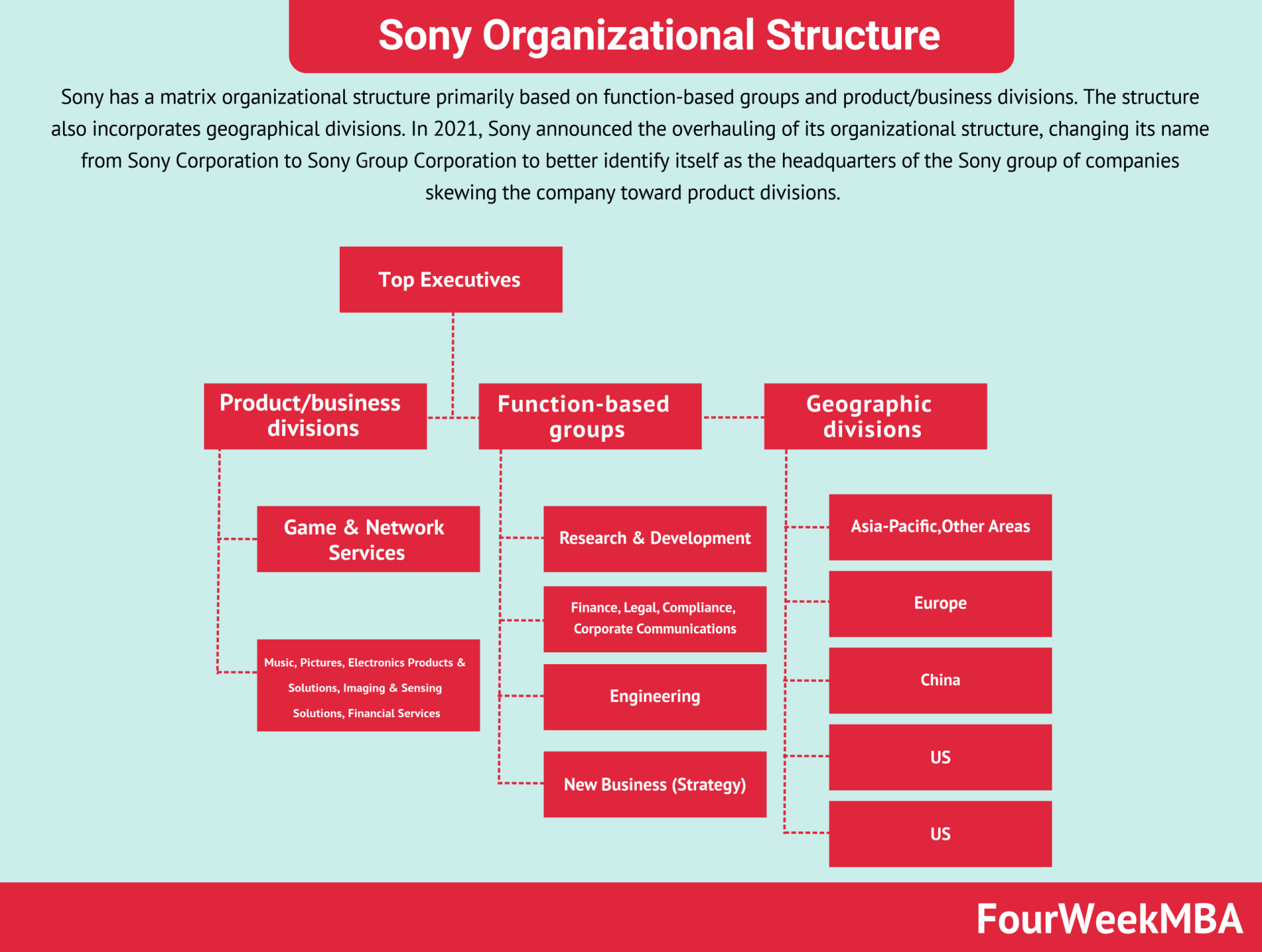
Starbucks Organizational Structure

Tesla Organizational Structure

Toyota Organizational Structure

Walmart Organizational Structure

Main Free Guides:


