Clayton Christensen was a business and academic consultant who introduced the theory of disruptive innovation in this 1997 book The Innovator’s Dilemma. The theory is widely considered to be one of the most important ideas in modern business. Christensen was a gifted and charismatic storyteller whose ideas and philosophies were followed by the likes of Steve Jobs, Reed Hastings, and Intel’s Andy Grove. In 2013, Christensen was named the most influential living management thinker at an event held by the British company Thinkers50.
Key Components
Education
Christensen, a devout Mormon, chose Brigham Young University over offers from Harvard and Yale once he left high school in 1970.
Early professional career
Christensen started his professional career as a project manager and consultant with Boston Consulting Group.
Back to Harvard
Despite classes having started for the year, Christensen was able to enroll at Harvard as a PhD student.
Consulting and investment firms
Christensen founded consulting firm Innosight in 2000 which applied his own theories of innovation to enable companies to develop growth opportunities.
Strengths
—
Limitations
✗Christensen founded consulting firm Innosight in 2000 which applied his own theories of innovation to enable companies to develop growth…
✗Innosight Ventures was subsequently launched which focused on investments in the SE Asia region.
✗In 2007, he founded Rose Park Advisors, a firm that identifies and then invests in disruptive companies.
✗In pursuit of more philanthropic endeavors, Christensen also launched the non-profit Christensen Institute with a mission to solve vexing…
✗Christensen died in 2020 at the age of 67 after a short battle with leukemia.
Real-World Examples
IntelStarbucksTarget
Quick Answers
What is Education?
Christensen, a devout Mormon, chose Brigham Young University over offers from Harvard and Yale once he left high school in 1970.
What is Early professional career?
Christensen started his professional career as a project manager and consultant with Boston Consulting Group.
What is Back to Harvard?
Despite classes having started for the year, Christensen was able to enroll at Harvard as a PhD student.
Key Insight
Christensen was a gifted and charismatic storyteller whose ideas and philosophies were followed by the likes of Steve Jobs, Reed Hastings, and Intel’s Andy Grove. In 2013, Christensen was named the most influential living management thinker at an event held by the British company Thinkers50.
Exec Package + Claude OS Master Skill | Business Engineer Founding Plan
FourWeekMBA x Business Engineer | Updated 2026
Clayton Christensen was a business and academic consultant who introduced the theory of disruptive innovation in this 1997 book The Innovator’s Dilemma. The theory is widely considered to be one of the most important ideas in modern business.
Christensen was a gifted and charismatic storyteller whose ideas and philosophies were followed by the likes of Steve Jobs, Reed Hastings, and Intel’s Andy Grove. In 2013, Christensen was named the most influential living management thinker at an event held by the British company Thinkers50.
Category
Details
Full Name
Clayton Magleby Christensen
Date of Birth
April 6, 1952
Date of Death
January 23, 2020
Place of Birth
Salt Lake City, Utah, USA
Nationality
American
Education
Bachelor of Arts in Economics from Brigham Young University, Master of Philosophy in Applied Econometrics from Oxford University (Rhodes Scholar), MBA and DBA from Harvard Business School
Early Career
Consultant at Boston Consulting Group, Founded Ceramics Process Systems Corporation
Major Companies
Innosight (co-founder), Rose Park Advisors (co-founder)
Positions
Professor at Harvard Business School, Co-founder of Innosight and Rose Park Advisors
Major Projects
Development of the theory of disruptive innovation, Author of “The Innovator’s Dilemma” and other influential books on innovation and management
Notable Achievements
Pioneered the concept of disruptive innovation, Influenced business strategies globally, Regarded as one of the most influential business theorists of his time
Education
Christensen, a devout Mormon, chose Brigham Young University over offers from Harvard and Yale once he left high school in 1970.
Awarded a full scholarship, he majored in economics and could count U.S. presidential candidate Mitt Romney among his first-year classmates.
After a two-year hiatus to serve as a missionary for his church in Korea, Christensen graduated in 1975 with honors in economics.
He was later accepted into Oxford University as a Rhodes Scholar where he received a Masters of Philosophy in 1977.
Two years later, he added an MBA from Harvard Business School to his growing list of accomplishments.
Early professional career
Christensen started his professional career as a project manager and consultant with Boston Consulting Group.
Whilst there, he took another leave of absence to work as the U.S. Secretary of Transportation’s personal assistant in 1982 where he later became a White House Fellow.
In 1984, Christensen helped start the Ceramics Process Systems Corporation (CPS) with several professors from the Massachusetts Institute of Technology (MIT).
Christensen lead the advanced materials company for a few years but was fired in 1987 after the Black Monday stock market crash caused the company’s share price to plummet.
Back to Harvard
Despite classes having started for the year, Christensen was able to enroll at Harvard as a PhD student.
He knew future Harvard Business school dean and CPS board member Kim Clark, who rang the head of the doctoral program on Christensen’s behalf to pull some strings.
Christensen received his doctorate in 1992 and joined the Harvard Business School Faculty to become a full professor after just six years.
While pursuing his DBA, Christensen began research into disruptive innovation which lead to the publication of his book The Innovators Dilemma.
He would go on to write more than nine best-selling books and more than 100 articles on innovation, growth, and disruption.
Consulting and investment firms
Christensen founded consulting firm Innosight in 2000 which applied his own theories of innovation to enable companies to develop growth opportunities.
Innosight Ventures was subsequently launched which focused on investments in the SE Asia region.
In 2007, he founded Rose Park Advisors, a firm that identifies and then invests in disruptive companies.
In pursuit of more philanthropic endeavors, Christensen also launched the non-profit Christensen Institute with a mission to solve vexing societal problems in areas such as education and healthcare.
Christensen died in 2020 at the age of 67 after a short battle with leukemia.
Key takeaways:
Clayton Christensen was a business and academic consultant who introduced the theory of disruptive innovation in this 1997 book The Innovator’s Dilemma.
Christensen started his professional career as a project manager and consultant with Boston Consulting Group and helped found the advanced materials company CPS in 1984. Sacked after the 1987 Black Monday stock market crash, Christensen enrolled as a PhD student at Harvard and become a full professor in 1998.
Christensen founded Innosight in 2000, a consultancy firm that uses his own theories of innovation to enable companies to develop growth opportunities. Related companies in the venture capital industry include Innosight Ventures and Rose Park Advisors.
Clayton Christensen: Father of Disruptive Innovation
Introduction of Disruptive Innovation: Clayton Christensen, through his 1997 book “The Innovator’s Dilemma,” introduced the concept of disruptive innovation, a groundbreaking theory in modern business.
Influence and Recognition: Christensen’s ideas were embraced by influential figures like Steve Jobs, Reed Hastings, and Andy Grove. He was named the most influential living management thinker in 2013 by Thinkers50.
Education: Christensen attended Brigham Young University, Oxford University (as a Rhodes Scholar), and Harvard Business School, earning degrees in economics, philosophy, and an MBA.
Early Career: He began as a consultant at Boston Consulting Group, served in the U.S. Secretary of Transportation’s office, and co-founded Ceramics Process Systems Corporation (CPS) in 1984.
Academic Journey: After CPS faced challenges due to market crash, Christensen pursued a doctorate at Harvard. He joined Harvard Business School’s faculty, where he became a full professor within six years.
Disruptive Innovation: During his doctoral research, Christensen developed his theory of disruptive innovation, which he explored further in “The Innovator’s Dilemma.”
Innosight and Ventures: Christensen founded Innosight in 2000, a consulting firm applying his innovation theories. He also launched Innosight Ventures, focusing on investments in Southeast Asia.
Rose Park Advisors: In 2007, Christensen established Rose Park Advisors, a firm investing in disruptive companies.
Philanthropy: He launched the non-profit Christensen Institute, aiming to address societal challenges in education, healthcare, and more.
Passing: Clayton Christensen passed away in 2020 at age 67, leaving behind a legacy of transformative ideas in business and innovation.
You can use the Ansoff Matrix as a strategic framework to understand what growthstrategy is more suited based on the market context. Developed by mathematician and business manager Igor Ansoff, it assumes a growthstrategy can be derived by whether the market is new or existing, and the product is new or existing.
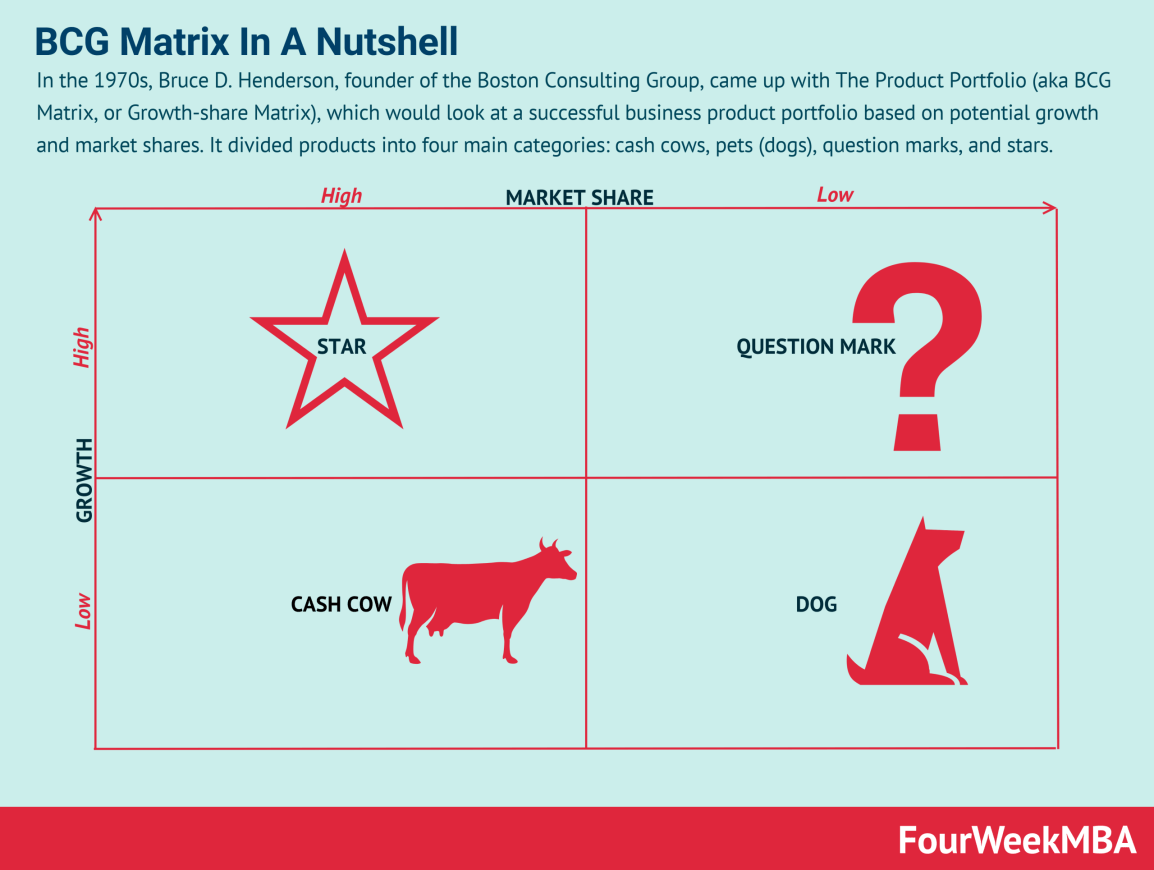
In the 1970s, Bruce D. Henderson, founder of the Boston Consulting Group, came up with The Product Portfolio (aka BCG Matrix, or Growth-share Matrix), which would look at a successful business product portfolio based on potential growth and market shares. It divided products into four main categories: cash cows, pets (dogs), question marks, and stars.
First proposed by accounting academic Robert Kaplan, the balanced scorecard is a management system that allows an organization to focus on big-picture strategic goals. The four perspectives of the balanced scorecard include financial, customer, business process, and organizational capacity. From there, according to the balanced scorecard, it’s possible to have a holistic view of the business.
A blue ocean is a strategy where the boundaries of existing markets are redefined, and new uncontested markets are created. At its core, there is valueinnovation, for which uncontested markets are created, where competition is made irrelevant. And the cost-value trade-off is broken. Thus, companies following a blue ocean strategy offer much more value at a lower cost for the end customers.
The PESTEL analysis is a framework that can help marketers assess whether macro-economic factors are affecting an organization. This is a critical step that helps organizations identify potential threats and weaknesses that can be used in other frameworks such as SWOT or to gain a broader and better understanding of the overall marketing environment.
Businesses use scenario planning to make assumptions on future events and how their respective business environments may change in response to those future events. Therefore, scenario planning identifies specific uncertainties – or different realities and how they might affect future business operations. Scenario planning attempts at better strategic decision making by avoiding two pitfalls: underprediction, and overprediction.
A SWOT Analysis is a framework used for evaluating the business’s Strengths, Weaknesses, Opportunities, and Threats. It can aid in identifying the problematic areas of your business so that you can maximize your opportunities. It will also alert you to the challenges your organization might face in the future.
In the FourWeekMBA growth matrix, you can apply growth for existing customers by tackling the same problems (gain mode). Or by tackling existing problems, for new customers (expand mode). Or by tackling new problems for existing customers (extend mode). Or perhaps by tackling whole new problems for new customers (reinvent mode).
A comparable company analysis is a process that enables the identification of similar organizations to be used as a comparison to understand the business and financial performance of the target company. To find comparables you can look at two key profiles: the business and financial profile. From the comparable company analysis it is possible to understand the competitive landscape of the target organization.
The business model canvas is a framework proposed by Alexander Osterwalder and Yves Pigneur in Busines Model Generation enabling the design of business models through nine building blocks comprising: key partners, key activities, value propositions, customer relationships, customer segments, critical resources, channels, cost structure, and revenue streams.
Business experiments help entrepreneurs test their hypotheses. Rather than define the problem by making too many hypotheses, a digital entrepreneur can formulate a few assumptions, design experiments, and check them against the actions of potential customers. Once measured, the impact, the entrepreneur, will be closer to define the problem.
A blue ocean is a strategy where the boundaries of existing markets are redefined, and new uncontested markets are created. At its core, there is valueinnovation, for which uncontested markets are created, where competition is made irrelevant. And the cost-value trade-off is broken. Thus, companies following a blue ocean strategy offer much more value at a lower cost for the end customers.
In the 1970s, Bruce D. Henderson, founder of the Boston Consulting Group, came up with The Product Portfolio (aka BCG Matrix, or Growth-share Matrix), which would look at a successful business product portfolio based on potential growth and market shares. It divided products into four main categories: cash cows, pets (dogs), question marks, and stars.
AIDA stands for attention, interest, desire, and action. That is a model that is used in marketing to describe the potential journey a customer might go through before purchasing a product or service. The AIDA model helps organizations focus their efforts when optimizing their marketing activities based on the customers’ journeys.
Venture capitalist, Dave McClure, coined the acronym AARRR which is a simplified model that enables to understand what metrics and channels to look at, at each stage for the users’ path toward becoming customers and referrers of a brand.
What are the key components of Who Is Clayton Christensen??
The key components of Who Is Clayton Christensen? include Full Name, Date of Birth, Date of Death, Place of Birth, Nationality. Full Name: Clayton Magleby Christensen Date of Birth: April 6, 1952
Christensen was a gifted and charismatic storyteller whose ideas and philosophies were followed by the likes of Steve Jobs, Reed Hastings, and Intel’s Andy Grove. In 2013, Christensen was named the most influential living management thinker at an event held by the British company Thinkers50.
How do you apply Who Is Clayton Christensen? in practice?
Christensen, a devout Mormon, chose Brigham Young University over offers from Harvard and Yale once he left high school in 1970.
What are the advantages and limitations of Who Is Clayton Christensen??
Awarded a full scholarship, he majored in economics and could count U.S. presidential candidate Mitt Romney among his first-year classmates.
What is Education?
Christensen, a devout Mormon, chose Brigham Young University over offers from Harvard and Yale once he left high school in 1970.
What is Early professional career?
Christensen started his professional career as a project manager and consultant with Boston Consulting Group.
What is Back to Harvard?
Despite classes having started for the year, Christensen was able to enroll at Harvard as a PhD student.
What are the consulting and investment firms?
Christensen founded consulting firm Innosight in 2000 which applied his own theories of innovation to enable companies to develop growth opportunities.
What is Clayton Christensen: Father of Disruptive Innovation?
Introduction of Disruptive Innovation: Clayton Christensen, through his 1997 book "The Innovator's Dilemma," introduced the concept of disruptive innovation, a groundbreaking theory in modern business.. Influence and Recognition: Christensen's ideas were embraced by influential figures like Steve Jobs, Reed Hastings, and Andy Grove.
Frequently Asked Questions
What is Who Is Clayton Christensen??
Clayton Christensen was a business and academic consultant who introduced the theory of disruptive innovation in this 1997 book The Innovator’s Dilemma. The theory is widely considered to be one of the most important ideas in modern business. Christensen was a gifted and charismatic storyteller whose ideas and philosophies were followed by the likes of Steve Jobs, Reed Hastings, and Intel’s Andy Grove.
What is Education?
Christensen, a devout Mormon, chose Brigham Young University over offers from Harvard and Yale once he left high school in 1970.
What is Early professional career?
Christensen started his professional career as a project manager and consultant with Boston Consulting Group.
What is Back to Harvard?
Despite classes having started for the year, Christensen was able to enroll at Harvard as a PhD student.
What are the consulting and investment firms?
Christensen founded consulting firm Innosight in 2000 which applied his own theories of innovation to enable companies to develop growth opportunities.
What is Clayton Christensen: Father of Disruptive Innovation?
Introduction of Disruptive Innovation: Clayton Christensen, through his 1997 book "The Innovator's Dilemma," introduced the concept of disruptive innovation, a groundbreaking theory in modern business.. Influence and Recognition: Christensen's ideas were embraced by influential figures like Steve Jobs, Reed Hastings, and Andy Grove. He was named the most influential living management thinker in 2013 by Thinkers50..
Gennaro is the creator of FourWeekMBA, which reached about four million business people, comprising C-level executives, investors, analysts, product managers, and aspiring digital entrepreneurs in 2022 alone | He is also Director of Sales for a high-tech scaleup in the AI Industry | In 2012, Gennaro earned an International MBA with emphasis on Corporate Finance and Business Strategy.