

A centralized organizational structure is characterized by the concentration of decision-making authority and control within a single or limited group of top-level executives or leaders at the pinnacle of the organizational hierarchy. In this model, lower-level employees and departments typically have minimal autonomy in decision-making processes, as major choices and directives emanate from the upper echelons of the organization. Key aspects of centralized structures include:
- Hierarchy of Authority: Centralized structures adhere to a traditional hierarchy, with a clear chain of command that culminates in a small group or individual at the top.
- Decision Control: The central leadership team holds significant decision-making power, encompassing choices related to strategy, resource allocation, and operational policies.
- Limited Autonomy: Lower-level employees and departments have limited autonomy in decision-making, often adhering to standardized procedures and directives from above.
- Efficiency and Consistency: Centralization aims to ensure efficiency and consistency in decision implementation, as choices are guided by a single overarching vision.
- Communication Flow: Communication flows primarily from the top down, with leaders disseminating information and directives to lower levels.
- Risk Management: Centralized structures enable leaders to maintain tighter control over organizational activities, potentially reducing risks associated with decentralized decision-making.
Key Characteristics of Centralized Structures
To grasp the essence of centralized organizational structures, it’s essential to recognize their key characteristics:
- Top-Down Decision-Making: Decision-making authority flows predominantly from top-level executives or a central leadership team down to lower-level employees.
- Limited Autonomy: Departments and divisions have limited autonomy, often following standardized procedures and guidelines set by senior leadership.
- Streamlined Control: Centralized structures aim to streamline control, ensuring that choices align with the organization’s overarching strategy and goals.
- Clear Hierarchy: A clear hierarchy exists, with well-defined roles and responsibilities at each level of the organization.
- Consistency in Execution: Centralization facilitates consistent execution of decisions, as directives are issued from a central source.
- Efficient Resource Allocation: Resource allocation decisions, such as budgeting and staffing, are typically centralized to optimize resource utilization.
Advantages of Centralized Organizational Structures
Implementing a centralized structure can offer several advantages to organizations:
- Efficient Decision-Making: Centralization can expedite decision-making, as major choices are made by a select few individuals or a central leadership team.
- Consistency and Alignment: Centralized structures ensure that decisions align with the organization’s overarching strategy and goals, promoting consistency in execution.
- Resource Optimization: Centralized control over resource allocation enables organizations to optimize resource utilization and prioritize strategic initiatives.
- Risk Management: Tighter control at the central level can help mitigate risks associated with decentralized decision-making and ensure compliance with regulations.
- Clarity of Authority: A clear chain of command provides clarity regarding authority and responsibilities, reducing ambiguity within the organization.
- Unified Vision: Centralization fosters a unified organizational vision, as major decisions are guided by a single overarching strategy.
Challenges of Centralized Organizational Structures
While centralized structures offer significant benefits, they come with their own set of challenges:
- Limited Adaptability: Centralized organizations may struggle to adapt quickly to changing market conditions or unforeseen challenges, as decision-making is concentrated at the top.
- Innovation Constraints: Centralized structures may stifle innovation and creativity, as lower-level employees have limited input into major decisions.
- Communication Barriers: Top-down communication can create communication barriers, hindering the flow of ideas and feedback from lower levels.
- Bureaucracy: Over-centralization can lead to bureaucracy and slow decision-making, particularly if the central leadership team is overwhelmed with responsibilities.
- Resistance to Change: Employees and departments may resist central directives, leading to resistance and decreased morale.
- Risk of Tunnel Vision: Centralized structures run the risk of developing tunnel vision, as decisions may be influenced by a limited set of perspectives at the top.
Real-World Applications of Centralized Structures
Centralized organizational structures can be found across various sectors and industries. Here are a few notable examples:
- Military Organizations: Military institutions often employ highly centralized structures, where top-ranking officers make critical decisions related to strategy, operations, and resource allocation.
- Large Corporations: Many large corporations adopt centralized structures, with a CEO or executive board making major decisions related to corporate strategy, acquisitions, and financial planning. Subsidiaries and divisions typically follow directives issued from the central headquarters.
- Government Agencies: Some government agencies operate with centralized decision-making, particularly in authoritarian or hierarchical political systems. High-ranking officials or central authorities dictate policy decisions and resource allocation.
- Manufacturing Companies: Manufacturing companies may centralize key functions like production planning, quality control, and procurement to maintain consistency and quality across various product lines.
- Educational Institutions: Universities and school districts often have centralized administrative bodies responsible for decisions related to budgeting, curriculum development, and strategic planning.
Strategies for Effective Implementation
Implementing a centralized organizational structure requires careful planning and execution. Here are strategies to ensure a successful transition:
- Clear Communication: Maintain open and transparent communication channels to ensure that decisions from the central leadership team are well-understood and can be effectively implemented throughout the organization.
- Delegate Selectively: While centralization implies concentrated decision-making power, selective delegation of authority to lower levels can help balance efficiency with adaptability.
- Regular Evaluation: Continuously evaluate the effectiveness of the centralized structure, seeking feedback from employees and departments to identify areas for improvement.
- Innovation Initiatives: Create avenues for innovation and idea generation, even within a centralized framework, to encourage creative thinking and adaptability.
- Change Management: Implement robust change management practices to address resistance to central directives and promote alignment with the organization’s vision.
- Scalability Considerations: Assess the scalability of the centralized structure to ensure that it can adapt to organizational growth or changes in market dynamics.
- Leadership Development: Invest in leadership development programs to cultivate the skills and competencies of top-level executives responsible for major decision-making.
Conclusion
Centralized organizational structures are a time-tested approach to streamline decision-making and control within organizations. While they offer efficiency, consistency, and risk management advantages, they also face challenges related to adaptability, innovation, and communication. Ultimately, the effectiveness of a centralized structure depends on the organization’s goals, industry context, and its ability to strike a balance between centralized control and the need for agility and creativity in today’s rapidly evolving business landscape. By understanding the key principles and strategies associated with centralized structures, organizations can make informed decisions about their organizational design to achieve their objectives effectively.
Key Highlights
- Definition:
- A centralized organizational structure is characterized by the concentration of decision-making authority and control within a single or limited group of top-level executives or leaders.
- It typically features a traditional hierarchy where major decisions are made by a central leadership team and flow down through the organization.
- Characteristics:
- Hierarchy of Authority: The structure follows a clear chain of command with a small group or individual at the top, responsible for decision-making.
- Decision Control: Significant decision-making power resides with the central leadership team, encompassing strategic, operational, and resource allocation choices.
- Limited Autonomy: Lower-level employees and departments have minimal autonomy in decision-making, often following standardized procedures and directives from above.
- Efficiency and Consistency: The structure aims to ensure efficiency and consistency in decision implementation, guided by a single overarching vision set by the central leadership.
- Communication Flow: Communication primarily flows from the top down, with leaders disseminating information and directives to lower levels.
- Risk Management: Centralization enables tighter control over organizational activities, potentially reducing risks associated with decentralized decision-making.
- Advantages:
- Efficient Decision-Making: Centralization expedites decision-making processes as major choices are made by a select few individuals or a central leadership team.
- Consistency and Alignment: Decisions align with the organization’s overarching strategy and goals, promoting consistency in execution.
- Resource Optimization: Centralized control over resource allocation optimizes resource utilization and prioritizes strategic initiatives.
- Risk Management: Tighter control at the central level can help mitigate risks associated with decentralized decision-making and ensure compliance with regulations.
- Clarity of Authority: A clear chain of command provides clarity regarding authority and responsibilities, reducing ambiguity within the organization.
- Unified Vision: Centralization fosters a unified organizational vision, as major decisions are guided by a single overarching strategy.
- Challenges:
- Limited Adaptability: Centralized organizations may struggle to adapt quickly to changing market conditions or unforeseen challenges due to concentrated decision-making.
- Innovation Constraints: Centralization may stifle innovation and creativity, as lower-level employees have limited input into major decisions.
- Communication Barriers: Top-down communication can create barriers, hindering the flow of ideas and feedback from lower levels.
- Bureaucracy: Over-centralization can lead to bureaucracy and slow decision-making, particularly if the central leadership team is overwhelmed with responsibilities.
- Resistance to Change: Employees and departments may resist central directives, leading to resistance and decreased morale.
- Risk of Tunnel Vision: Centralized structures run the risk of developing tunnel vision, as decisions may be influenced by a limited set of perspectives at the top.
- Real-World Applications:
- Military Organizations: Military institutions often employ highly centralized structures, where top-ranking officers make critical decisions related to strategy and operations.
- Large Corporations: Many large corporations adopt centralized structures, with a CEO or executive board making major decisions related to corporate strategy and financial planning.
- Government Agencies: Some government agencies operate with centralized decision-making, particularly in authoritarian or hierarchical political systems.
- Manufacturing Companies: Manufacturing companies may centralize key functions like production planning and quality control to maintain consistency and quality.
- Educational Institutions: Universities and school districts often have centralized administrative bodies responsible for decisions related to budgeting and curriculum development.
- Strategies for Effective Implementation:
- Clear Communication: Maintain open and transparent communication channels to ensure that decisions from the central leadership team are well-understood and effectively implemented.
- Selective Delegation: While centralization implies concentrated decision-making power, selectively delegate authority to lower levels to balance efficiency with adaptability.
- Regular Evaluation: Continuously evaluate the effectiveness of the centralized structure, seeking feedback from employees and departments to identify areas for improvement.
- Innovation Initiatives: Create avenues for innovation and idea generation, even within a centralized framework, to encourage creative thinking and adaptability.
- Change Management: Implement robust change management practices to address resistance to central directives and promote alignment with the organization’s vision.
- Scalability Considerations: Assess the scalability of the centralized structure to ensure it can adapt to organizational growth or changes in market dynamics.
- Leadership Development: Invest in leadership development programs to cultivate the skills and competencies of top-level executives responsible for major decision-making.
| Case Study | Strategy | Outcome |
|---|---|---|
| McDonald’s | Centralized Organization: Maintained tight control over franchised operations with standardized procedures and menus. | Ensured consistency in customer experience and product quality worldwide, driving brand loyalty and operational efficiency. |
| Coca-Cola | Centralized Organization: Controlled major decisions and product strategies from headquarters. | Maintained brand consistency and efficient global operations, driving strong market presence and profitability. |
| Walmart | Centralized Organization: Managed purchasing, pricing, and inventory decisions centrally. | Achieved significant cost savings and operational efficiencies, maintaining competitive pricing and market leadership. |
| Apple | Centralized Organization: Made key product design and development decisions at headquarters. | Maintained high product quality and innovation standards, driving strong brand loyalty and market success. |
| Toyota | Centralized Organization: Centralized control over production processes and quality standards. | Ensured high quality and consistency in manufacturing, driving customer satisfaction and brand reputation. |
| Procter & Gamble | Centralized Organization: Centralized R&D and product development to streamline innovation. | Increased efficiency in product development and market responsiveness, driving growth and competitiveness. |
| Starbucks | Centralized Organization: Centralized menu development and marketing strategies. | Maintained brand consistency and customer experience worldwide, driving strong customer loyalty and growth. |
| IBM | Centralized Organization: Centralized decision-making for global strategies and major investments. | Achieved strategic coherence and efficient allocation of resources, driving global market leadership. |
| Microsoft | Centralized Organization: Centralized control over product development and strategic initiatives. | Ensured alignment with corporate goals and high-quality product offerings, driving market success and innovation. |
| Unilever | Centralized Organization: Centralized marketing and product development for global brands. | Maintained brand consistency and efficiency in global operations, driving strong market presence and profitability. |
| ExxonMobil | Centralized Organization: Centralized decision-making for exploration, production, and refining activities. | Achieved efficiency in operations and resource allocation, driving profitability and global market leadership. |
| Johnson & Johnson | Centralized Organization: Centralized R&D and product development for pharmaceuticals and medical devices. | Ensured high quality and innovation in product offerings, driving market leadership and growth. |
| Ford Motor Company | Centralized Organization: Centralized control over product design and manufacturing processes. | Ensured consistency in quality and efficiency in production, driving customer satisfaction and market competitiveness. |
| Nestlé | Centralized Organization: Centralized decision-making for product development and global marketing strategies. | Maintained brand consistency and operational efficiency, driving strong market presence and profitability. |
| PepsiCo | Centralized Organization: Centralized control over global brand strategies and product innovation. | Achieved efficiency in marketing and product development, driving growth and market leadership. |
| L’Oréal | Centralized Organization: Centralized R&D and marketing strategies for global brands. | Maintained high standards of quality and brand consistency, driving strong market presence and customer loyalty. |
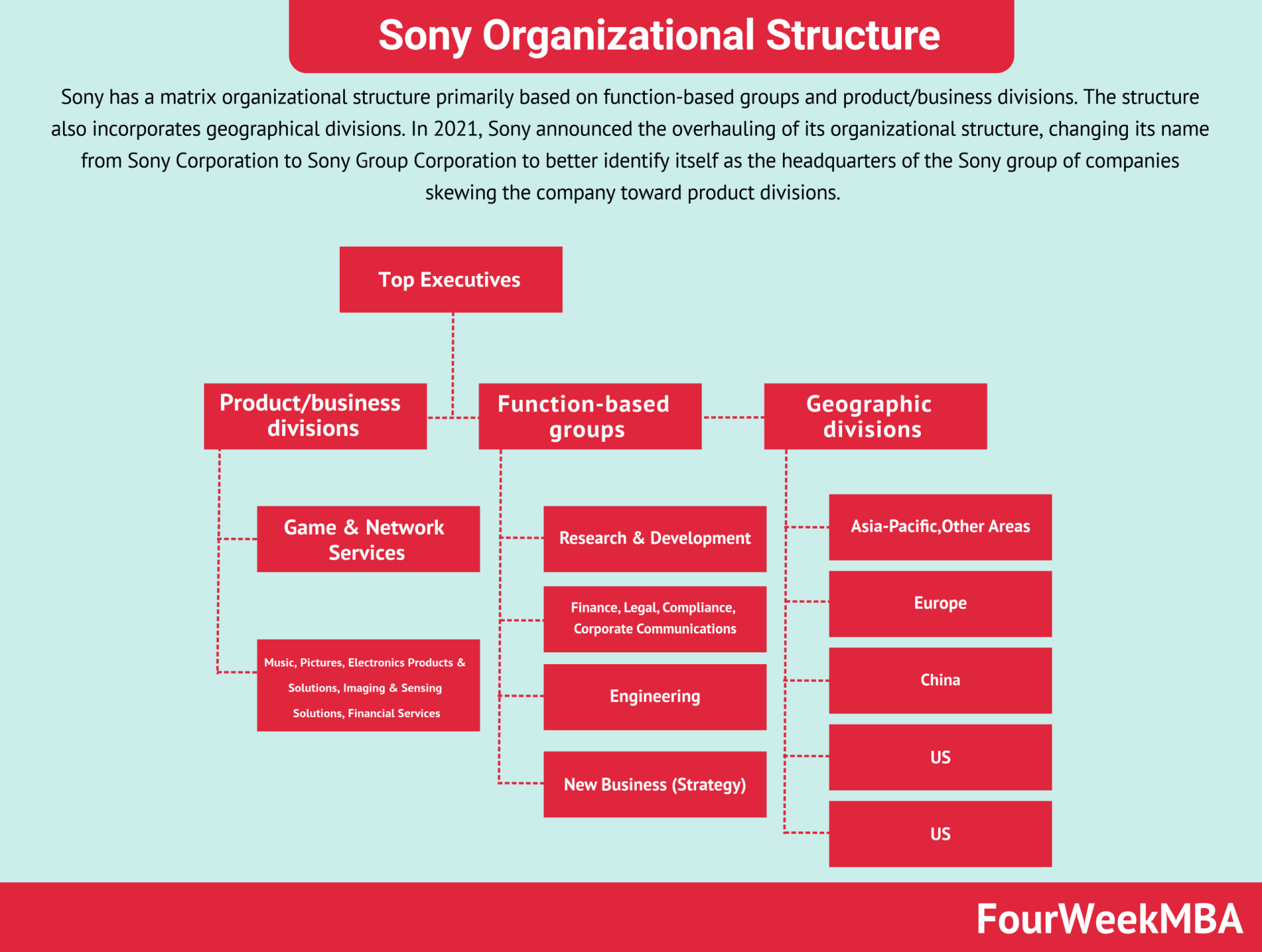
| Sony | Centralized Organization: Centralized control over product development and strategic initiatives. | Ensured high-quality product offerings and strategic alignment, driving market success and innovation. |
| Nike | Centralized Organization: Centralized control over product design and global marketing strategies. | Maintained brand consistency and high-quality product offerings, driving strong market presence and customer loyalty. |
| Chevron | Centralized Organization: Centralized decision-making for exploration, production, and refining activities. | Achieved efficiency in operations and resource allocation, driving profitability and global market leadership. |
| Disney | Centralized Organization: Centralized control over content creation and global marketing strategies. | Ensured high standards of quality and brand consistency, driving strong market presence and customer loyalty. |
| Related Organizational Structures | Description | Implications |
|---|---|---|
| Centralized Organizational Structure | A Centralized Organizational Structure is characterized by a hierarchical system where decision-making authority is concentrated at the top of the organization, typically with top management or a central executive team. Decision-making flows from top to bottom, and communication channels are structured in a clear hierarchy. Centralized structures often have a single point of control, with limited autonomy and discretion granted to lower-level employees or departments. | Centralized Organizational Structures offer clear lines of authority and control, enabling efficient decision-making and coordination within the organization. By consolidating decision-making power at the top, centralized structures can ensure consistency, uniformity, and alignment with organizational goals and objectives. However, they may also result in slower response times, reduced flexibility, and limited innovation due to the bottleneck effect at the top of the hierarchy. |
| Hierarchical Organizational Structure | A Hierarchical Organizational Structure is similar to a centralized structure but may involve multiple layers of management and decision-making authority distributed across various levels of the organization. Each level has distinct roles, responsibilities, and reporting relationships, with higher levels exercising authority and control over lower levels. Hierarchical structures emphasize vertical communication and supervision, with decision-making flowing from top to bottom. | Hierarchical Organizational Structures provide a systematic framework for organizing roles, responsibilities, and reporting relationships within the organization. By delineating clear lines of authority and accountability, hierarchical structures can facilitate effective coordination, delegation, and oversight of activities. However, they may also create bureaucratic inefficiencies, communication barriers, and decision-making delays due to the need for information to flow through multiple levels of management. |
| Command-and-Control Structure | Command-and-Control Structure is a traditional management approach characterized by centralized decision-making and strict top-down control over organizational activities. It involves managers or leaders dictating instructions and tasks to subordinates, who are expected to follow orders without question. Command-and-control structures prioritize obedience, compliance, and conformity to authority, with little room for employee autonomy or initiative. | Command-and-Control Structures offer clarity and direction in organizational operations, ensuring that tasks are executed according to established procedures and standards. By centralizing decision-making and control, command-and-control structures can maintain consistency, discipline, and adherence to organizational policies. However, they may stifle creativity, innovation, and employee engagement, as individuals may feel disempowered or constrained by rigid hierarchical control. |
| Traditional Organizational Structure | Traditional Organizational Structures typically follow a centralized model of management, with decision-making authority concentrated at the top of the hierarchy. They often have well-defined roles, responsibilities, and reporting relationships, with clear lines of authority and supervision. Traditional structures may be prevalent in industries or organizations with stable environments, established routines, and hierarchical cultures. | Traditional Organizational Structures provide stability and orderliness in organizational operations, enabling efficient coordination and control. By centralizing decision-making and authority, traditional structures can ensure consistency, compliance, and alignment with organizational goals. However, they may struggle to adapt to change, respond to emerging opportunities, or foster innovation due to their hierarchical and bureaucratic nature. |
Read Next: Organizational Structure.
Types of Organizational Structures

Siloed Organizational Structures
Functional

Divisional

Open Organizational Structures
Matrix

Flat

Connected Business Frameworks


Nadler-Tushman Congruence Model

McKinsey’s Seven Degrees of Freedom


Organizational Structure Case Studies
OpenAI Organizational Structure

Airbnb Organizational Structure

Amazon Organizational Structure

Apple Organizational Structure

Coca-Cola Organizational Structure

Costco Organizational Structure


Facebook Organizational Structure

Goldman Sachs’ Organizational Structure

Google Organizational Structure


McDonald’s Organizational Structure

McKinsey Organizational Structure

Microsoft Organizational Structure

Nestlé Organizational Structure


Patagonia Organizational Structure

Samsung Organizational Structure

Starbucks Organizational Structure

Tesla Organizational Structure

Toyota Organizational Structure

Walmart Organizational Structure

Main Free Guides:
- Business Models
- Business Strategy
- Business Development
- Digital Business Models
- Distribution Channels
- Marketing Strategy
- Platform Business Models
- Revenue Models
- Tech Business Models


