While it’s tempting to complex things up when performing businessanalysis, in reality, there is a simple tool, that you have been using for years, which can help you to perform a good part of your analysis: Google.
A comparable company analysis is a process that enables the identification of similar organizations to be used as a comparison to understand the business and financial performance of the target company. To find comparables you can look at two key profiles: the business and financial profile. From the comparable company analysis it is possible to understand the competitive landscape of the target organization.
Performing a comparative analysis can be tricky in today’s’ business environment, especially if you’re looking at digital platforms.
That’s because the boundaries of business strategy and many new industries, risen during the web era, are still consolidating. Therefore, some players, while dominating in some industries are overlapping in some others.
For instance, Google dominates search and digital advertising, yet Amazon also is a competitor. On the other end, Amazon AWS is a key player in the cloud space, yet Google Cloud also competes.
And Microsoft has its hands in search, advertising, and cloud, thus being dominant in some industries (cloud) yet competing in others (search, advertising).
In this scenario, there is a free tool, with billions of data points that can kick start your analysis.
Search is a lot about discovery—the basic human need to learn and broaden your horizons. But searching still requires a lot of hard work by you, the user. So today I’m really excited to launch the Knowledge Graph, which will help you discover new information quickly and easily.
…The Knowledge Graph enables you to search for things, people or places that Google knows about—landmarks, celebrities, cities, sports teams, buildings, geographical features, movies, celestial objects, works of art and more—and instantly get information that’s relevant to your query. This is a critical first step towards building the next generation of search, which taps into the collective intelligence of the web and understands the world a bit more like people do.
…the Knowledge Graph can help you make some unexpected discoveries. You might learn a new fact or new connection that prompts a whole new line of inquiry. Do you know where Matt Groening, the creator of the Simpsons (one of my all-time favorite shows), got the idea for Homer, Marge and Lisa’s names? It’s a bit of a surprise:
In 2012, Google started to roll out officially its Knowledge Graph (though its attempt to make the search experience even smarter and more semantic started way back and it escalated when the company acquired MetaWeb).
With that, Google started do develop more and more features related to giving beyond the classic ten blue links we have seen for years.
Those features we see appearing more and more on search results are coming from the massive Google’s semantic database made of billions of data points called Knowledge Graph.
Within the Knowledge Graph, Google combined semantic knowledge, to billions of users’ preferences and data, refined by its powerful algorithms and refined by its human raters.
This massive knowledge base is there to be explored, for free, it only requires you to be aware of it.
Industry analysis and set up
To start using your free BI tool by performing a simple search like “Amazon” you will see how Google will suggest on the search results a set of entities, or defined things in the Google Knowledge Graph. This matters because those entities draw data from Google Knowledge Graph which is a combination of things that Google’s algorithms learned over the years, as the data coming from billions of users each day. In short, you have a powerhouse at your disposal to start up your analysis.
When searching for “Amazon” on Google, at the bottom of the page (from desktop) you will find several suggestions from Google, based on the industries where Amazon operates.
In short, Google is suggesting that Amazon primarily operates as an online retailer, and as such it compares it with other retailers (online and offline). Yet Google’s Knowledge Graph also expands on that and tells you more.
Amazon is also an AI company competing against other AI companies which offers you an interesting insight into the products of the company.
At the same time, Google is suggesting that Amazon is also a key player in the cloud space, thus it offers you some perspectives of how the cloud industry looks like by pointing out some direct competitors (like Microsoft and Oracle) and other companies operating in the cloud space.
How the Google Knowledge Graph expands your search by providing interesting insights and a quick overview of companies that might make sense to comprise in your analysis. This is extremely useful to speed up the set up of your analysis.
Expand the research
From there you can drill down in each of the carousels you see showing on Google to have a more detailed overview and expand the research. You can stretch it as far as you want, depending on the scope of the analysis.
Example of how you can differentiate among physical retailers and department stores by looking at “related search.” This is a great feature as it enables you to see how in the mind consumers ho a brand is potentially perceived. So what they look also for when looking for the same brand. You can also drill down in each category, suck as “AI companies” and navigate within the carousel to find out all the potential companies in the space, thus expanding you analysis. You can do the same with “cloud companies”
Discover new data points
As example, when you drill further down and you search for “cloud companies” at the bottom fo the search result page you will find other categories of companies part of the cloud industry.
From PaaS to IaaS models all born as part of the cloud industry.
Expand the search to find out more and figure out new models from PaaS to IaaS and more.
Key takeaway
When performing an analysis, try to ask a difficult question like “what’s the single data point (or data points) that can tell me a lot about the company I’m researching?”
While it’s easy to look for the ultimate business intelligence tools when performing an analysis, in reality, it makes sense to stop for a second and think what might be the single data points that can give you insights about a company.
From there you can use explorative tools, like Google to find out and drill down to draft an analysis that can give you different insights and enable you to reverse engineer many large companies.
Key Highlights
Simplifying Business Analysis with Google: Google can serve as a powerful and simple tool for businessanalysis. Its extensive data resources can provide valuable insights for analysis, particularly in a digital landscape.
Comparable Company Analysis: Comparable company analysis involves identifying similar organizations for comparison to understand a target company’s business and financial performance. Two key profiles, business, and financial, are used to find comparables and discern the competitive landscape.
Complexities of Comparative Analysis: Performing a comparative analysis can be challenging in today’s dynamic business environment, especially with digital platforms. Boundaries between industries and strategies are still consolidating, leading to overlapping players in various sectors.
Leveraging Google’s Knowledge Graph: Google’s Knowledge Graph, launched in 2012, aids discovery by offering relevant information based on user queries. It serves as a free tool with billions of data points, providing insights from semantic knowledge, user preferences, and algorithms.
Using Google for Industry Analysis: Searching for entities like “Amazon” on Google reveals a wealth of information from the Knowledge Graph. It suggests industries Amazon operates in, such as online retail, AI, and cloud services, providing valuable insights for analysis.
Quick Overview and Insights: Google’s suggestions in search results and the Knowledge Graph offer insights into a company’s diverse operations and positioning in various industries. This accelerates the setup of analysis by providing a quick overview.
Expanding Research and Analysis: The Knowledge Graph enables deeper research by providing carousels with related information. Drilling down into categories such as AI companies or cloud companies expands the analysis and provides a more comprehensive view.
Discovering New Data Points: Exploring categories like “cloud companies” reveals diverse segments within the industry, from PaaS to IaaS models. This helps in understanding new models and expanding the analysis.
Key Takeaway: Focusing on Single Data Points That Matter: Instead of seeking complex business intelligence tools, consider identifying single data points that provide substantial insights. Exploratory tools like Google can help draft analyses, offering diverse perspectives and enabling the reverse engineering of large companies.
A Blockchain Business Model according to the FourWeekMBA framework is made of four main components: Value Model (Core Philosophy, Core Values and Value Propositions for the key stakeholders), Blockchain Model (Protocol Rules, Network Shape and Applications Layer/Ecosystem), Distribution Model (the key channels amplifying the protocol and its communities), and the Economic Model (the dynamics/incentives through which protocol players make money). Those elements coming together can serve as the basis to build and analyze a solid Blockchain Business Model.
In an asymmetric businessmodel, the organization doesn’t monetize the user directly, but it leverages the data users provide coupled with technology, thus have a key customer pay to sustain the core asset. For example, Google makes money by leveraging users’ data, combined with its algorithms sold to advertisers for visibility.
In a business world driven by technology and digitalization, competition is much more fluid, as innovation becomes a bottom-up approach that can come from anywhere. Thus, making it much harder to define the boundaries of existing markets. Therefore, a proper business competition analysis looks at customer, technology, distribution, and financial model overlaps. While at the same time looking at future potential intersections among industries that in the short-term seem unrelated.
Technological modeling is a discipline to provide the basis for companies to sustain innovation, thus developing incremental products. While also looking at breakthrough innovative products that can pave the way for long-term success. In a sort of Barbell Strategy, technological modeling suggests having a two-sided approach, on the one hand, to keep sustaining continuous innovation as a core part of the businessmodel. On the other hand, it places bets on future developments that have the potential to break through and take a leap forward.
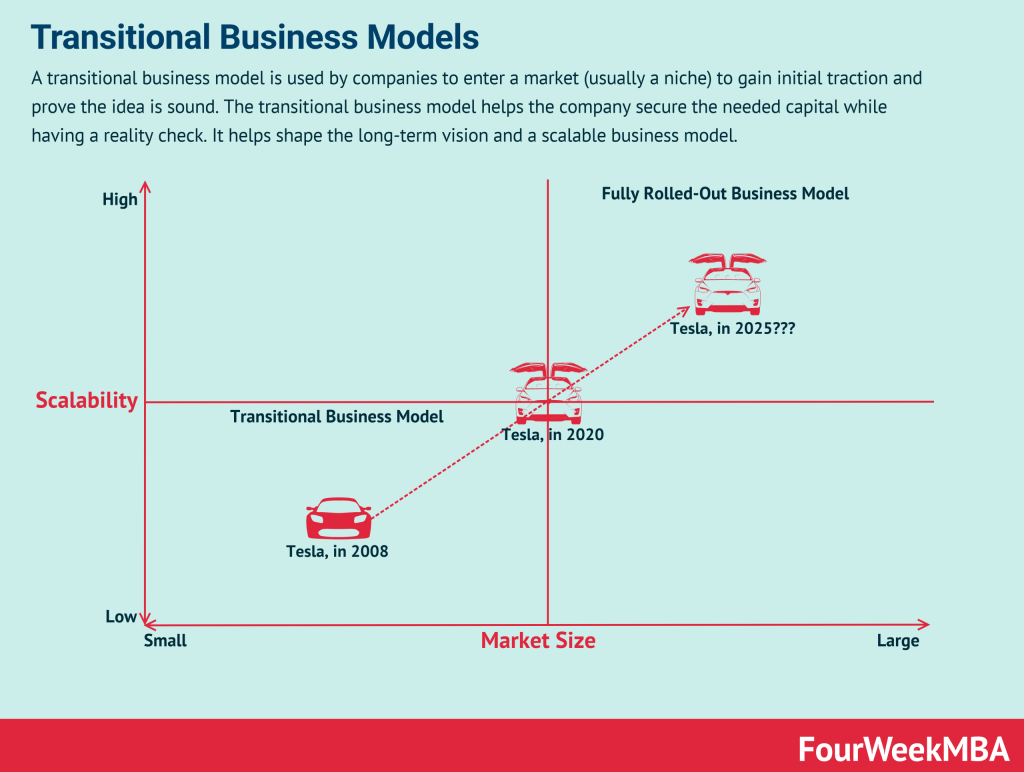
A transitional business model is used by companies to enter a market (usually a niche) to gain initial traction and prove the idea is sound. The transitional business model helps the company secure the needed capital while having a reality check. It helps shape the long-term vision and a scalable businessmodel.
The minimum viable audience (MVA) represents the smallest possible audience that can sustain your business as you get it started from a microniche (the smallest subset of a market). The main aspect of the MVA is to zoom into existing markets to find those people which needs are unmet by existing players.
Business scaling is the process of transformation of a business as the product is validated by wider and wider market segments. Business scaling is about creating traction for a product that fits a small market segment. As the product is validated it becomes critical to build a viable businessmodel. And as the product is offered at wider and wider market segments, it’s important to align product, businessmodel, and organizational design, to enable wider and wider scale.
The market expansion consists in providing a product or service to a broader portion of an existing market or perhaps expanding that market. Or yet, market expansions can be about creating a whole new market. At each step, as a result, a company scales together with the market covered.
In the FourWeekMBA growth matrix, you can apply growth for existing customers by tackling the same problems (gain mode). Or by tackling existing problems, for new customers (expand mode). Or by tackling new problems for existing customers (extend mode). Or perhaps by tackling whole new problems for new customers (reinvent mode).
In the FourWeekMBA Revenue Streams Matrix, revenue streams are classified according to the kind of interactions the business has with its key customers. The first dimension is the “Frequency” of interaction with the key customer. As the second dimension, there is the “Ownership” of the interaction with the key customer.
Revenue model patterns are a way for companies to monetize their business models. A revenue model pattern is a crucial building block of a business model because it informs how the company will generate short-term financial resources to invest back into the business. Thus, the way a company makes money will also influence its overall businessmodel.
A pricing strategy or model helps companies find the pricing formula in fit with their business models. Thus aligning the customer needs with the product type while trying to enable profitability for the company. A good pricing strategy aligns the customer with the company’s long term financial sustainability to build a solid businessmodel.
Gennaro is the creator of FourWeekMBA, which reached about four million business people, comprising C-level executives, investors, analysts, product managers, and aspiring digital entrepreneurs in 2022 alone | He is also Director of Sales for a high-tech scaleup in the AI Industry | In 2012, Gennaro earned an International MBA with emphasis on Corporate Finance and Business Strategy.