Workers displaced from AI-exposed jobs since 2025 took about a month longer to find a new job than other displaced workers, Goldman Sachs economist Pierfrancesco Mei found in a note published Thursday, Fortune reported on 30 October 2026. They were also roughly 10 percentage points more likely to still be unemployed a year after losing their job, according to the report.
Mei wrote that those effects are “comparable in magnitude” to what Goldman found in earlier waves of technological change, calling the damage from those waves “long-lasting”, according to Fortune. We have not read the Goldman note itself.
A vertical news Short narrated from this piece’s headline and opening line.
Business Engineer Course · The FDE Playbook
An evergreen Business Engineer course on forward-deployed engineering, how AI gets put to work inside organisations. It teaches the general idea only and does not discuss Goldman Sachs or this research.
The key insight: Goldman Sachs economist Pierfrancesco Mei found that workers displaced from AI-exposed jobs since 2025 took about a month longer to find a new job than other displaced workers, Fortune reports, while BLS data show reemployment for long-tenured workers 65 and older running 34.3 percentage points below those 25 to 54, by our arithmetic.
According to Fortune, AI-displaced workers 35 and older took about five weeks longer than other displaced workers to get back to full-time work, and those under 35 about three weeks longer. That is a gap of about two weeks between the age groups, by our arithmetic.
Fortune reports that Goldman analysed more than 15,000 displaced workers who lost jobs between 2016 and 2025, using the Current Population Survey’s Displaced Worker Supplement. Goldman said the newly released 2023 to 2025 data “likely captures the first wave of AI-displaced workers”.
No survey question asks whether AI cost someone their job, Fortune notes. Goldman built a score from the occupation’s AI exposure, the industry’s AI adoption rate and whether the position was eliminated, and treated the top 30% as likely AI-displaced, according to the report. Goldman found no significant gap between the two groups for job losses before 2023.
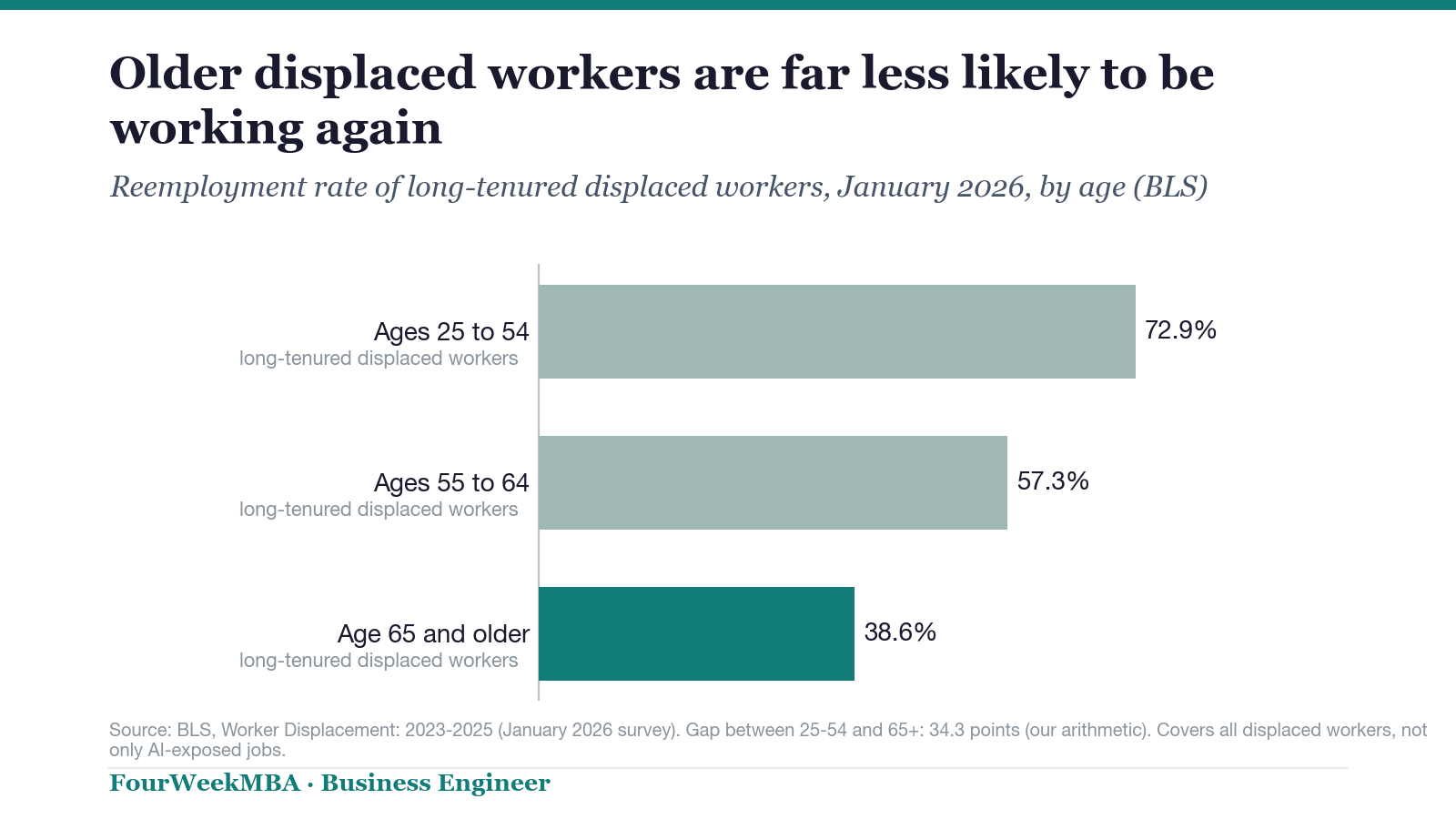
Reemployment rate of long-tenured displaced workers in January 2026, by age, from the Bureau of Labor Statistics. These figures cover all displaced workers, not only those in AI-exposed jobs.
The Government Numbers Underneath
The Bureau of Labor Statistics reported that displaced workers “totaled 7.4 million from 2023 to 2025”, up from 6.3 million for the 2021-23 survey period. That is an increase of about 17 percent, by our arithmetic.
Among long-tenured displaced workers, BLS says the reemployment rate in January 2026 was 72.9 percent for those ages 25 to 54, 57.3 percent for ages 55 to 64 and 38.6 percent for those 65 and older. The gap between the youngest and oldest of those groups is 34.3 percentage points, by our arithmetic.
Of reemployed full-time workers who reported earnings on their lost job, “about 49 percent were earning as much or more than they did at their lost job”, BLS says, “compared with about 62 percent from the prior survey in January 2024”. That is a drop of about 13 percentage points, by our arithmetic.
Who Recovers Faster
Goldman’s earlier research, using data back to 1979, found that younger, college-educated and urban workers saw cumulative real earnings losses about half as large as other technology-displaced workers over 10 years, Fortune reports. Mei wrote that younger workers “may be able to adapt more flexibly to AI disruption”.
Goldman cautioned it is “still too early to assess the impact along all of these dimensions”, such as education and geography, according to Fortune. The report adds that Stanford researchers wrote they “do not see widespread, economy-wide job displacement associated with AI”.
Public sentiment (30 Oct). The first Axios-CivicScience AI Sentiment Index, published 30 October, put net sentiment on whether AI will grow the economy at +10 and on whether it will create more jobs at -30.4, according to Axios. The online polling ran from 1 to 26 October with more than 7,300 respondents aged 18 and over, and October’s overall reading was 41.8 on a 0 to 100 scale. The gap between the two measures is 40.4 points, our arithmetic.
The Structural Read
As we read the report, the new element is timing: Goldman says the 2023 to 2025 data likely captures the first wave of AI-displaced workers, and it found no significant gap for job losses before 2023.
As we read the BLS figures, the share of reemployed full-time workers earning as much or more fell about 13 percentage points between surveys, by our arithmetic; BLS does not attribute that to AI.
As we read the age data, Goldman’s three-week and five-week gaps point the same way as the BLS reemployment rates by age, though the two measure different groups.
Goldman Sachs economist Pierfrancesco Mei, as quoted by Fortune, 30 October 2026
“may be able to adapt more flexibly to AI disruption”
Three Implications
FOR DISPLACED WORKERS Fortune reports Goldman found AI-displaced workers 35 and older took about five weeks longer than other displaced workers to get back to full-time work.
FOR EMPLOYERS Fortune reports employers have cited AI in 120,136 announced job cuts through September, about 21% of all cuts, according to Challenger, Gray & Christmas.
FOR THE EVIDENCE BASE Fortune reports Stanford researchers wrote they do not see widespread, economy-wide job displacement associated with AI.
The framework says “Full-range cognitive workers earn a structural premium that automation cannot touch.”
The framework is the owner’s argument, not evidence about displaced workers; it was published in June 2026 and does not discuss Goldman’s note, Fortune’s report or the BLS figures.
What Is Not Established
We have not read Goldman’s note, which Fortune reports; the Goldman figures here are as Fortune states them. Goldman’s AI-displacement label is an estimate built from occupation and industry scores, not a survey answer. The BLS figures cover all displaced workers, not only those in AI-exposed jobs.
This Week In The AI Supercycle
Execution Fault Lines, Concentrated Demand, and Geopolitical Firewalls
This week’s issue: the AI build is not short of demand for its parts. It is short of cheap money, and its end revenue rests on a narrow base of large, often venture-funded buyers.
Goldman Sachs economist Pierfrancesco Mei found that workers displaced from AI-exposed jobs since 2025 took about a month longer to find new work than other displaced workers, and called the effects of earlier technology waves “long-lasting”, Fortune reports.
A note on sourcing. Goldman findings are as reported by Fortune on 30 October 2026; we have not read the Goldman note. Displacement and reemployment figures come from the Bureau of Labor Statistics. Figures labelled our arithmetic are our own calculations.
Gennaro Cuofano is a CRO and tech executive who has worked in AI since late 2015, starting with bringing NLP, natural-language generation, voice and chatbot products to the marketing industry. His background is in law and finance: he holds a Master's degree in Law and an International MBA with an emphasis on corporate finance (LUISS Business School and the University of San Diego, 2012), and worked as a financial analyst at a real-estate investment firm in San Diego and as an assistant controller. His work focuses on business model strategy, business engineering and, more broadly, structural analysis: how companies make money, read from their own filings. He created FourWeekMBA and leads research there and at The Business Engineer, his newsletter on AI and business strategy, with over 95,000 subscribers and more than 1,000 published analyses. His writing has also appeared on Entrepreneur (for example, How to Digitize a Family Business in Europe) and HackerNoon. Find him on LinkedIn and Substack. See how we source.