Nvidia is close to paying more than $500 million for Inception, a startup that builds diffusion language models, The Information reported, as we covered on 19 November. A diffusion model writes a whole answer at once and then refines it, instead of producing one word after another.
This explainer covers how diffusion models differ from today’s chatbots, how fast their makers say they are, what the trade-offs look like and why a chipmaker might want the team behind them.
We track what AI models can do, and how they compare, on our AI model benchmarks page.
Business Pill: Cost Per Task
An evergreen Business Engineer explainer on paying for the finished job rather than the token. It teaches the general idea only and does not discuss diffusion models or Inception.
The key insight: Diffusion language models draft a whole answer and refine it instead of writing word by word; Inception cites 1,109 tokens per second for Mercury Coder Mini, Google lists 1,479 for Gemini Diffusion, and The Information reports Nvidia is close to paying more than $500 million for Inception.
Most large language models are autoregressive. They write one token, a word or part of a word, at a time, left to right, and each new token waits for the one before it.
Google DeepMind puts it this way: “Traditional autoregressive language models generate text one word – or token – at a time. This sequential process can be slow, and limit the quality and coherence of the output.”
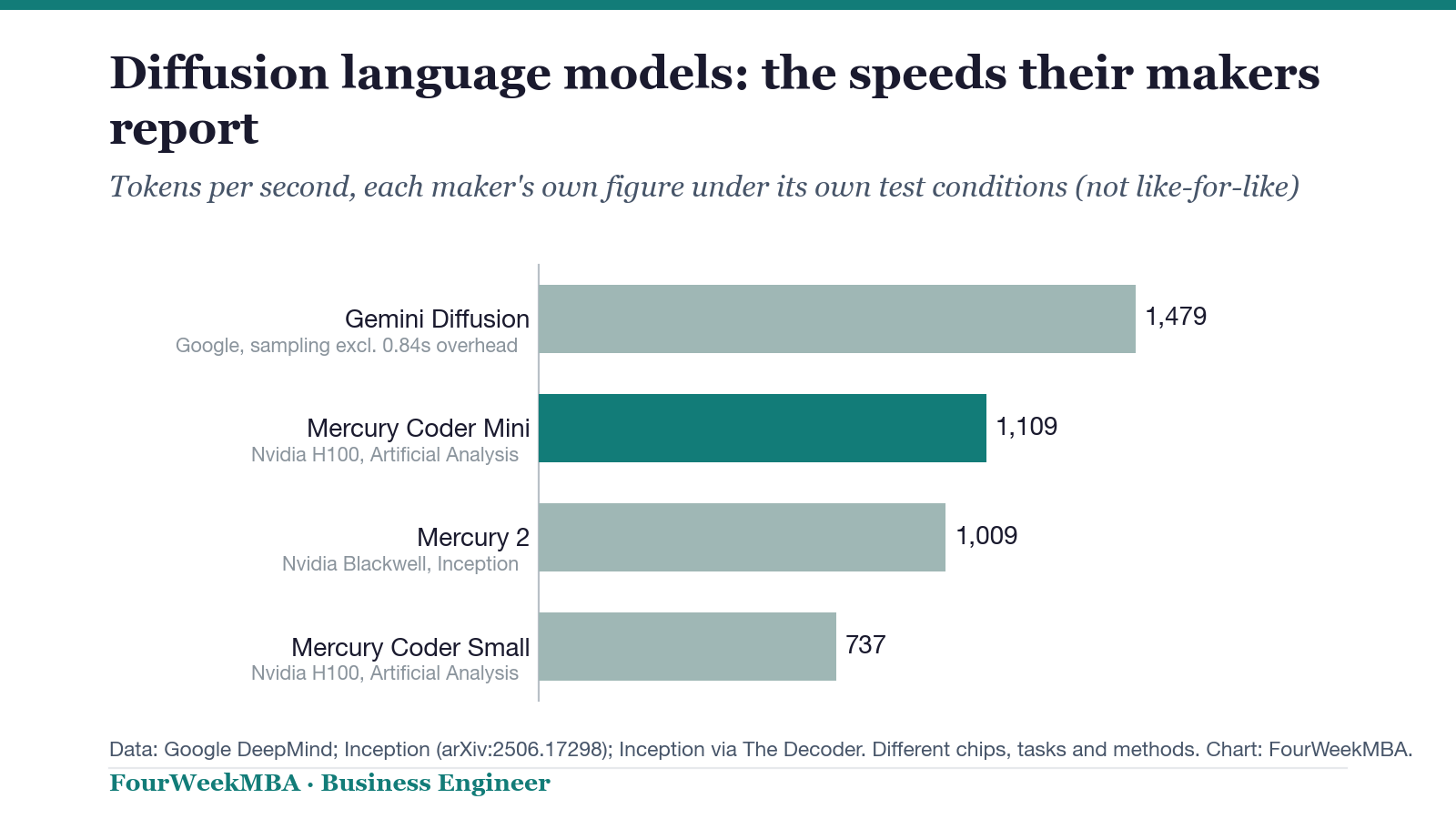
Reported speeds: Gemini Diffusion 1,479 tokens per second (Google); Mercury Coder Mini 1,109 and Small 737 on Nvidia H100 (Artificial Analysis, cited by Inception); Mercury 2 1,009 on Nvidia Blackwell (Inception, via The Decoder). Not a like-for-like comparison.
What Does a Diffusion Model Do Differently?
Diffusion is the technique behind many image generators. The model starts from noise and cleans it up step by step until a picture appears. Applied to text, the model drafts a whole block of tokens and improves it over several passes.
Diffusion models “learn to generate outputs by refining noise, step-by-step”, Google DeepMind says, so they “can iterate on a solution very quickly and error correct during the generation process.” Inception’s Mercury paper describes its models as Transformers “trained to predict multiple tokens in parallel.”
The approach is not limited to one company. Researchers behind LLaDA, a diffusion model trained from scratch, reported that their 8-billion-parameter version was “competitive with strong LLMs like LLaMA3 8B in in-context learning.”
How Fast Are They?
Speed is the main claim. In its June 2025 paper, Inception said independent evaluations by Artificial Analysis put Mercury Coder Mini and Mercury Coder Small at 1,109 and 737 tokens per second on Nvidia H100 chips. It said they outperform speed-optimised frontier models “by up to 10x on average while maintaining comparable quality.”
Inception later said Mercury 2 reaches 1,009 tokens per second on Nvidia Blackwell chips, The Decoder reported, and in October it said Mercury 3 runs “4–8x faster at 1,000+ tokens per second” than the rivals it named, as we reported. Google lists a sampling speed of 1,479 tokens per second for its experimental Gemini Diffusion, excluding 0.84 seconds of overhead.
These are the makers’ own figures, measured on different chips and tasks, so they are not a like-for-like race.
What Are the Trade-Offs?
Quality is the open question. On Google’s own table, Gemini Diffusion beat Gemini 2.0 Flash-Lite on some coding tests, such as LiveCodeBench at 30.9% against 28.5%, but trailed it on others, such as GPQA Diamond at 40.4% against 56.5%.
The makers also claim more control. Inception says the diffusion framework “provides fine‑grained control over outputs, allowing adherence to specific schemas and semantic constraints”, and Google says refining as it goes “helps them excel at tasks like editing.” Those are the companies’ descriptions, not independent findings.
Why Does Speed Matter for Cost?
Every answer an AI model gives uses chip time. A model that produces tokens faster can serve more answers on the same hardware. Inception claims “5-7x higher throughput, and up to 70% lower cost per task” on its homepage.
Epoch AI estimated that agentic inference capacity, the ability to run AI agents, grew 4.6 times from the second quarter of 2025 to the second quarter of 2026, against 2.6 times for computing power, as we reported.
Why Would Nvidia Buy Inception?
The Information reported that Nvidia is close to paying more than $500 million for Inception, a company with just over 30 employees that had raised $50 million. That works out to roughly $16 million per employee, by our arithmetic. Neither company has announced a deal.
Inception’s $50 million seed round in November 2025 was led by Menlo Ventures, with NVentures, Nvidia’s venture arm, taking part. Wall St Engine, summarising The Information’s report, said Nvidia plans to use the technology and researchers to strengthen its Nemotron open-weight models and its robotics systems.
The Structural Read
As we read it, the case for diffusion models is about serving cost as much as quality: faster tokens mean more answers per chip.
As we read it, the quality picture is mixed on the makers’ own tables, so the speed claims matter most for tasks where a fast, editable draft is good enough.
Google DeepMind, Gemini Diffusion
“Instead of predicting text directly, they learn to generate outputs by refining noise, step-by-step.”
Three Implications
FOR AI USERS Faster drafts and edits are the main promise, per the makers.
FOR AI LABSGoogle reports Gemini Diffusion beating a fast rival on some tests and trailing on others.
FOR CHIPMAKERS The Information reports Nvidia is close to buying a diffusion model team.
What Is Not Established
The speed and cost figures come from Inception and Google. Independent tests exist for some of them, such as the Artificial Analysis evaluations cited in Inception’s paper, but quality comparisons vary by task, and diffusion models are not yet the default for general chat.
This Week In The AI Supercycle
A World Without an Order, and an AI Central Bank Without a Successor
This week’s issue: the week AI memory stayed largely sold out while the people holding the shares paid: why the AI Supercycle is not a dot-com replay, read through geopolitics, macro and technology, with the gap between building and financing the widest we’ve recorded.
Diffusion language models draft a whole answer and refine it instead of writing word by word. Their makers say that makes them several times faster, with Inception citing 1,109 tokens per second for Mercury Coder Mini, and Nvidia is reported to be close to paying more than $500 million for the team.
A diffusion language model generates a whole block of text at once and refines it over several passes, the way image diffusion models clean up noise into a picture. Most chatbots are autoregressive instead: they write one token at a time, left to right.
Are diffusion language models faster?
Their makers say so. Inception's paper cites Artificial Analysis evaluations of 1,109 and 737 tokens per second for Mercury Coder Mini and Small on Nvidia H100 chips, and Google lists 1,479 tokens per second for its experimental Gemini Diffusion. The figures use different chips and tasks.
Are they as good as normal models?
It depends on the task. On Google's own table, Gemini Diffusion beat Gemini 2.0 Flash-Lite on some coding tests and trailed it on others, such as the GPQA Diamond science test at 40.4% against 56.5%.
Why does Nvidia want Inception?
The Information reported that Nvidia is close to paying more than $500 million for Inception, a diffusion modelstartup with just over 30 employees that had raised $50 million. Wall St Engine, summarising that report, said Nvidia plans to use Inception's technology and researchers to strengthen its Nemotron open-weight models and its AI systems for robotics. Neither company has announced a deal.
A note on sourcing. The descriptions of autoregressive and diffusion generation and the Gemini Diffusion speed and benchmark figures are from Google DeepMind’s Gemini Diffusion page. The Mercury Coder speeds and the up-to-10x claim are from Inception’s June 2025 paper, which cites Artificial Analysis; Mercury 2 and Mercury 3 figures are Inception’s, as reported by The Decoder and in our October piece; the throughput and cost claims are from Inception’s homepage. The LLaDA result is from its authors’ paper. The deal details are The Information’s reporting, via our 19 November piece and its updates; the Nemotron and robotics plans are Wall St Engine’s summary of that report. The per-employee figure is our arithmetic.
Gennaro Cuofano is a CRO and tech executive who has worked in AI since late 2015, starting with bringing NLP, natural-language generation, voice and chatbot products to the marketing industry. His background is in law and finance: he holds a Master's degree in Law and an International MBA with an emphasis on corporate finance (LUISS Business School and the University of San Diego, 2012), and worked as a financial analyst at a real-estate investment firm in San Diego and as an assistant controller. His work focuses on business model strategy, business engineering and, more broadly, structural analysis: how companies make money, read from their own filings. He created FourWeekMBA and leads research there and at The Business Engineer, his newsletter on AI and business strategy, with over 95,000 subscribers and more than 1,000 published analyses. His writing has also appeared on Entrepreneur (for example, How to Digitize a Family Business in Europe) and HackerNoon. Find him on LinkedIn and Substack. See how we source.