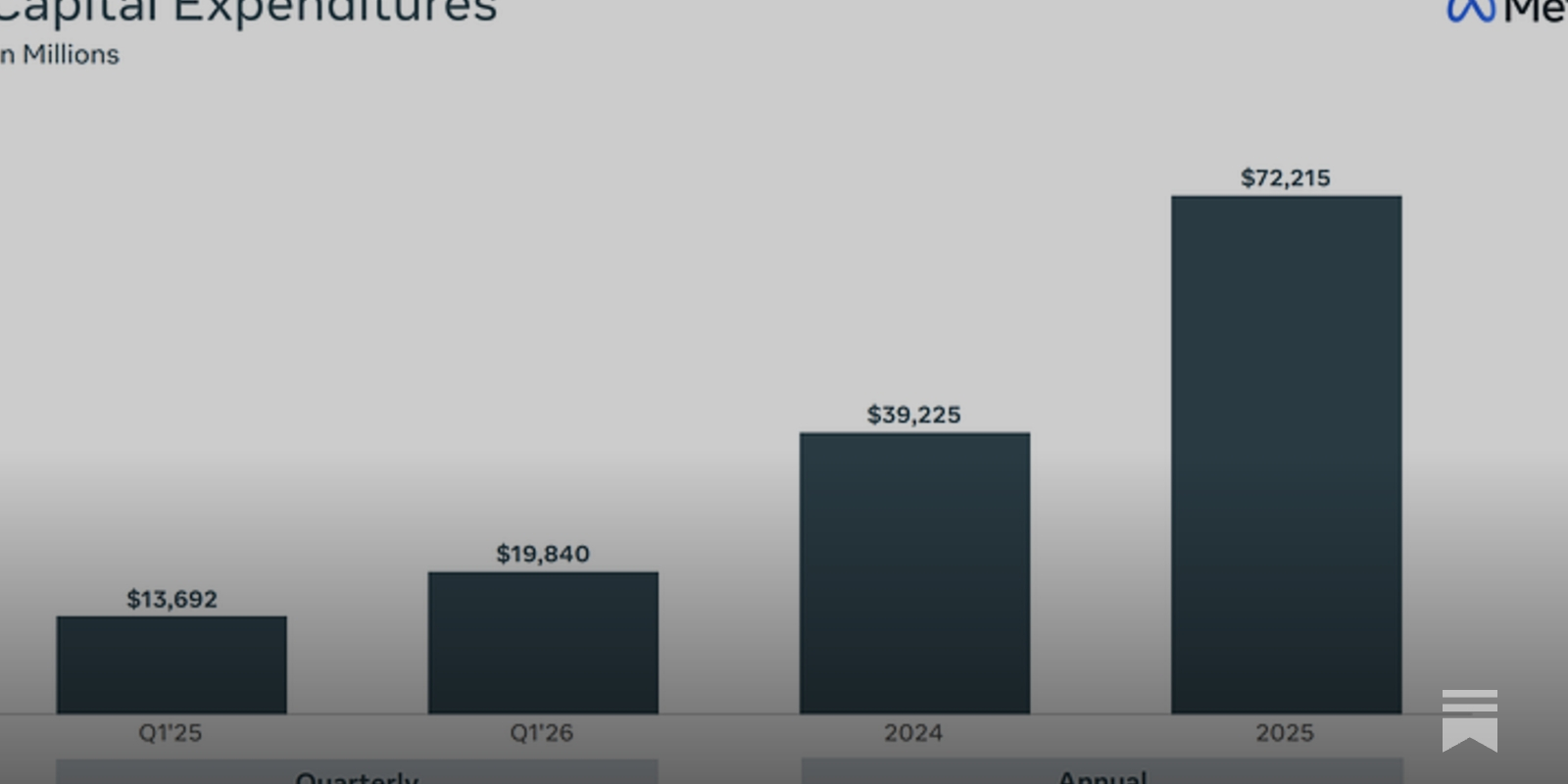
Meta has allocated over $40 billion annually to capital expenditures, primarily for AI infrastructure — as explored in the economics of AI compute infrastructure — development, funded almost entirely by its advertising revenue machine that generates nearly $135 billion in annual sales. The social media giant’s advertising business maintains operating margins exceeding 40%, creating a cash flow engine that supports one of the technology sector’s most aggressive AI infrastructure buildouts.
Advertising Revenue Fuels AI Infrastructure Spending
Meta’s advertising segment generated $131.9 billion in revenue during 2023, representing 97.5% of total company revenue. This advertising dominance provides the financial foundation for the company’s substantial AI investments, which include data center construction, specialized AI chips, and compute infrastructure.
Source: The Business Engineer
The company’s Reality Labs division, which houses its metaverse and AI hardware initiatives, posted an operating loss of $13.7 billion in 2023. Despite these losses, Meta continues expanding AI capabilities through its core advertising platform while simultaneously building next-generation AI infrastructure.
Capital Expenditure Trajectory Signals Long-Term Commitment
Meta’s capital expenditure guidance for 2024 ranges between $35-40 billion, with the majority allocated to AI-related infrastructure investments. This represents a significant increase from the $28.1 billion spent in 2023, according to analysis by The Business Engineer.
The company has constructed multiple data centers specifically designed for AI workloads, featuring custom-designed chips and advanced cooling systems. These facilities support both current advertising optimization algorithms and future AI product development initiatives.
Meta’s heavy reliance on advertising revenue creates both opportunity and risk for its AI investment strategy. The advertising business generates sufficient cash flow to fund AI development without external financing, but any significant downturn in digital advertising could impact investment capacity.
The company’s user base across Facebook, Instagram, WhatsApp, and Threads exceeds 3.98 billion monthly active users, providing scale advantages for both advertising revenue generation and AI model training data collection.
Competitive Position in AI Infrastructure Race
Meta competes directly with Google, Microsoft, and Amazon in AI infrastructure development, each company investing tens of billions annually. Meta’s approach differs through its focus on social media applications and consumer-facing AI products, rather than enterprisecloud services.
The company has open-sourced several AI models, including Llama 2, creating ecosystem benefits while reducing development costs compared to fully proprietary approaches adopted by competitors.
Strategic Implications for Technology Sector
Meta’s capital allocation strategy demonstrates how dominant digital platforms can leverage existing revenue streams to fund transformational technology investments. The sustainability of this approach depends on maintaining advertising revenuegrowth while achieving meaningful returns on AI infrastructure investments.
The company’s ability to self-fund AI development without diluting shareholders or increasing debt provides competitive advantages in the capital-intensive AI race. However, investor patience for return on AI investments may influence future spending levels and strategic priorities across the technology sector.
FREE NEWSLETTER
Get AI Strategy Intelligence Daily
Join 90,000+ strategists. Business modelanalysis, AI maps, and earnings deep dives — free.
Gennaro is the creator of FourWeekMBA, which reached about four million business people, comprising C-level executives, investors, analysts, product managers, and aspiring digital entrepreneurs in 2022 alone | He is also Director of Sales for a high-tech scaleup in the AI Industry | In 2012, Gennaro earned an International MBA with emphasis on Corporate Finance and Business Strategy.
Scroll to Top
Discover more from FourWeekMBA
Subscribe now to keep reading and get access to the full archive.