Drupal has patched a critical flaw in its core installer that can let an unauthenticated attacker reinstall a live site and take it over, and its advisory credits the discovery to Anthropic’s OSS Scanner, Cyber Kendra reported.
Drupal rates the bug, CVE-2026-132165, Critical at 18 out of 25 on its own risk scale, and fixed releases cover all three supported branches. Live price and key dates are on our Anthropic stock page.
Important: not investment advice
This article is for information and education only. It is not investment, financial, legal or tax advice, and it is not a recommendation or an offer to buy or sell any security, ETF, option or other financialproduct. FourWeekMBA is not a broker-dealer or a registered investment adviser. IPO shares, leveraged and inverse ETFs, and options carry significant risk, including the loss of your entire investment; leveraged and inverse ETFs reset daily and can lose value quickly. Prices, availability, fees and eligibility change and can differ by country and broker, so check the prospectus and your broker’s terms. Figures marked “our arithmetic” are our own calculations from the cited filings and may contain errors. Do your own research and consider speaking to a licensed financial professional before making any investment decision.
Business Pill · Least Privilege
An evergreen Business Engineer explainer. It teaches the general idea only and does not discuss this advisory.
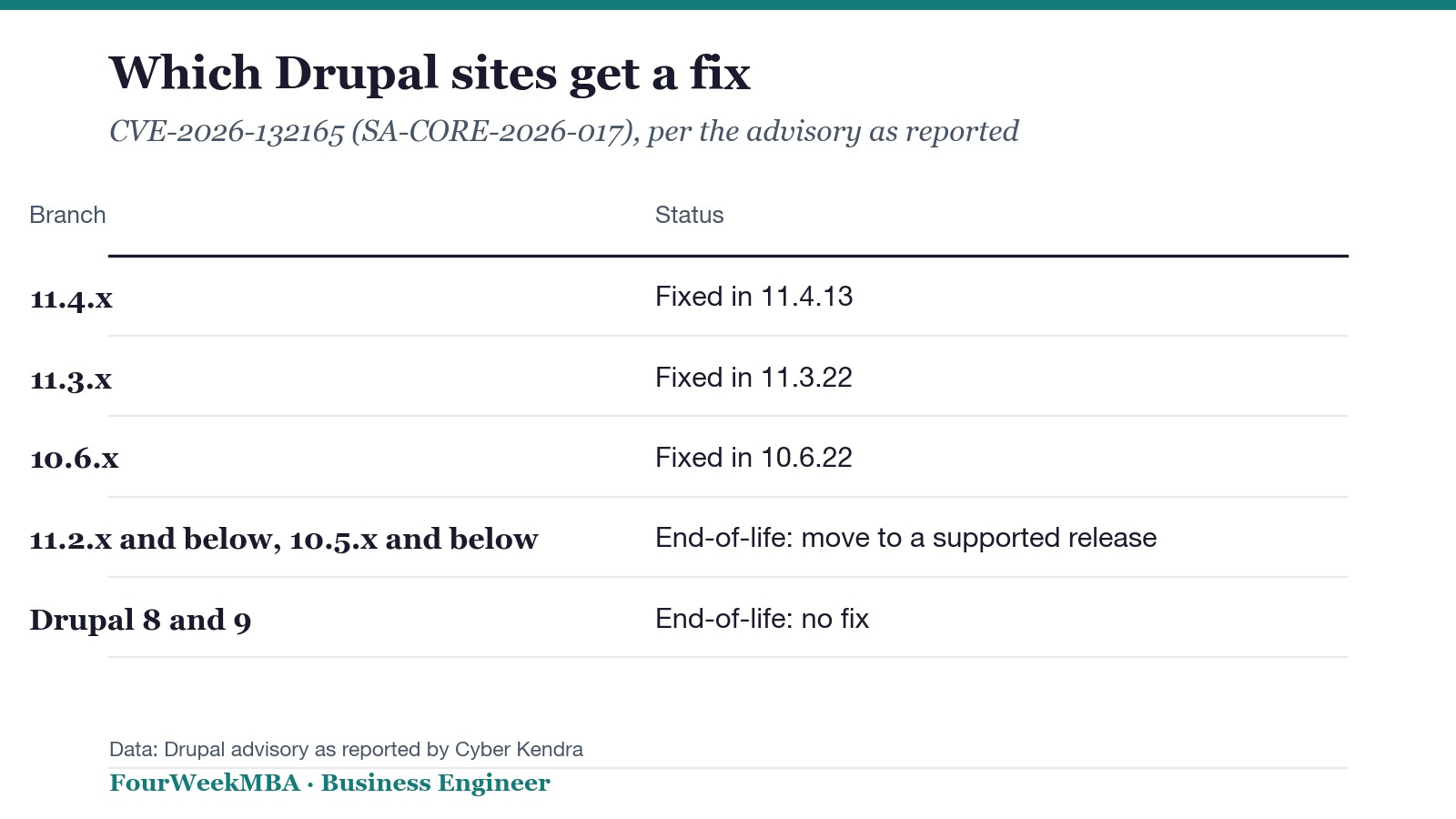
The key insight: Drupal credited Anthropic’s OSS Scanner with a critical installer flaw rated 18 of 25 that allows unauthenticated site takeover; fixes cover 11.4.13, 11.3.22 and 10.6.22.
The Drupal Security Team disclosed the issue in SA-CORE-2026-017 on Wednesday, 18 November, alongside fixed releases, per Cyber Kendra.
The flaw affects every supported Drupal core branch before 10.6.22, 11.3.22 and 11.4.13. Per Cyber Kendra, Drupal 11.2.x and below, 10.5.x and below, and Drupal 8 and 9 are end-of-life, and the advisory lists no fix for them.
Drupal’s fix covers its three supported branches; end-of-life branches get no patch, per the advisory as reported.
How the Attack Works
Drupal ships install.php, the script that sets up a new site. On an installed site it should refuse to run; under specific conditions, the bug lets an attacker invoke it anyway and start a reinstall.
A reinstall runs setup logic with the web server’s privileges, so an attacker can end up with administrative control and, from there, code execution on the host, according to Horizon3.ai’s analysis cited by Cyber Kendra.
Drupal’s own risk rating for the installer flaw, 18 of 25 (72%, our arithmetic).
Anthropic’s Role
Drupal credits the discovery to Anthropic’s OSS Scanner, which tracked the issue as ANT-2026-GMRPK0BU. The advisory lists Lee Rowlands of the Drupal Security Team among the reporters, with Pamela Barone, Scott Euser, Stephan Zeidler and Tyler Nighswander.
Drupal’s risk vector marks a proof of concept as existing, but no exploit code has been published. As of 20 November, neither Drupal nor Horizon3.ai reported exploitation in the wild, per Cyber Kendra.
The National Vulnerability Database had not published a CVSS score as of 20 November. A separate advisory, SA-CORE-2026-018, fixes a moderately critical gadget chain that needs admin rights and a second flaw, outlets report.
What Site Owners Should Do
Update to Drupal 11.4.13, 11.3.22 or 10.6.22. Outlets covering the advisory say sites that cannot update at once should block public access to /core/install.php and make sure settings.php is not writable by the web server.
Our Numbers
Drupal’s 18 out of 25 is 72% of its maximum risk score, and fixes span three supported branches (our arithmetic). Our check of a viral AI-cyber claim this week covers the attack side of the same trend.
The Structural Read
As we read it, AI labs are now named in open-source security advisories as bug finders, not just as tools.
As we read it, end-of-life Drupal sites carry the most risk, since the advisory lists no patch for them.
Cyber Kendra (20 Nov 2026)
“Drupal credits the discovery to Anthropic’s OSS Scanner, which tracked the issue as ANT-2026-GMRPK0BU.”
Three Implications
FOR SITE OWNERS Update to 11.4.13, 11.3.22 or 10.6.22, outlets advise; the advisory lists no fix for end-of-life branches.
FOR ANTHROPIC Its OSS Scanner is credited by name in Drupal’s advisory, per Cyber Kendra.
FOR SECURITY TEAMS No exploitation was reported as of 20 November, per Cyber Kendra.
What Is Not Established
We could not read Drupal’s advisory page directly, so its details are as quoted by outlets. Anthropic has not published its own write-up that we found, and no official CVSS score was out as of 20 November.
This Week In The AI Supercycle
AI Lost Its Central Banker, the Lab Oligopoly, and the Future of Open Source
This week’s issue: the Nvidia leadership change, read as the AI build-out losing its central banker: who now finances the GPU landlords, backstops the data centres and sponsors open models, and why two labs are becoming the bank.
Drupal patched a critical installer flaw rated 18 of 25 that allows unauthenticated site takeover, and credited Anthropic’s OSS Scanner with finding it.
Important: not investment advice
This article is for information and education only. It is not investment, financial, legal or tax advice, and it is not a recommendation or an offer to buy or sell any security, ETF, option or other financialproduct. FourWeekMBA is not a broker-dealer or a registered investment adviser. IPO shares, leveraged and inverse ETFs, and options carry significant risk, including the loss of your entire investment; leveraged and inverse ETFs reset daily and can lose value quickly. Prices, availability, fees and eligibility change and can differ by country and broker, so check the prospectus and your broker’s terms. Figures marked “our arithmetic” are our own calculations from the cited filings and may contain errors. Do your own research and consider speaking to a licensed financial professional before making any investment decision.
A note on sourcing. Drupal’s advisory page blocked our reader, so its details (rating, versions, credit, reporters) are as quoted by Cyber Kendra and other outlets that read it. Horizon3.ai’s analysis is cited via Cyber Kendra. The mitigation steps are as described by outlets covering the advisory. The 72% and the branch count are our arithmetic.
Gennaro Cuofano is a CRO and tech executive who has worked in AI since late 2015, starting with bringing NLP, natural-language generation, voice and chatbot products to the marketing industry. His background is in law and finance: he holds a Master's degree in Law and an International MBA with an emphasis on corporate finance (LUISS Business School and the University of San Diego, 2012), and worked as a financial analyst at a real-estate investment firm in San Diego and as an assistant controller. His work focuses on business model strategy, business engineering and, more broadly, structural analysis: how companies make money, read from their own filings. He created FourWeekMBA and leads research there and at The Business Engineer, his newsletter on AI and business strategy, with over 95,000 subscribers and more than 1,000 published analyses. His writing has also appeared on Entrepreneur (for example, How to Digitize a Family Business in Europe) and HackerNoon. Find him on LinkedIn and Substack. See how we source.