Figma competes with various design and prototyping tools like Sketch, Adobe XD, InVision Studio, and Axure RP. It also faces competition from collaboration and project management tools such as Miro, Zeplin, Jira, and Trello. These tools offer alternative solutions for design, collaboration, and project management needs in the digital design industry.
Competitor
Description
Key Insights
Competitive Overlap
Differentiation
Adobe XD
A design and prototyping tool by Adobe, known for its integration with other Adobe Creative Cloud apps. Adobe XD competes directly with Figma in the design and prototyping software market.
Adobe XD offers design and prototyping capabilities, directly competing with Figma in segments like UI/UX design, collaboration, and integration with other Adobe software, targeting designers and creative professionals.
Both compete in the design and prototyping software market, providing tools for UI/UX design and collaboration, with Adobe XD’s focus on seamless integration with Adobe’s creative suite.
Adobe XD’s integration with Adobe Creative Cloud apps.
Sketch
A vector graphics editor for macOS, widely used by UI/UX designers. Sketch competes with Figma in the UI/UX design and prototyping market.
Sketch is known for its UI/UX design capabilities, directly competing with Figma in segments like vector graphics editing, design libraries, and macOS compatibility, targeting designers and creative teams.
Both compete in the UI/UX design and prototyping market, offering vector graphics editing and design collaboration, with Sketch’s focus on a native macOS experience and robust plugins ecosystem.
Sketch’s native macOS experience and extensive plugins.
InVision
A digital product design and prototyping tool focused on user experience design. InVision competes with Figma in the UI/UX design and prototyping market.
InVision provides design and prototyping solutions, directly competing with Figma in segments like user testing, design collaboration, and interactive prototypes, targeting design and product teams.
Both compete in the UI/UX design and prototyping market, offering design collaboration and interactive prototyping, with InVision’s focus on user testing and comprehensive design workflows.
InVision’s emphasis on user testing and comprehensive design tools.
Zeplin
A design handoff and collaboration tool for designers and developers. Zeplin competes with Figma in the design collaboration and handoff market.
Zeplin focuses on design handoff and collaboration, directly competing with Figma in segments like design specs, developer handoff, and design-to-code workflows, targeting designers and development teams.
Both compete in the design collaboration and handoff market, providing tools for seamless design-to-development workflows, with Zeplin’s focus on simplifying the handoff process and integration with various design tools.
Zeplin’s streamlined design handoff and developer collaboration.
Proto.io
A web-based prototyping tool for creating interactive prototypes and wireframes. Proto.io competes with Figma in the interactive prototyping and wireframing market.
Proto.io offers interactive prototyping and wireframing capabilities, directly competing with Figma in segments like mobile app prototyping, user testing, and collaborative design, targeting designers and product teams.
Both compete in the interactive prototyping and wireframing market, providing tools for creating interactive app prototypes and wireframes, with Proto.io’s focus on user-friendly prototyping for mobile apps.
Proto.io’s user-friendly approach to mobile app prototyping.
Axure RP
A wireframing, prototyping, and specification software used for creating complex interactive designs. Axure RP competes with Figma in the interactive prototyping and wireframing market.
Axure RP specializes in complex interactive designs, directly competing with Figma in segments like interactive prototypes, specifications, and enterprise design solutions, targeting designers and enterprise teams.
Both compete in the interactive prototyping and wireframing market, offering tools for creating complex and interactive design prototypes, with Axure RP’s focus on enterprise-grade design and documentation.
Axure RP’s enterprise-grade design and specification capabilities.
Marvel
A design and prototyping platform with a focus on simplicity and user-friendly design tools. Marvel competes with Figma in the design and prototyping software market.
Marvel offers design and prototyping solutions, directly competing with Figma in segments like user testing, design collaboration, and interactive prototypes, targeting designers and creative teams with a user-friendly approach.
Both compete in the design and prototyping software market, providing design collaboration and interactive prototyping tools, with Marvel’s focus on simplicity and ease of use for designers.
Marvel’s user-friendly and accessible design tools.
Balsamiq
A wireframing tool known for its simplicity and quick wireframe creation. Balsamiq competes with Figma in the wireframing and low-fidelity prototyping market.
Balsamiq specializes in quick wireframe creation, directly competing with Figma in segments like low-fidelity prototyping, mockups, and wireframe sketching, targeting designers and product teams seeking rapid prototyping.
Both compete in the wireframing and low-fidelity prototyping market, offering tools for creating quick mockups and wireframes, with Balsamiq’s focus on simplicity and rapid ideation.
Balsamiq’s emphasis on quick wireframe creation and simplicity.
Adobe Creative Cloud
Adobe’s suite of creative tools, including Photoshop, Illustrator, and more. Adobe Creative Cloud competes with Figma indirectly as it offers individual design and prototyping software within its suite.
Adobe Creative Cloud provides a range of creative software, including design and prototyping tools, indirectly competing with Figma in segments like graphic design, illustration, and vector graphics, targeting creative professionals.
While Adobe Creative Cloud includes design and prototyping tools, it competes indirectly with Figma by offering a comprehensive suite of creative software, with Adobe’s focus on industry-standard applications and integrations.
Adobe Creative Cloud’s industry-standard applications and extensive creative suite.
Design and Prototyping Tools
Sketch: A digital design and prototyping tool for macOS.
Adobe XD: A vector-based design and prototyping tool by Adobe.
InVision Studio: A screen design and prototyping tool by InVision.
Axure RP: A prototyping and wireframing tool for interactive design.
Collaboration and Project Management Tools
Miro: A collaborative online whiteboard platform.
Zeplin: A collaboration tool for designers and developers.
Jira: A project management and issue tracking tool by Atlassian.
Trello: A web-based project management and collaboration tool by Atlassian.
Key Highlights:
Figma and Design Tools: Figma competes with a range of design and prototyping tools, including Sketch, Adobe XD, InVision Studio, and Axure RP. These tools are essential for creating digital designs and interactive prototypes.
Alternative Solutions: Each design tool offers unique features and workflows, catering to different design preferences and requirements. Figma competes by offering collaborative and cloud-based capabilities that differentiate it from others.
Collaboration and Project Management Tools: Figma also faces competition from collaboration and project management tools like Miro, Zeplin, Jira, and Trello. These tools enhance teamwork, communication, and project organization in the design process.
Creative Workflows: Designers and teams often choose tools based on their preferred workflows, project complexity, and integration capabilities.
Adobe’s Presence: Adobe’s tools like Adobe XD and Adobe Creative Cloud suite have a significant presence in the design industry, leading to competition and innovation among design tool providers.
Prototyping and Interaction: Tools like InVision Studio and Axure RP focus on advanced prototyping and interactive design, appealing to designers who require more complex interaction features.
Real-time Collaboration: Figma’s real-time collaboration and cloud-based nature have positioned it as a popular choice for remote teams working together on design projects.
Cross-Functional Teams: Collaboration tools like Miro and Trello address the needs of cross-functional teams, including designers, developers, project managers, and stakeholders.
Visual Design vs. Project Management: The competition spans both visual design tools and project management tools, showcasing the importance of seamless integration between these aspects of the design process.
Usability and User Experience: Ease of use, user experience, and intuitive interfaces are crucial factors that influence designers’ tool preferences.
Evolution of Design: The design industry continues to evolve, with new tools and features being developed to address emerging trends in user experience, user interface, and interaction design.
Integrated Workflows: Integrated design and collaboration workflows help streamline processes, reduce friction, and enhance productivity for design teams.
Adobe generated most of its revenue (93%) from subscriptions in 2022. Indeed, the company generated $16.39 billion in subscriptionrevenue in 2022 compared to $686 million from services, and $532 million from product
Adobe generates most of its revenue from subscriptions. The subscriptionbusiness consists of digital media, digital experiences, and publishing & advertising. Indeed, in 2022, Adobe generated $12.38 billion in digital media, $3.88 billion in digital experiences, and $123 million from publishing & advertising.
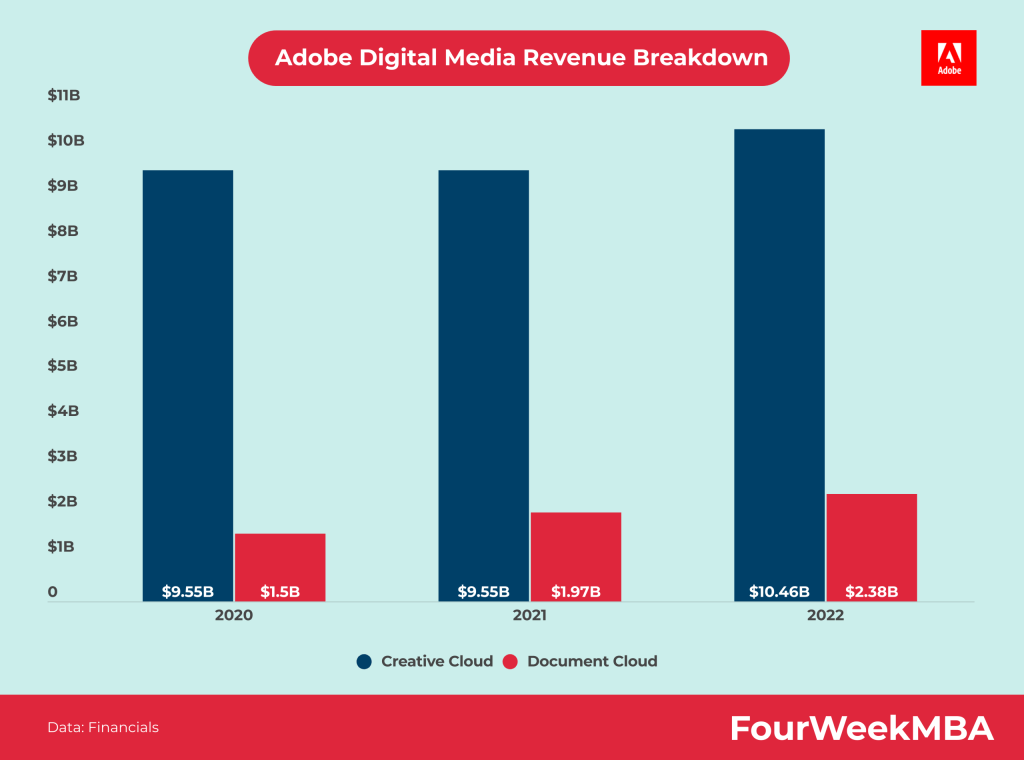
The Adobe digital media business consists of two segments: creative cloud and document cloud. In 2022, Adobe generated $10.46 billion from creative cloud vs. $2.38 from document cloud.
Adobe has a cost structure skewed toward subscriptions, which carry a high gross margin compared to other segments. Indeed, subscriptions generate most of the revenue for Adobe, and in 2022, for instance, on $17.6 billion in revenue, $2.16 in cost of revenue, and $15.44 in gross margins.
Adobe spent $4.97 billion in sales and marketing expenses in 2022, which represented 28% of its total revenue. Compared to $4.32 billion in 2021, which represented 27% of its total revenue.
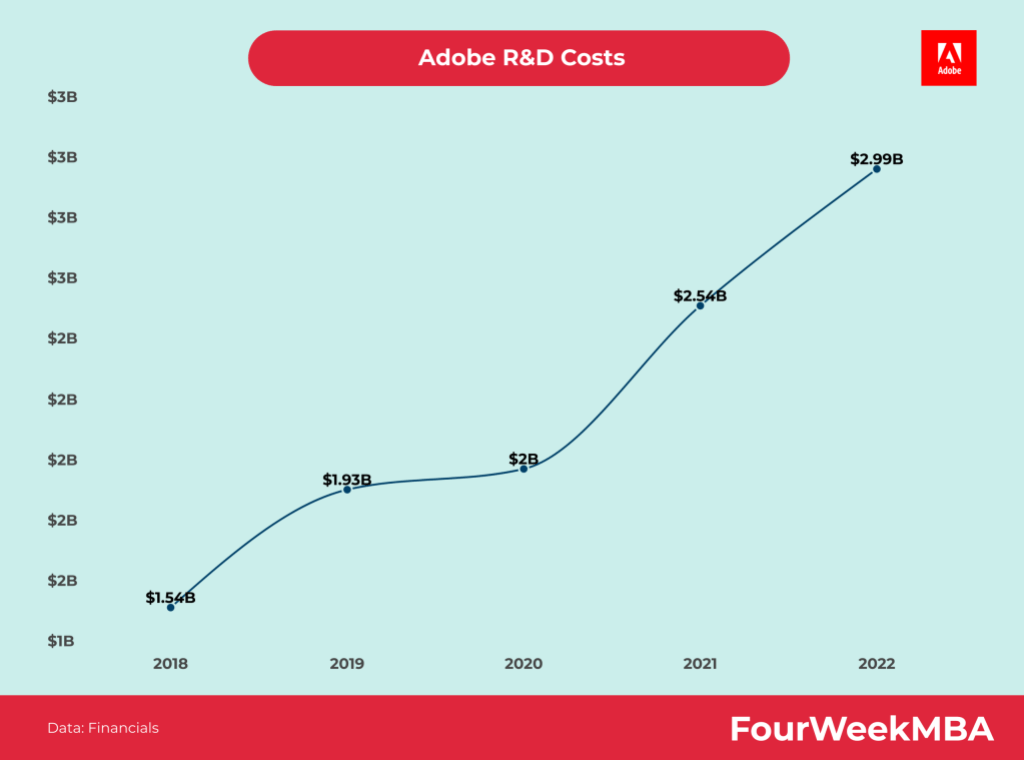
Adobe spent $2.99 billion in R&D expenses in 2022, which represented 17% of its total revenue, vs. $2.54 billion in 2021, which represented 16% of its total revenue.
Gennaro is the creator of FourWeekMBA, which reached about four million business people, comprising C-level executives, investors, analysts, product managers, and aspiring digital entrepreneurs in 2022 alone | He is also Director of Sales for a high-tech scaleup in the AI Industry | In 2012, Gennaro earned an International MBA with emphasis on Corporate Finance and Business Strategy.
Scroll to Top
Discover more from FourWeekMBA
Subscribe now to keep reading and get access to the full archive.