Minneapolis Mayor Jacob Frey vetoed the City Council’s data center ordinance on Thursday, MPR News reported. The council passed it on a 7-6 vote last week.
Overriding a mayoral veto takes nine votes. That is two more than the ordinance won (our arithmetic).
Important: not investment advice
This article is for information and education only. It is not investment, financial, legal or tax advice, and it is not a recommendation or an offer to buy or sell any security, ETF, option or other financialproduct. FourWeekMBA is not a broker-dealer or a registered investment adviser. IPO shares, leveraged and inverse ETFs, and options carry significant risk, including the loss of your entire investment; leveraged and inverse ETFs reset daily and can lose value quickly. Prices, availability, fees and eligibility change and can differ by country and broker, so check the prospectus and your broker’s terms. Figures marked “our arithmetic” are our own calculations from the cited filings and may contain errors. Do your own research and consider speaking to a licensed financial professional before making any investment decision.
Business Pill · Guardrails Explained
An evergreen Business Engineer explainer on guardrails. It teaches the general idea only and does not discuss Minneapolis.
The key insight: Minneapolis Mayor Jacob Frey vetoed a data center ordinance that passed 7-6, saying the ordinance as passed would be a de facto ban; an override needs nine votes, two more than the ordinance won.
In his veto letter, Frey said he would sign the framework city staff first presented, which he called “one of the strictest data center regulatory frameworks in the country”, per MPR.
He objected to two compromises. One, added at the last minute, requires case-by-case council approval of every new data center. The other limits new centers to existing buildings in two downtown zoning districts.
Frey says the ordinance as passed would “result in a de facto ban”. He also vetoed the council’s rejection of his police chief nominee on the same day.
Votes on the Minneapolis data center ordinance and the nine votes needed to override the mayor’s veto, per MPR News.
The Vote and the Clock
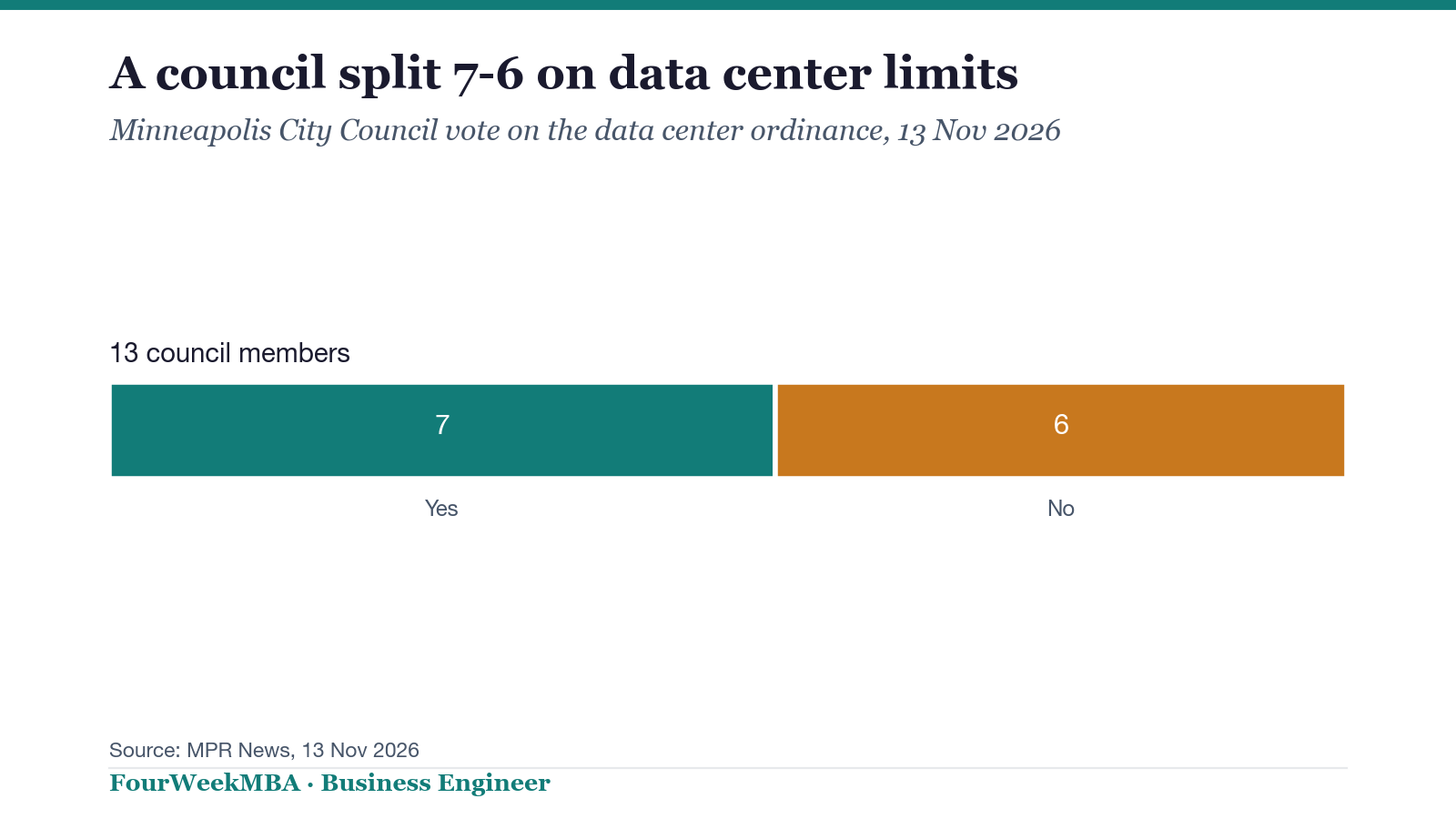
The seven yes votes came from council members Chavez, Wonsley, Chughtai, Whiting, Chowdhury, Stevenson and Payne, MPR listed on 13 November. Six voted no.
How the 13-member Minneapolis City Council split on the data center ordinance on 13 November, per MPR News.
A temporary moratorium that blocks most new data centers in the city expires on 21 November. The council planned to reconvene on 20 November to address a possible veto, one day before that deadline.
Council member Aurin Chowdhury backed case-by-case approval as “an up or down vote that evolves with the industry”. Council member Elizabeth Shaffer, who voted no, argued small data centers in empty buildings could ease the tax load on homeowners.
Why It Matters Beyond Minneapolis
We reported the 7-6 vote and the nine-vote override bar in our 14 November piece. The veto turns that math into the decision point.
As we read it, the fight is not about whether to regulate data centers but about who approves each one: staff rules or a council vote.
As we read the calendar, the 21 November moratorium expiry gives both sides a deadline within days of the veto.
Mayor Jacob Frey, veto letter, via MPR News, 19 Nov 2026
“result in a de facto ban”
Three Implications
FOR DATA CENTER DEVELOPERS Minneapolis rules depend on whether the council finds nine votes or the mayor’s preferred staff framework prevails.
FOR CITY COUNCILS ELSEWHERE Case-by-case council approval is one of the two provisions the mayor objected to, alongside limiting new centers to existing downtown buildings.
FOR THE AI BUILDOUT Local votes are one more gate on where new capacity can go, alongside power and water.
What Is Not Established
We found no report on whether the council has the votes to override. MPR did not report a vote count for the override attempt, and none of our sources said what happens to new projects on 21 November if neither side moves.
This Week In The AI Supercycle
AI Lost Its Central Banker, the Lab Oligopoly, and the Future of Open Source
This week’s issue: the Nvidia leadership change, read as the AI build-out losing its central banker: who now finances the GPU landlords, backstops the data centres and sponsors open models, and why two labs are becoming the bank.
Frey says he wants strict data center rules but not case-by-case council votes. The council needs nine votes to keep its version, two more than it had.
Important: not investment advice
This article is for information and education only. It is not investment, financial, legal or tax advice, and it is not a recommendation or an offer to buy or sell any security, ETF, option or other financialproduct. FourWeekMBA is not a broker-dealer or a registered investment adviser. IPO shares, leveraged and inverse ETFs, and options carry significant risk, including the loss of your entire investment; leveraged and inverse ETFs reset daily and can lose value quickly. Prices, availability, fees and eligibility change and can differ by country and broker, so check the prospectus and your broker’s terms. Figures marked “our arithmetic” are our own calculations from the cited filings and may contain errors. Do your own research and consider speaking to a licensed financial professional before making any investment decision.
A note on sourcing. The veto, Frey’s objections and his quotes are from MPR News’ 19 November report on his veto letter; we did not read the letter itself. The vote list, the 21 November moratorium expiry, the planned 20 November meeting and council members’ quotes are from MPR’s 13 November report. That the override bar is two votes above the ordinance’s seven is our arithmetic.
Gennaro Cuofano is a CRO and tech executive who has worked in AI since late 2015, starting with bringing NLP, natural-language generation, voice and chatbot products to the marketing industry. His background is in law and finance: he holds a Master's degree in Law and an International MBA with an emphasis on corporate finance (LUISS Business School and the University of San Diego, 2012), and worked as a financial analyst at a real-estate investment firm in San Diego and as an assistant controller. His work focuses on business model strategy, business engineering and, more broadly, structural analysis: how companies make money, read from their own filings. He created FourWeekMBA and leads research there and at The Business Engineer, his newsletter on AI and business strategy, with over 95,000 subscribers and more than 1,000 published analyses. His writing has also appeared on Entrepreneur (for example, How to Digitize a Family Business in Europe) and HackerNoon. Find him on LinkedIn and Substack. See how we source.