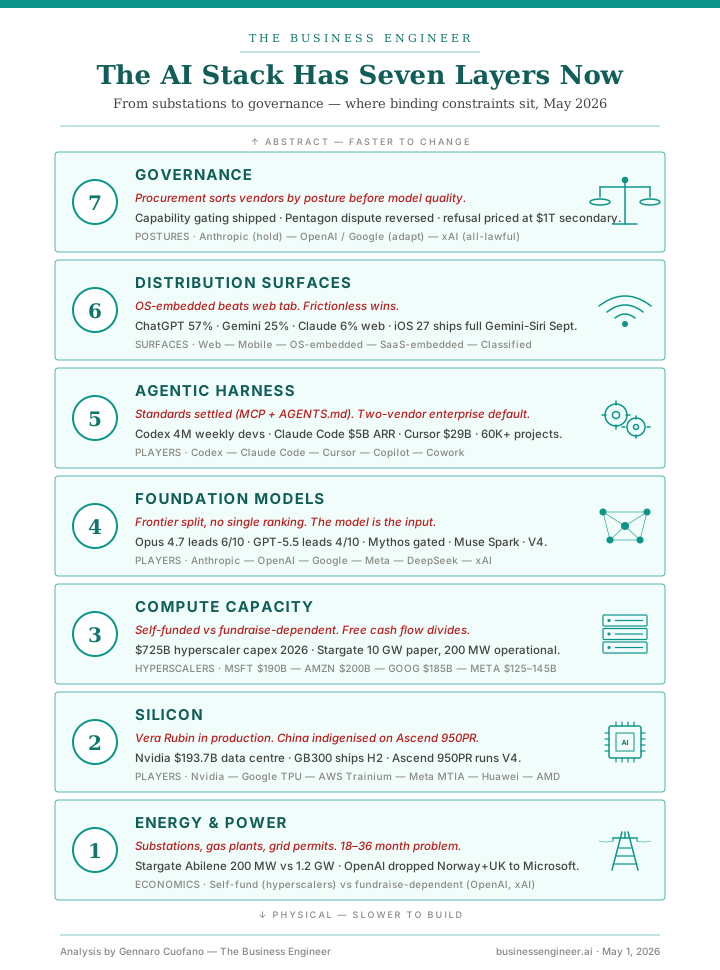
The visual below maps the five critical cascades that determine AI market outcomes. Capital, Governance, Distribution, Agentic capabilities, and Indigenisation create interconnected layers where disruption in one area ripples unpredictably through all others.
Source: The Business Engineer — Map of AI, May 2026
Capital Cascade: The Foundation Layer
OpenAI — as explored in the intelligence factory race between AI labs — ‘s $6.6 billion funding round and Anthropic’s $4 billion Amazon partnership demonstrate how capital flows shape everything above. When Microsoft commits $10 billion to OpenAI, that decision cascades through governance structures, distribution channels, and ultimately determines which agentic capabilities reach market first.
Governance Cascade: The Control Layer
Regulatory decisions create immediate downstream effects across all other layers. The EU’s AI Act covers 27 countries and affects companies with over €50 million in annual revenue, while China’s AI regulations influence how ByteDance and Baidu structure their global operations.
Distribution Cascade: The Access Layer
Google’s integration of Bard into Search (handling 8.5 billion queries daily) exemplifies how distribution advantages compound. Apple’s 1.8 billion active devices create distribution cascades that can instantly amplify or constrain AI capabilities regardless of their technical superiority.
Agentic Cascade: The Capability Layer
As AI systems become more autonomous, their capabilities cascade back up through distribution and governance layers. Microsoft’s 365 Copilot, deployed across 400 million Office users, demonstrates how agentic AI reshapes both user behavior and regulatory attention simultaneously.
Indigenisation Cascade: The Localization Layer
Local adaptation creates the most unpredictable cascades of all. India’s push for sovereign AI capabilities and the Middle East’s $100 billion AI investment commitments show how indigenisation efforts cascade back through capital allocation and governance frameworks globally.
Why Cascades Matter More Than Races
Traditional AI analysis focuses on individual technology races—who has the best model or most compute — as explored in the economics of AI compute infrastructure — . This framework reveals that cascade effects between layers now determine market outcomes more than individual superiorities.
The companies that master cascade dynamics, not just individual layer excellence, will capture disproportionate value. Understanding these interconnections becomes essential for strategic positioning in the AI economy.
Which cascade represents the biggest strategic opportunity—or threat—for your industry positioning?
FREE NEWSLETTER
Get AI Strategy Intelligence Daily
Join 90,000+ strategists. Business modelanalysis, AI maps, and earnings deep dives — free.
Gennaro is the creator of FourWeekMBA, which reached about four million business people, comprising C-level executives, investors, analysts, product managers, and aspiring digital entrepreneurs in 2022 alone | He is also Director of Sales for a high-tech scaleup in the AI Industry | In 2012, Gennaro earned an International MBA with emphasis on Corporate Finance and Business Strategy.
Scroll to Top
Discover more from FourWeekMBA
Subscribe now to keep reading and get access to the full archive.