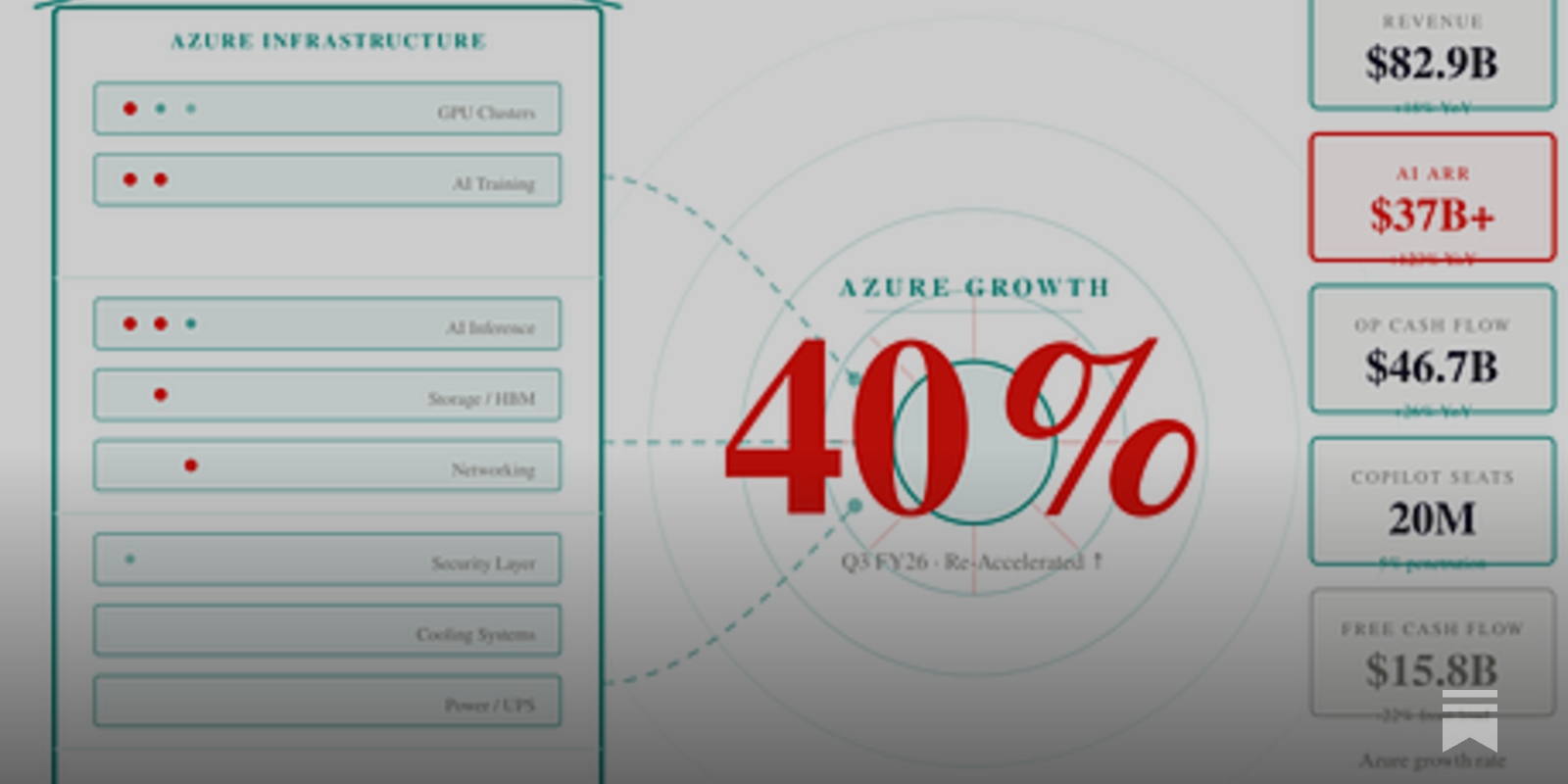
Microsoft reported that artificial intelligence workloads are driving a measurable revenue surge in its cloudbusiness, with Azure posting 40% growth that defied industry-wide deceleration trends in the most recent quarter.
The tech giant’s AI investments are translating into concrete financial returns through enterprise adoption of Copilot services and increased cloud infrastructure — as explored in the economics of AI compute infrastructure — spending. Azure’s re-acceleration comes as competitors face slowing growth rates, positioning Microsoft ahead in the race to monetize artificial intelligence.
Enterprise AI Adoption Fuels Infrastructure Spending
Source: The Business Engineer
Microsoft’s Copilot enterprise services are generating substantial cloudrevenue as businesses integrate AI capabilities into their operations. The company’s strategic positioning of AI tools within its existing Office and Azure ecosystem is creating a compounding effect on infrastructure usage.
Enterprise customers are not just experimenting with AI but deploying it at scale, requiring significant cloud computing resources. This shift represents a fundamental change from proof-of-concept projects to production-level AI workloads that demand robust infrastructure.
Market Leadership Through AI Infrastructure
According to analysis by The Business Engineer, Microsoft’s 40% Azure growth rate stands in sharp contrast to the broader cloud market slowdown affecting other major providers. The company’s early investment in OpenAI and integration of GPT models into its product suite is paying dividends through increased customer spending.
The revenue surge demonstrates that AI is moving beyond the hype cycle into genuine business applications. Microsoft’s ability to bundle AI services with existing enterprisesoftware creates higher customer lifetime value and reduces churn rates.
Financial Impact on Cloud Revenue Streams
AI workloads require significantly more computational resources than traditional cloud applications, driving higher per-customer revenue. The processing demands of large language model — as explored in the intelligence factory race between AI labs — s and machine learning operations translate directly into increased Azure consumption.
Microsoft’s pricingstrategy for AI services reflects this computational intensity, with Copilot subscriptions and API usage generating premium margins. The company is effectively monetizing both the software layer through Copilot and the infrastructure layer through Azure.
Competitive Positioning in AI Market
While competitors struggle with AI monetization strategies, Microsoft has created a clear path from AI capabilities to revenue generation. The integration of AI across its product portfolio creates multiple revenue streams from the same underlying technology investment.
The company’s partnership with OpenAI provides exclusive access to cutting-edge models while maintaining control over the infrastructure layer. This vertical integration allows Microsoft to capture value at multiple points in the AI stack.
Strategic Implications for Cloud Industry
Microsoft’s success in translating AI investments into measurable cloudrevenuegrowth establishes a new benchmark for the industry. The company’s ability to maintain 40% growth rates while competitors decelerate suggests that AI workloads represent a genuine growth catalyst rather than a temporary boost.
This revenue surge validates Microsoft’s strategy of integrating AI deeply into existing products rather than treating it as a separate offering. The approach creates sustainable competitive advantages that will be difficult for rivals to replicate without similar ecosystem integration.
FREE NEWSLETTER
Get AI Strategy Intelligence Daily
Join 90,000+ strategists. Business modelanalysis, AI maps, and earnings deep dives — free.
Gennaro is the creator of FourWeekMBA, which reached about four million business people, comprising C-level executives, investors, analysts, product managers, and aspiring digital entrepreneurs in 2022 alone | He is also Director of Sales for a high-tech scaleup in the AI Industry | In 2012, Gennaro earned an International MBA with emphasis on Corporate Finance and Business Strategy.
Scroll to Top
Discover more from FourWeekMBA
Subscribe now to keep reading and get access to the full archive.