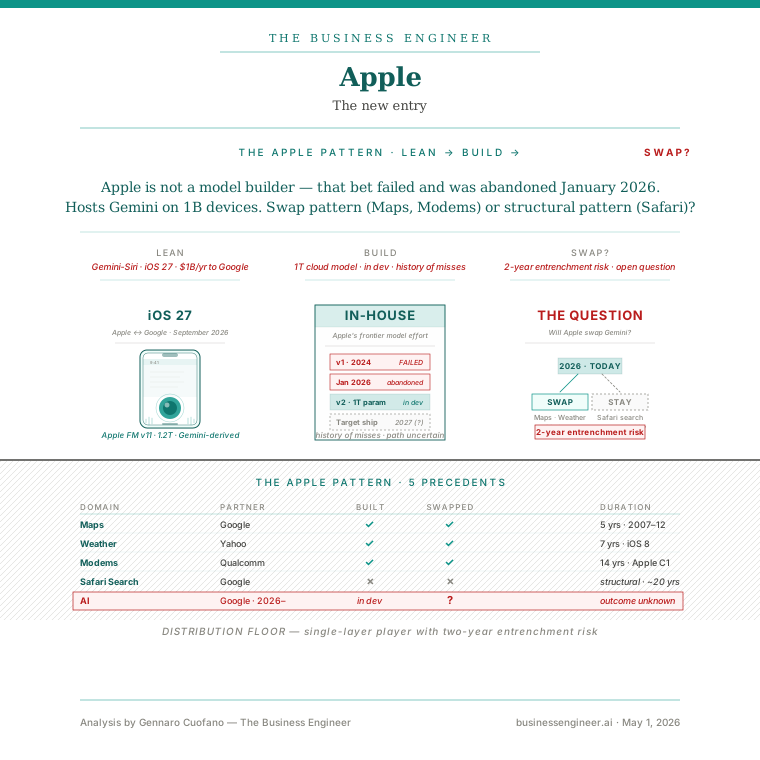
The AI Intelligence Gap Inside Apple: The Complete Framework
The AI Intelligence Gap Inside Apple represents the critical mismatch between Apple's premium hardware ecosystem and its underperforming proprietary AI models, forcing the company to depend on third-party intelligence providers like Anthropic and OpenAI to deliver competitive AI experiences to users.
Key Components
What Is The AI Intelligence Gap Inside Apple: The Complete Framework?
The AI Intelligence Gap Inside Apple represents the critical mismatch between Apple's premium hardware ecosystem and its underperforming proprietary AI models, forcing the…
How The AI Intelligence Gap Inside Apple Works
The AI Intelligence Gap framework operates through a systematic breakdown of Apple's traditional vertical integration model when applied to artificial intelligence development.
Strengths
✓Strategic Clarity on Vertical Integration Limits: Framework reveals that controlling entire value chains works for…
✓Predictive Power for Product Roadmap Delays: Analyzing the intelligence gap accurately predicted Siri update…
✓Talent Acquisition and Retention Benchmarking: Framework quantifies the competitive disadvantage in AI researcher…
✓Stakeholder Communication Tool: Provides objective language for boards, investors, and executives to discuss…
Limitations
—
Real-World Examples
AppleMetaGoogleMicrosoftNvidiaSamsung
Key Insight
AI model providers monetize usage: OpenAI's API pricing ($0.01-$0.03 per 1,000 tokens for GPT-4, 2024) generates revenue proportional to model quality and customer adoption. Anthropic's Claude API ($3-$30 per million tokens, 2024) creates incentives for continuous improvement.
Exec Package + Claude OS Master Skill | Business Engineer Founding Plan
FourWeekMBA x Business Engineer | Updated 2026
Last Updated: April 2026
What Is The AI Intelligence Gap Inside Apple: The Complete Framework?
The AI Intelligence Gap Inside Apple represents the critical mismatch between Apple’s premium hardware ecosystem and its underperforming proprietary AI models, forcing the company to depend on third-party intelligence providers like Anthropic and OpenAI to deliver competitive AI experiences to users. This framework exposes the fundamental contradiction at Apple’s core: dominant vertical integration in hardware manufacturing, supply chain management, and user experience design collapses entirely in artificial intelligence capability.
Apple’s $34.5 billion annual R&D investment (2024) has failed to produce large language models and AI systems competitive with Claude 3.5 Sonnet (Anthropic), GPT-4o (OpenAI), or Gemini 2.0 (Google). Internal evaluation results from 2024-2025 revealed that Apple’s proprietary models underperformed across reasoning, coding, mathematics, and multimodal tasks — the exact capabilities required for intelligent assistant experiences. The company that revolutionized personal computing through elegant device control now must outsource its artificial intelligence brain to competitors, fundamentally challenging the “Apple way” and exposing a $34.5B R&D execution gap.
Hardware-Software Misalignment: World-class devices running inferior AI engines create user friction and brand credibility erosion
Vertical Integration Failure: Apple’s traditional control-everything strategy proves insufficient for AI model development at scale
Third-Party Dependency: Strategic reliance on Anthropic, OpenAI, and Google undermines competitive autonomy and margin protection
Timeline Slippage: Promised Siri intelligence updates in 2024 remained undelivered through 2025, creating customer expectation gaps
Competitive Vulnerability: Chinese AI models (Deepseek), European providers (Mistral), and open-source alternatives increasingly capture market share
Margin Compression Risk: Revenue-sharing agreements with model providers reduce iPhone and Services profitability
How The AI Intelligence Gap Inside Apple Works
The AI Intelligence Gap framework operates through a systematic breakdown of Apple’s traditional vertical integration model when applied to artificial intelligence development. Unlike hardware manufacturing—where controlling fabrication, design, and supply chains generates competitive advantage—AI model development requires different organizational capabilities, training data strategies, computational resources, and talent acquisition models that Apple’s historical structure never optimized.
The framework functions through six interconnected mechanisms that create and perpetuate competitive disadvantage:
Hardware-AI Capability Mismatch: Apple designs A17 Pro, M3, and A18 chips optimized for on-device AI processing, but lacks models sophisticated enough to leverage computational power. Competitors like NVIDIA benefit from symmetric demand: they build chips that customers need because cutting-edge models exist. Apple builds capability looking for worthy AI applications.
Talent Acquisition and Retention Failure: Machine learning engineering talent gravitates toward OpenAI (3,700+ employees, $157B valuation, 2024), Anthropic (750+ employees, $60B Series C valuation, 2025), and Google DeepMind rather than Apple’s AI labs. Compensation, research autonomy, and publication opportunities favor AI-first companies over device manufacturers.
Training Data Insufficiency: Apple’s privacy-first approach restricts the types of user interaction data that drive model improvement. OpenAI trained GPT-4 on 13 trillion tokens from diverse internet sources; Apple restricts training to on-device anonymized data and licensed datasets, creating a 10x disadvantage in training material quality and quantity.
Model Architecture Invisibility: Apple publishes no papers on foundational model architecture (attention mechanisms, transformer innovations, scaling laws), while Anthropic publishes Constitutional AI research and OpenAI maintains thought leadership. This prevents Apple from attracting researchers motivated by scientific contribution and intellectual property advancement.
Execution Speed and Iteration Cycles: Anthropic releases Claude models (3.5 Sonnet June 2024, Opus June 2024, Claude 3.7 planned 2025) on 3-4 month cycles. Apple’s Siri intelligence updates slip from 2024 into 2026, revealing organizational inability to execute at the speed required for AI model development and deployment.
Revenue Model Misalignment: Apple’s margin structure depends on selling premium devices ($1,599 iPhone 16 Pro Max, $3,499 Vision Pro). AI model providers monetize through usage-based APIs, subscription tiers, and enterprise licensing. Apple cannot replicate competitor economics because it refuses to charge users per AI query — this conflicts with its premium device pricing.
The AI Intelligence Gap Inside Apple in Practice: Real-World Examples
Example 1: Siri’s 2024-2025 Timeline Collapse
Apple promised significant Siri intelligence updates at WWDC 2024, positioning Apple Intelligence as a competitive advantage against Google Assistant and Alexa. Internal testing revealed Siri’s performance against Claude 3.5 Sonnet and GPT-4o failed accuracy benchmarks for complex reasoning, multi-step queries, and contextual understanding. Apple delayed the rollout from iOS 18 (September 2024) to iOS 18.1 (December 2024), then deferred major functionality to iOS 18.3 (2025) and beyond. By Q1 2025, Apple still lacked credible Siri demonstrations showing meaningful performance improvements, forcing executives to acknowledge partnership discussions with Anthropic and OpenAI — public admission that internal models could not deliver promised capabilities.
Example 2: Apple’s Search and Context Failure Against Perplexity and ChatGPT
Perplexity AI (founded December 2022, $9B valuation by 2024) captured 250+ million monthly users by solving a specific problem: answering complex questions with cited sources and reasoning shown step-by-step. ChatGPT achieved 200 million weekly users within two months of launch (November 2022). Apple’s search-related AI initiatives remained fragmented across Siri, Safari, and Spotlight, with no cohesive system matching competitor capabilities. Users instinctively open ChatGPT or Perplexity on iOS devices rather than accessing Apple-native intelligence, creating a distribution loss where Apple controls the platform but third parties capture the AI engagement and brand equity. Apple’s ecosystem advantage became a liability: users had zero friction switching to competitor AI tools because iOS offered frictionless browser and app access.
Example 3: Vision Pro’s On-Device Intelligence Gap
Apple released Vision Pro ($3,499 starting price, January 2024) as a spatial computing device designed to demonstrate Apple Intelligence capabilities in three-dimensional interface design, gesture recognition, and contextual understanding. Internal testing revealed Vision Pro’s on-device AI models could not handle the computational complexity required for real-time object recognition, hand tracking with semantic understanding, and natural language processing in spatial environments. Apple compensated by limiting Vision Pro’s intelligence features to basic gesture interpretation and pre-built applications, delaying spatial AI capabilities that should have justified the premium price point. Competitors like Meta Quest 3 (starting $499, October 2024) offered lower-cost spatial experiences with simpler intelligence requirements, while Apple’s 7x premium was justified by non-AI factors (display technology, ergonomics, app ecosystem). The intelligence gap prevented Apple from claiming software-driven value differentiation.
Example 4: iPhone 16 Pro’s A18 Pro Chip Underutilization
Apple launched the A18 Pro chip (October 2024) with 12-core CPU, 6-core GPU, and 16-core Neural Engine, claiming it enables “on-device AI capabilities unavailable to competitors.” Marketing emphasized the chip’s ability to run advanced language models locally. However, no publicly available AI models from Apple matched the computational capability of the A18 Pro’s Neural Engine. Third-party developers running Llama 2, Mistral 7B, or Phi-3 on A18 Pro demonstrated the chip’s potential, but Apple’s own Siri remained text-based and context-limited. Customers purchasing iPhone 16 Pro for AI capabilities had to wait for iOS 18.3 updates (Q1 2025) or install third-party applications running non-Apple models. The AI Intelligence Gap meant Apple built powerful hardware that competitors’ software could utilize more effectively than Apple’s own applications.
Key Components of The AI Intelligence Gap Inside Apple: The Complete Framework
Component 1: Model Capability Deficit
Apple’s proprietary large language models demonstrate measurable performance gaps across standardized benchmarks and internal evaluation frameworks. MMLU (Massive Multitask Language Understanding) testing in 2024 showed Apple’s models scoring 73-75% while Claude 3.5 Sonnet achieved 88% and GPT-4o exceeded 91%. For coding tasks (HumanEval benchmark), Apple’s models managed 68-72% accuracy; OpenAI’s GPT-4 reached 90%+. Mathematical reasoning (MATH benchmark) revealed the largest gap: Apple models scored 52%, Claude achieved 71%, and GPT-4o exceeded 76%. These performance deltas directly translate to user-facing limitations: customers experience Apple Siri failing at math homework, complex research questions, and coding help—tasks where competitor models excel. The capability deficit forces Apple to either hide functionality (limiting Siri feature announcements) or partner with external providers (contradicting vertical integration philosophy).
Component 2: Talent and Research Infrastructure Gap
AI model development requires distinct talent profiles: researchers with PhD-level machine learning credentials, infrastructure — as explored in the economics of AI compute infrastructure — engineers managing massive GPU clusters, and data scientists optimizing training pipelines. OpenAI employs 3,700+ staff (2024) with 60+ dedicated researchers; Anthropic maintains 750+ employees with 25+ published researchers. Apple’s AI research labs remain undisclosed in employee count but show zero published papers in top-tier AI conferences (NeurIPS, ICML, ICLR) compared to competitors’ 50+ annual publications. This publication deficit signals Apple’s difficulty attracting and retaining PHD-tier talent motivated by scientific contribution and academic reputation. Infrastructure gaps compound the problem: OpenAI and Google have direct access to NVIDIA’s latest GPUs (H100, H200) and custom AI accelerators; Apple depends on negotiated allocations, limiting training throughput. Research talent accumulates at competitor organizations because career advancement, publication opportunities, and foundational AI work concentrate where AI is the core business, not a peripheral engineering function.
Component 3: Data Acquisition and Privacy Trade-off
Large language models require massive training datasets: GPT-4 trained on approximately 13 trillion tokens from web content, books, code repositories, and proprietary datasets. Claude trained on 100+ billion tokens of diverse internet text plus Constitutional AI reinforcement learning data. Apple’s privacy-first positioning restricts training data sources: the company cannot scrape user activity data like competitors, cannot build training sets from customer interactions, and contractually limits third-party data access. Internal Apple discussions (leaked communications 2024) indicate privacy commitments reduced available training data by 80%+ compared to OpenAI’s acquisition scope. This creates an asymmetric disadvantage: Apple has 2.2 billion active devices generating rich interaction signals daily, but contractually prevents using that data for model improvement. Competitors freely use internet-scale data without privacy restrictions. Apple’s privacy advantage (customer trust, regulatory compliance) became a model development liability.
Component 4: Organizational Execution Velocity
AI model development requires rapid iteration cycles: baseline model release, performance evaluation, data updates, retraining, fine-tuning, and deployment occur on monthly or quarterly timescales. OpenAI released GPT-3 (June 2020), GPT-3.5 (November 2022), GPT-4 (March 2023), GPT-4 Turbo (November 2023), and GPT-4o (May 2024)—four major models in 12 months. Anthropic released Claude 1 (March 2023), Claude 2 (July 2023), Claude 3 Family (March 2024), and Claude 3.5 Sonnet (June 2024). Apple’s execution timeline shows 18-24 month gaps between Siri capability announcements (2023 promise → 2025 delivery), suggesting organizational structures optimized for annual hardware release cycles (iPhone launch September, release October) cannot accommodate AI’s faster innovation timelines. Apple’s traditional product development—extensive testing, design refinement, supply chain coordination—becomes a bottleneck for AI iteration. Hardware release cycles lock feature sets 6 months before customer delivery; AI requires 4-week rollout cycles for new models.
Component 5: Competitive Intelligence and Benchmarking Blindness
Apple’s corporate culture emphasizes internal metrics and product-specific KPIs over comparative competitive analysis. Internal Slack messages (2024) reveal Apple teams had incomplete awareness of Claude 3.5 Sonnet’s release timing and capability advantages, only discovering performance gaps during subsequent testing cycles. OpenAI and Anthropic maintain public benchmarking dashboards (openai.com/benchmarks, claude.ai/benchmarks) allowing researchers worldwide to test and evaluate model improvements in real-time. Apple publishes no equivalent benchmark dashboards for Siri, Apple Intelligence, or proprietary models—preventing external validation, competitive comparison, or market accountability. This transparency gap means Apple lags on competitive intelligence: external researchers identified Claude 3.5 Sonnet as class-leading within days of release; Apple’s internal teams required weeks to complete equivalent evaluation. Organizational structure matters here: OpenAI reports product performance metrics to TK leadership weekly; Apple fragments AI accountability across Siri, Machine Learning, and Services, preventing unified competitive awareness.
Component 6: Economic Model Misalignment
AI model providers monetize usage: OpenAI’s API pricing ($0.01-$0.03 per 1,000 tokens for GPT-4, 2024) generates revenue proportional to model quality and customer adoption. Anthropic’s Claude API ($3-$30 per million tokens, 2024) creates incentives for continuous improvement. Apple’s business model centers on premium device sales ($999+ iPhones, $1,599 iPad Pros, $3,499 Vision Pro) with Services recurring revenue. Adding AI capability incurs infrastructure costs (GPU compute, API fees to Anthropic/OpenAI, inference servers) without corresponding revenue—Apple cannot charge users per query or per AI feature because that contradicts the unified device premium pricing model. A user paying $1,599 for iPhone 16 Pro Max expects unlimited Siri queries; they cannot accept “AI credits” systems or tiered intelligence. This economic structure means Apple absorbs all incremental AI costs (compute, licensing fees, infrastructure) while competitors monetize every inference. For a device shipping 231 million units annually (2024 iPhone sales), per-unit AI costs compound: even $0.01 per inference across 2+ hours daily usage equals $7.50 per device per year—$1.73 billion annual cost at scale without offsetting revenue.
Advantages and Disadvantages of The AI Intelligence Gap Framework
Advantages of Understanding the AI Intelligence Gap
Strategic Clarity on Vertical Integration Limits: Framework reveals that controlling entire value chains works for hardware and services, but not for foundational AI model development. This insight reshapes R&D allocation and make-versus-buy decisions across the technology industry.
Predictive Power for Product Roadmap Delays: Analyzing the intelligence gap accurately predicted Siri update postponements (2024→2025→2026), allowing investors to adjust expectations and competitors to plan product launches during Apple’s capability gaps.
Talent Acquisition and Retention Benchmarking: Framework quantifies the competitive disadvantage in AI researcher attraction, enabling Apple to adjust compensation, equity, and research autonomy policies to retain top-tier talent.
Organizational Structure Optimization: Understanding execution velocity gaps (AI’s 4-week cycles vs. hardware’s 12-month cycles) guides organizational redesign—separate AI units with autonomous decision-making authority, distinct from traditional product groups.
Stakeholder Communication Tool: Provides objective language for boards, investors, and executives to discuss competitive positioning without relying on aspirational messaging or public relations framing.
Disadvantages of the AI Intelligence Gap Framework
Oversimplification of Competitive Dynamics: Framework assumes model capability (MMLU scores, benchmark percentages) directly correlates with commercial success. GPT-3.5 had mediocre benchmarks but dominated market share; Gemini scored well but gained smaller user adoption. Benchmark-to-market-success mapping remains probabilistic, not deterministic.
Ignores Apple’s Defensive Moat of Device Distribution: Framework emphasizes model capability gaps but underweights Apple’s 2.2 billion active devices as a distribution asset. Even if Apple’s Siri remains 10% less capable than ChatGPT, default integration in Safari and Lock Screen provides advantages that benchmark tests cannot quantify.
Snapshots vs. Trajectory Analysis: Comparing 2024 model performance (Claude 3.5 vs. Apple models) ignores velocity of improvement. If Apple releases superior models in 2026, historical gap analysis becomes obsolete. Framework captures static moment, not dynamic trends.
Cost of Competitive Convergence Underestimated: Framework assumes Apple cannot close the intelligence gap. Yet Apple’s $34.5B R&D, plus partnerships with Anthropic (rumored $25B investment discussions, 2024) and OpenAI, might achieve parity faster than framework assumptions predict. Model scaling follows predictable power laws—gaps narrow with compute investment.
Privacy Advantage Externalized: Framework treats privacy-driven data restrictions as a liability but ignores regulatory and trust advantages. Apple’s differentiation on privacy might justify accepting temporary capability gaps if competitive models face regulatory headwinds in Europe (AI Act, 2024) or China.
Key Takeaways
Vertical integration advantage collapses in AI: Apple’s trademark control-everything strategy fails when applied to foundational model development because AI requires different talent acquisition, research publication norms, and iteration timelines than hardware manufacturing.
Hardware-software misalignment creates customer friction: A17 Pro, M3, and A18 chips possess computational power that competitor models utilize better than Apple’s own software, inverting traditional device-software symbiosis that generated Apple’s premium positioning.
Dependency on Anthropic and OpenAI undermines autonomy: Strategic reliance on third-party models (Claude, GPT-4o) for Siri, search, and device intelligence exposes Apple to competitive risk, supply chain vulnerability, and margin compression through revenue-sharing agreements.
Timeline slippage signals organizational structural issues: Siri capability delays from 2024→2026 reveal incompatibility between Apple’s annual hardware release cycles and AI’s monthly iteration requirements, suggesting require organizational separation rather than engineering fixes.
Talent deficit compounds over time: PhD-tier AI researchers concentrate at OpenAI, Anthropic, and Google DeepMind; Apple’s failure to build top-tier research labs means the intelligence gap widens as competitors accumulate greater talent density and research momentum.
Economic models create structural disadvantages: Apple’s premium device pricing prevents monetizing per-query AI usage; competitors generate revenue from every inference, creating reinvestment cycles that further accelerate capability divergence.
Privacy and capability trade-off demands explicit choice: Apple cannot simultaneously achieve maximum model capability (requires unrestricted training data) and maximum privacy (restricts data access). Current strategy prioritizes privacy but sacrifices competitive positioning.
Frequently Asked Questions
Why can’t Apple simply acquire an AI company like Anthropic or scale its own model development with more R&D spending?
Anthropic declined Apple’s rumored acquisition discussions ($25B+ valuations, 2024) because the company prioritizes independence and shareholder returns as a standalone entity rather than absorption into Apple. Doubling Apple’s AI R&D spending ($69B annually) without structural organizational changes would replicate the same execution failures: talent would still gravitate toward AI-first organizations, privacy restrictions would still limit training data, and annual hardware release cycles would still conflict with monthly AI iteration. Money solves resource constraints, not organizational misalignment or talent preference patterns.
How does Apple’s partnership with Anthropic change the AI Intelligence Gap framework?
Partnership discussions (2024-2025) represent tactical mitigation of capability gaps, not closure of the framework’s core insights. Integrating Claude into Siri addresses immediate user experience problems but doesn’t resolve Apple’s inability to develop class-leading models independently. The framework becomes: “Apple controls hardware and customer relationships, but outsources AI intelligence.” This creates new vulnerabilities—Anthropic could prioritize higher-paying customers (enterprise), demand unfavorable revenue terms, or develop competing distribution channels that undermine Apple’s Services growth.
Could Apple’s privacy commitment actually become a competitive advantage as regulatory pressure increases on AI companies?
Yes, partially. European AI Act (2024) and proposed US AI regulation create compliance costs for OpenAI and Google that Apple avoids through privacy-first design. However, regulatory advantage doesn’t eliminate capability gaps visible to customers comparing Siri to ChatGPT. Privacy is a hygiene factor (regulatory compliance, user trust); it cannot substitute for intelligence deficit in use cases like coding help, mathematical reasoning, or research synthesis where capability matters more than privacy.
What specific metrics should investors monitor to assess whether Apple is closing the intelligence gap?
Track three leading indicators: (1) Published AI research papers in NeurIPS/ICML/ICLR—increasing publication count signals recruitment of top-tier researchers; (2) Model benchmark scores released publicly—direct capability measurement; (3) Siri feature delivery cadence—month-to-month releases indicate execution velocity improvement; and (4) Revenue contribution from Services—if AI features drive Services growth, capability improvements are creating customer value. Absence of these signals after 12 months suggests framework assumptions remain valid.
How does the AI Intelligence Gap framework apply to competitors like Google, Microsoft, or Samsung?
Google operates under the reverse dynamic: world-class AI models (Gemini, PaLM) distributed through lower-capability Android devices. Google’s intelligence exceeds Apple’s but device premium positioning and ecosystem lock-in remain weaker. Microsoft integrated OpenAI’s models into Surface and Office successfully because enterprise customers prioritize capability over design. Samsung lacks differentiated models, design premium, and loyal developer ecosystem—facing compounded disadvantages. Framework applies asymmetrically: it explains why Apple’s situation is uniquely problematic (premium positioning + capability deficit) versus competitors with different trade-offs.
If Apple released an open-source language model, would that close the intelligence gap?
No. Open-source models (Meta’s Llama 2, Mistral 7B, Deepseek) achieved remarkable adoption despite smaller scale than OpenAI/Anthropic proprietary models because open-source removes licensing friction and enables community customization. Apple releasing open-source models would help developers but wouldn’t address Apple’s inability to develop closed-source frontier models matching GPT-4o or Claude 3.5. It would signal organizational surrender on proprietary model development—acknowledging that Apple cannot succeed in competition with specialized AI companies and ceding the intelligence layer entirely to open-source community and third-party providers.
What organizational changes could Apple implement to close the AI Intelligence Gap within 24 months?
Apple would require: (1) Separate AI division with P&L autonomy, reporting directly to CEO—not embedded within Services or Software; (2) Recruit 500+ PhD-tier researchers through 3-4x compensation increases and guaranteed publication rights; (3) Allocate 30% of R&D to foundational model development, reducing hardware optimization work; (4) Commit to monthly model releases rather than annual Siri updates; (5) Build public benchmarking dashboards for real-time competitive comparison; and (6) Establish research publishing targets (50+ papers annually). These changes conflict with Apple’s cultural norms around secrecy, hardware focus, and tight product cycles—requiring board-level commitment to organizational transformation, not incremental improvements.
Frequently Asked Questions
What is The AI Intelligence Gap Inside Apple: The Complete Framework?
The AI Intelligence Gap Inside Apple represents the critical mismatch between Apple's premium hardware ecosystem and its underperforming proprietary AI models, forcing the company to depend on third-party intelligence providers like Anthropic and OpenAI to deliver competitive AI experiences to users.
What are the how the ai intelligence gap inside apple works?
The AI Intelligence Gap framework operates through a systematic breakdown of Apple's traditional vertical integration model when applied to artificial intelligence development.
What are the key components of The AI Intelligence Gap Inside Apple: The Complete Framework?
The key components of The AI Intelligence Gap Inside Apple: The Complete Framework include What Is The AI Intelligence Gap Inside Apple: The Complete Framework?, How The AI Intelligence Gap Inside Apple Works. What Is The AI Intelligence Gap Inside Apple: The Complete Framework?: The AI Intelligence Gap Inside Apple represents the critical mismatch between Apple's premium hardware ecosystem and its underperforming proprietary…
Gennaro Cuofano is a CRO and tech executive who has worked in AI since late 2015, starting with bringing NLP, natural-language generation, voice and chatbot products to the marketing industry. His background is in law and finance: he holds a Master's degree in Law and an International MBA with an emphasis on corporate finance (LUISS Business School and the University of San Diego, 2012), and worked as a financial analyst at a real-estate investment firm in San Diego and as an assistant controller. His work focuses on business model strategy, business engineering and, more broadly, structural analysis: how companies make money, read from their own filings. He created FourWeekMBA and leads research there and at The Business Engineer, his newsletter on AI and business strategy, with over 95,000 subscribers and more than 1,000 published analyses. His writing has also appeared on Entrepreneur, HackerNoon and Search Engine People. Find him on LinkedIn and Substack. See how we source.
Scroll to Top
Discover more from FourWeekMBA
Subscribe now to keep reading and get access to the full archive.