Apple’s $3.5T Market Cap Hangs on Solving the AI Frontier Gap
Apple’s commanding market position faces an unprecedented threat as the company grapples with a fundamental shift in the technology landscape—one where its legendary distribution advantage and premium margins may prove worthless without mastering frontier artificial intelligence.
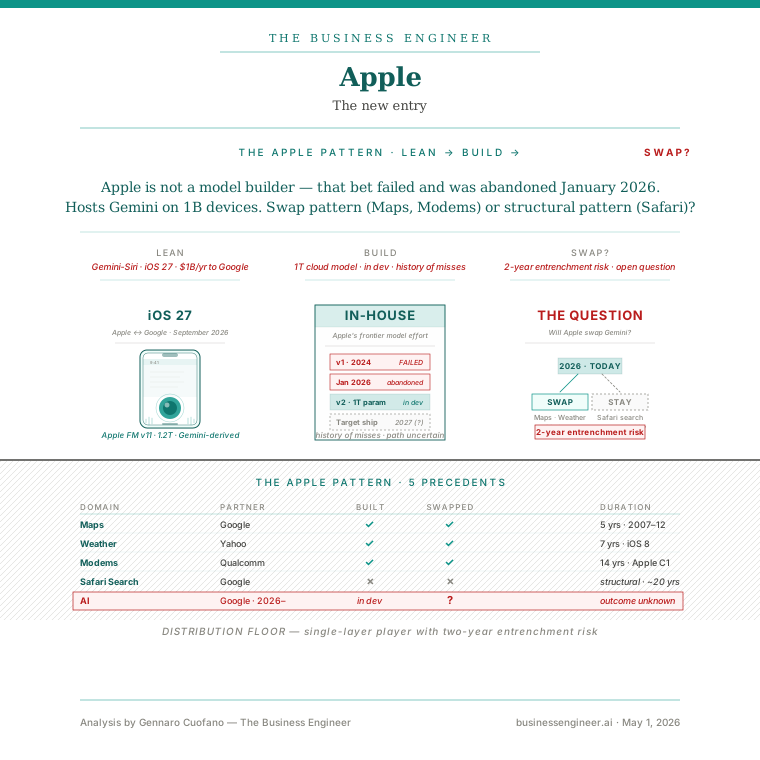
According to analysis from The Business Engineer, Apple’s traditional competitive moat built on ecosystem lock-in and hardware-software integration is becoming increasingly vulnerable. The report, titled “Apple’s Edge Moat & the AI Frontier Gap,” argues that while Apple maintains significant edge computing advantages, these strengths are meaningless without a solid foundation in frontier AI models.
Source: The Business Engineer
“Edge moat is distribution and margin. Frontier model is the floor. Without the floor the moat is meaningless,” the analysis states, capturing the existential challenge facing the Cupertino giant.
The company’s $3.5 trillion market capitalization reflects investor confidence in Apple’s ability to maintain premium pricing and market share across its product ecosystem. However, this valuation increasingly depends on the company’s capacity to integrate cutting-edge AI capabilities that match or exceed offerings from competitors like Google, Microsoft, and emerging AI-native companies.
Apple’s current AI strategy centers on on-device processing and privacy-focused machine learning, positioning the company’s silicon advantages as a key differentiator. The company’s M-series and A-series chips provide substantial edge computing capabilities, enabling sophisticated AI features while maintaining user privacy—a core brand promise.
But industry observers worry this approach may not be sufficient as AI applications become more sophisticated and require access to large language model — as explored in the intelligence factory race between AI labs — s and advanced reasoning capabilities that currently exist primarily in cloud-based frontier AI systems.
The frontier AI gap becomes particularly concerning when considering Apple’s services revenue, which has grown to represent nearly 25% of total company revenue. Services like Siri, App Store recommendations, and content discovery increasingly compete with AI-powered alternatives that leverage more advanced natural language processing and reasoning capabilities.
Meanwhile, competitors are rapidly advancing frontier AI integration. Google’s integration of Bard across its ecosystem, Microsoft’s Copilot strategy, and Amazon’s Alexa improvements all threaten to make Apple’s offerings appear outdated by comparison.
The challenge extends beyond consumer perception to practical functionality. As AI assistants become more capable of complex reasoning, multi-step task completion, and contextual understanding, Apple’s Siri—despite recent improvements—risks becoming a legacy interface — as explored in the interface layer wars reshaping consumer tech — in an AI-first world.
Apple’s response has included significant investments in AI research and development, partnerships with AI companies, and hints at major Siri improvements. The company has also been recruiting top AI talent and expanding its machine learning teams across key product divisions.
However, the timeline for closing the frontier AI gap remains unclear, and the window for maintaining competitive advantage may be narrowing. As the analysis suggests, Apple’s impressive distributionnetwork and ability to command premium margins become strategic liabilities rather than assets if the underlying AI capabilities cannot match user expectations shaped by frontier model experiences.
For investors, the question becomes whether Apple’s substantial resources and engineering capabilities can bridge this gap before competitors erode the company’s ecosystem advantages and justify seeking AI-superior alternatives.
FREE NEWSLETTER
Get AI Strategy Intelligence Daily
Join 90,000+ strategists. Business modelanalysis, AI maps, and earnings deep dives — free.
Gennaro is the creator of FourWeekMBA, which reached about four million business people, comprising C-level executives, investors, analysts, product managers, and aspiring digital entrepreneurs in 2022 alone | He is also Director of Sales for a high-tech scaleup in the AI Industry | In 2012, Gennaro earned an International MBA with emphasis on Corporate Finance and Business Strategy.
Scroll to Top
Discover more from FourWeekMBA
Subscribe now to keep reading and get access to the full archive.