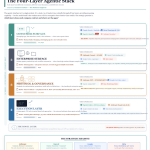
The Agentic Commerce Stack is crystallizing into four distinct layers: Discovery (how agents find products), Entity (how products are represented), State (how transactions execute), and Trust (how payments authorize). Control of any layer creates leverage; control of multiple layers creates platform dominance.
Discovery Layer (Agent Experience Optimization): How agents find and evaluate products. Structured data, schema markup, and agent-readable feeds replace SEO and advertising. Early adopters gain disproportionate visibility in AI agent selection.
Entity Layer (Product Feed): How products are represented to agents. Complete, accurate, real-time data on pricing, availability, specifications, and policies. Data quality becomes competitive advantage.
State Layer (Checkout Spec): How transactions execute. OpenAI’s ACP and Google’s AP2 compete to define the protocol. Whoever wins controls how agents complete purchases.
Trust Layer (Delegated Payment): How payments authorize. Cryptographic mandates, delegated permissions, fraud prevention. Financial infrastructure that enables agents to transact on behalf of users.
Framework Analysis
The stack reveals where value will concentrate. Discovery Layer: Google’s search monopoly faces disruption if agents select products without search queries. Entity Layer: Data aggregators and feed management platforms become critical infrastructure. State Layer: Protocol winners (ACP or AP2) capture transaction fees and ecosystem control. Trust Layer: Payment networks that enable agent authorization capture the financial layer.
The AI Value Chain applies here: each layer has different competitive dynamics, margin structures, and defensibility characteristics. Vertical integration across layers creates the strongest positions.
Strategic Implications
For merchants: Excellence must span all four layers. Discoverable data structures, complete product feeds, protocol support for both ACP and AP2, and integration with delegated payment systems. Weakness in any layer creates vulnerability.
For platforms: Stack control is the prize. Google’s dual strategy (proprietary AI Mode plus open AP2) positions them across multiple layers. OpenAI’s ACP captures Discovery and State simultaneously through ChatGPT integration.
The Deeper Pattern
Technology stacks consolidate around standards, then value accrues to the layers with most scarcity or switching costs. The Agentic Commerce Stack will follow this pattern – early protocol decisions will determine valuedistribution for decades.
Key Takeaway
The Agentic Commerce Stack – Discovery, Entity, State, Trust – defines how AI transacts. Control of any layer creates leverage; control of multiple layers creates platform dominance in the agent economy.
Gennaro is the creator of FourWeekMBA, which reached about four million business people, comprising C-level executives, investors, analysts, product managers, and aspiring digital entrepreneurs in 2022 alone | He is also Director of Sales for a high-tech scaleup in the AI Industry | In 2012, Gennaro earned an International MBA with emphasis on Corporate Finance and Business Strategy.