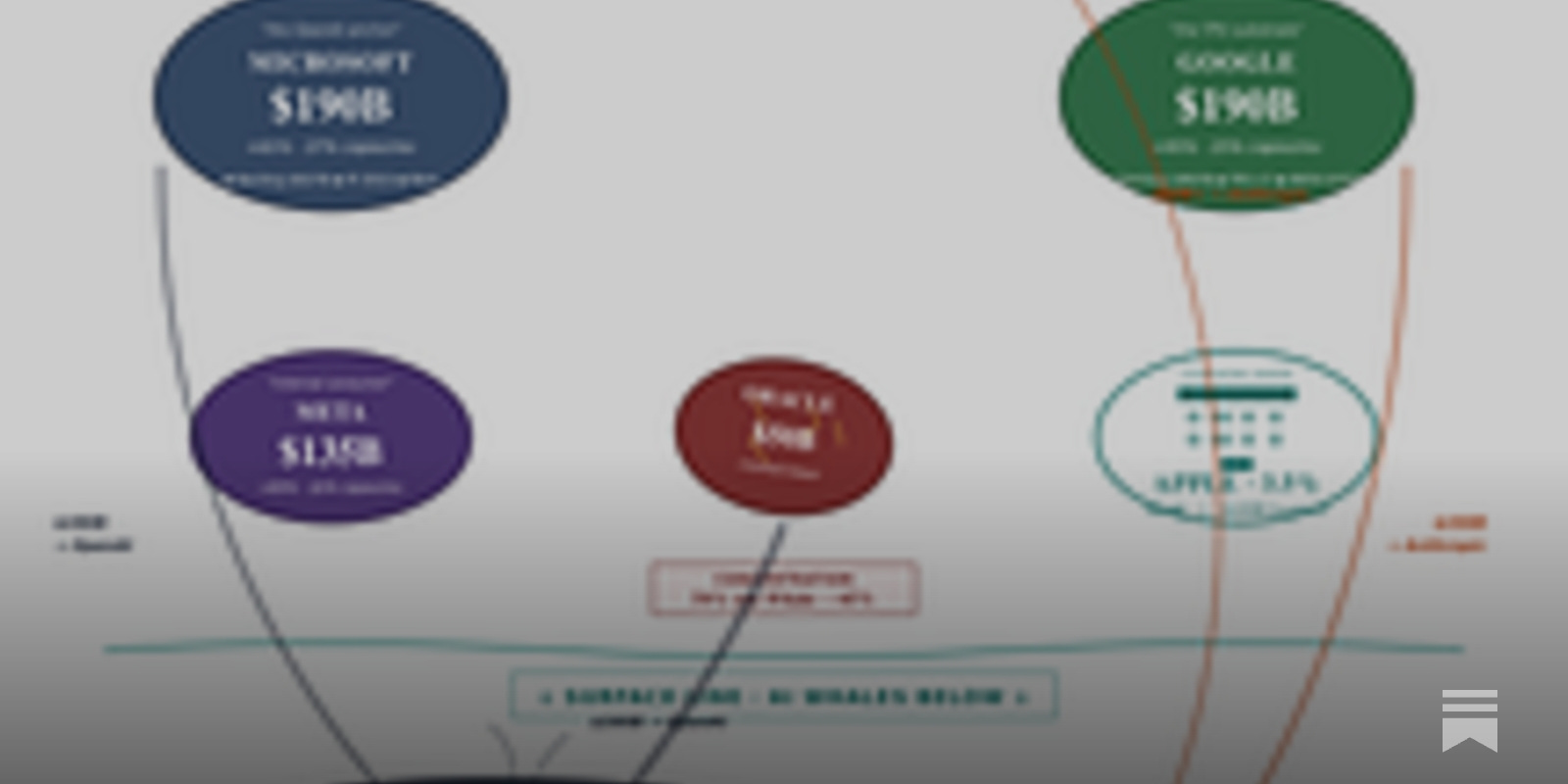
The AI Capital Cascade — How $725B Flows Through the Stack
The visual below maps how AI capital flows through three distinct layers, revealing why tech giants are winning the infrastructure — as explored in the economics of AI compute infrastructure — war. This cascade framework shows where $725 billion in AI investment actually goes — and who controls each bottleneck.
Source: The Business Engineer — Map of AI, May 2026
At the foundation layer, hyperscalers dominate with self-funded buildouts. Microsoft commands $190 billion in resources, Amazon deploys $200 billion, and Alphabet controls $185 billion in capital allocation power.
Meta operates with $125-145 billion, giving these four companies unprecedented control over compute infrastructure. Their advantage isn’t just financial — it’s temporal.
The middle layer reveals the funding paradox. Companies like OpenAI and xAI that rely on external fundraising operate on quarterly funding cycles.
While they chase billion-dollar rounds, hyperscalers deploy capital at internet speed. This creates a structural advantage that compounds monthly, not annually.
The application layer shows the most fragmentation. Thousands of AI companies compete for the remaining capital, but they’re building on infrastructure controlled by the bottom layer.
The cascade effect means control flows upward. Platform owners extract value from every transaction, every API call, every model training run.
Geographic concentration amplifies this power. US companies control 65% of global AI infrastructure — as explored in the AI stack war reshaping big tech — spending, with China holding another 20%.
The remaining 15% splits across Europe, Japan, and emerging markets. This concentration determines which countries can build sovereign AI capabilities.
Timing differences create permanent advantages. While funded AI companies present quarterly progress updates, hyperscalers make decade-long infrastructure commitments.
Amazon’s recent $75 billion data center expansion exemplifies this patient capital approach. Google’s $20 billion AI infrastructure pledge follows the same playbook.
The capital cascade reveals why AI leadership concentrates among platform owners. They control the infrastructure, set the pricing, and extract rent from every layer above.
But this framework raises a critical strategic question: If you can’t win the infrastructure layer, where exactly in this stack can you build defensible value that hyperscalers can’t simply replicate and commoditize?
FREE NEWSLETTER
Get AI Strategy Intelligence Daily
Join 90,000+ strategists. Business modelanalysis, AI maps, and earnings deep dives — free.
Gennaro Cuofano is a CRO and tech executive who has worked in AI since late 2015, starting with bringing NLP, natural-language generation, voice and chatbot products to the marketing industry. His background is in law and finance: he holds a Master's degree in Law and an International MBA with an emphasis on corporate finance (LUISS Business School and the University of San Diego, 2012), and worked as a financial analyst at a real-estate investment firm in San Diego and as an assistant controller. His work focuses on business model strategy, business engineering and, more broadly, structural analysis: how companies make money, read from their own filings. He created FourWeekMBA and leads research there and at The Business Engineer, his newsletter on AI and business strategy, with over 95,000 subscribers and more than 1,000 published analyses. His writing has also appeared on Entrepreneur (for example, How to Digitize a Family Business in Europe) and HackerNoon. Find him on LinkedIn and Substack. See how we source.
Scroll to Top
Discover more from FourWeekMBA
Subscribe now to keep reading and get access to the full archive.