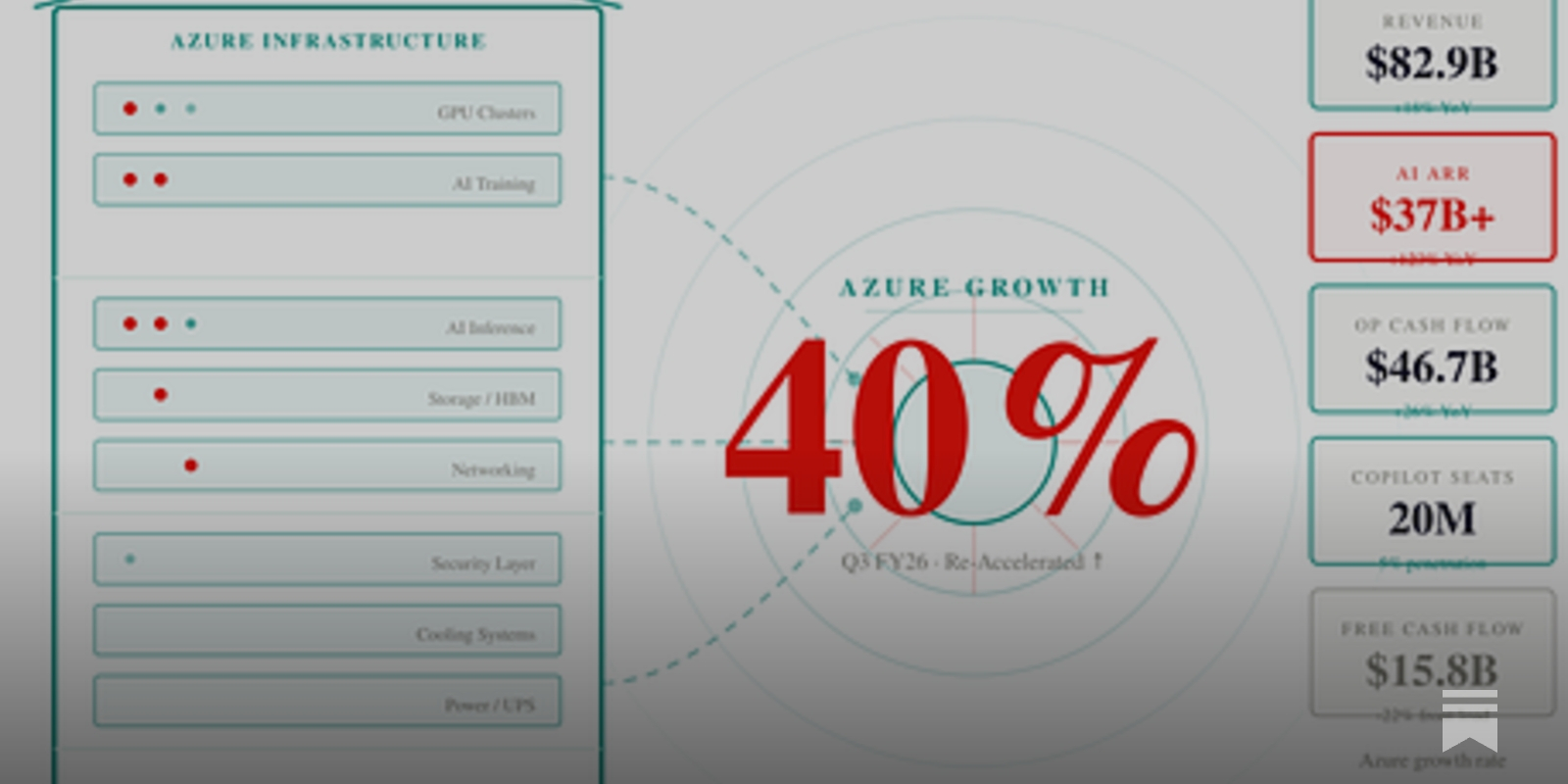
Microsoft’s Azure cloud division has achieved significant revenue acceleration in recent quarters, driven by the company’s aggressive artificial intelligence infrastructure — as explored in the economics of AI compute infrastructure — investments and the strategic integration of AI capabilities across its service portfolio.
The cloud computing giant’s Azure revenuegrowth has rebounded from previous quarters of deceleration, with AI-driven services contributing substantially to the platform’s performance metrics. Microsoft’s Copilot integration across Azure services has emerged as a key revenue driver, attracting enterprise customers seeking AI-enhanced cloud solutions.
According to analysis by The Business Engineer, Microsoft’s substantial capital expenditures on AI infrastructure are now translating into measurable revenue returns. The company has invested billions in GPU clusters, data center expansions, and AI model training capabilities to support growing demand for artificial intelligence workloads.
Enterprise customers are increasingly migrating to Azure specifically for AI capabilities, with many organizations requiring cloud infrastructure that can handle machine learning workloads and large language model — as explored in the intelligence factory race between AI labs — deployments. This shift has positioned Microsoft ahead of competitors who were slower to integrate AI services into their cloud offerings.
Microsoft’s Copilot for Azure has become a significant differentiator, enabling developers and IT professionals to manage cloud resources through natural language interfaces. The service has driven both new customer acquisitions and expanded usage among existing Azure clients.
Revenue per customer has increased notably as organizations consume more compute resources for AI training and inference workloads. These AI applications typically require more processing power and storage than traditional cloud workloads, resulting in higher average revenue per user.
Infrastructure Investments Show Returns
The company’s massive infrastructure buildout is now operating at scale, with new data centers specifically designed for AI workloads coming online. Microsoft has partnered with NVIDIA and other chip manufacturers to secure adequate GPU supply for its expanding AI services.
Azure OpenAI Service has become a cornerstone offering, providing enterprise access to GPT models and other advanced AI capabilities through Microsoft’s cloud platform. This service has attracted customers from financial services, healthcare, and technology sectors seeking to integrate AI into their operations.
The integration of AI capabilities into existing Azure services, rather than offering AI as separate products, has driven increased consumption across Microsoft’s entire cloud ecosystem. Customers using AI-enhanced databases, analytics tools, and development platforms are generating higher revenue per workload.
Competitive Positioning Strengthens
Microsoft’s early investment in OpenAI and rapid AI service deployment has created competitive advantages in the cloud market. While Amazon Web Services remains the overall market leader, Microsoft has gained ground specifically in AI-focused cloud services.
The revenue acceleration demonstrates how strategic technology investments can translate into measurable business outcomes when aligned with market demand. Microsoft’s ability to monetize AI infrastructure investments positions the company to capture a larger share of enterprisecloud spending as organizations prioritize AI capabilities in their technology strategies.
FREE NEWSLETTER
Get AI Strategy Intelligence Daily
Join 90,000+ strategists. Business modelanalysis, AI maps, and earnings deep dives — free.
Gennaro Cuofano is a CRO and tech executive who has worked in AI since late 2015, starting with bringing NLP, natural-language generation, voice and chatbot products to the marketing industry. His background is in law and finance: he holds a Master's degree in Law and an International MBA with an emphasis on corporate finance (LUISS Business School and the University of San Diego, 2012), and worked as a financial analyst at a real-estate investment firm in San Diego and as an assistant controller. His work focuses on business model strategy, business engineering and, more broadly, structural analysis: how companies make money, read from their own filings. He created FourWeekMBA and leads research there and at The Business Engineer, his newsletter on AI and business strategy, with over 95,000 subscribers and more than 1,000 published analyses. His writing has also appeared on Entrepreneur (for example, How to Digitize a Family Business in Europe) and HackerNoon. Find him on LinkedIn and Substack. See how we source.
Scroll to Top
Discover more from FourWeekMBA
Subscribe now to keep reading and get access to the full archive.