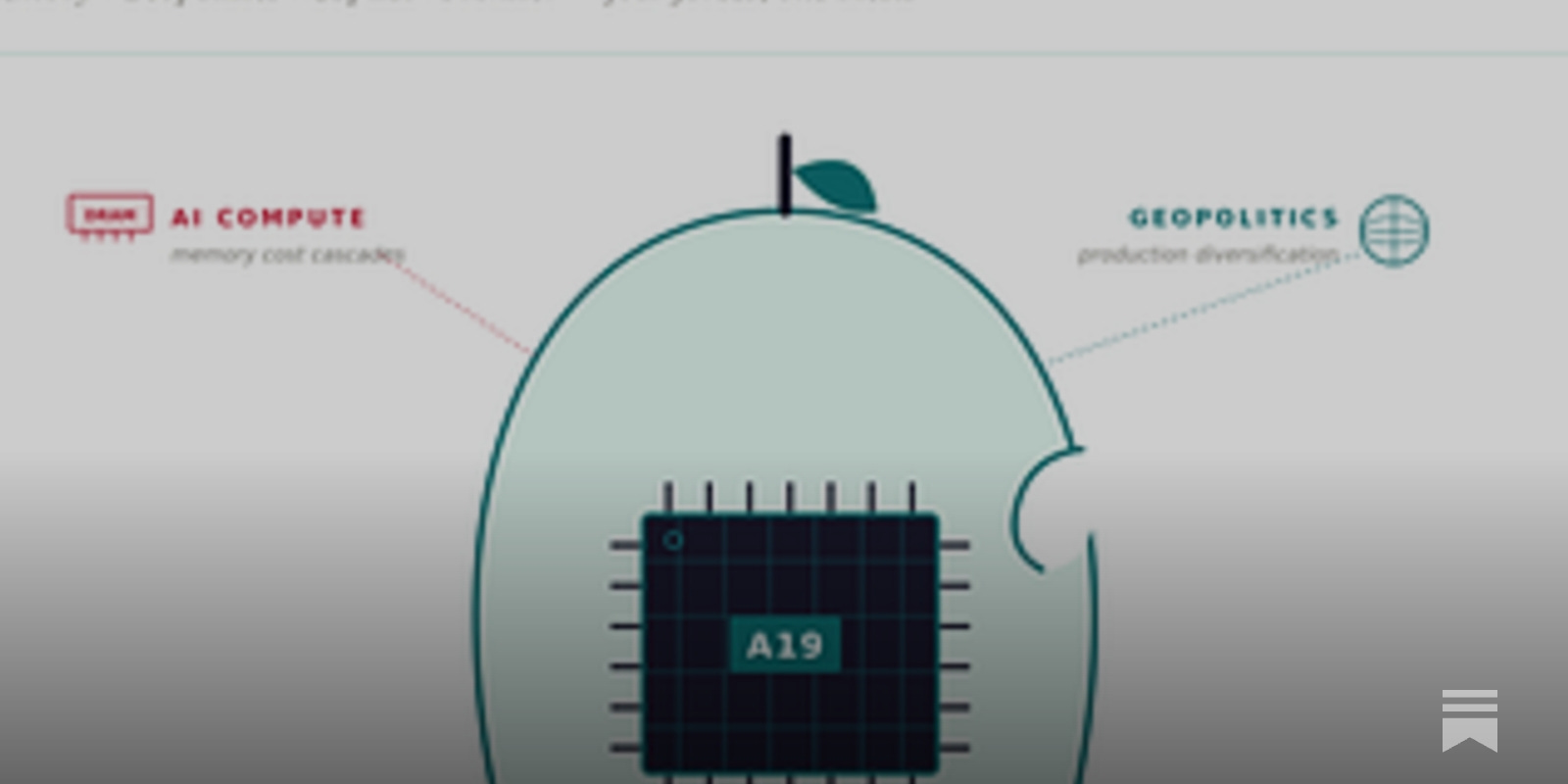
Why Apple’s Gemini Partnership Reveals Its Biggest AI Weakness
Apple’s rumored partnership with Google’s Gemini AI represents more than just another tech collaboration—it’s a strategic admission that the iPhone maker has fallen dangerously behind in the AI arms race that will define the next decade of computing.
The partnership, which would integrate Google’s advanced language model into Apple’s ecosystem, signals a fundamental shift in Apple’s historically closed approach to core technologies. For a company that has built its empire on controlling every aspect of the user experience — as explored in the interface layer wars reshaping consumer tech — , outsourcing AI capabilities to its biggest rival represents an unprecedented concession.
Source: The Business Engineer
According to analysis by The Business Engineer in “Apple’s Edge Moat & the AI Frontier Gap,” this move exposes Apple’s most glaring weakness: its frontier AI models simply cannot compete with Google’s Gemini, OpenAI’s GPT-4, or Anthropic’s Claude in sophisticated reasoning tasks.
While Apple has excelled at on-device AI for features like photo recognition and Siri’s basic functions, the company has struggled to develop the massive, cloud-based models that power today’s most impressive AI applications. These frontier model — as explored in the intelligence factory race between AI labs — s require enormous computational resources, vast datasets, and specialized expertise that Apple has been slow to acquire.
The partnership reveals Apple’s pragmatic recognition that AI capabilities have become table stakes for premium devices. As competitors integrate increasingly sophisticated AI assistants, Apple risks losing its innovation edge if Siri remains limited to basic commands while Google Assistant and others evolve into true digital companions.
For Google, the deal represents a strategic coup. Gaining access to Apple’s billion-plus users would provide invaluable data and usage patterns to further refine Gemini’s capabilities. It also potentially locks Apple into dependence on Google’s AI infrastructure for years to come.
The arrangement echoes Apple’s existing relationship with Google for search, where the iPhone maker pays billions annually to make Google the default search engine. However, AI partnerships carry higher stakes—they shape how users interact with their devices at the most fundamental level.
Industry analysts suggest Apple’s AI gap stems from cultural and strategic factors. The company’s privacy-first approach, while commendable, has limited its ability to collect the massive datasets that train the most powerful AI models. Additionally, Apple’s focus on hardware margins may have diverted resources from the long-term AI research investments that competitors prioritized.
The partnership also highlights the growing bifurcation in the AI industry between companies that can afford to develop frontier models and those that must rely on external providers. Even Apple, with its massive cash reserves, appears to have concluded that building competitive AI from scratch would take too long.
For Apple, the Gemini partnership represents a necessary short-term solution while the company presumably works to develop its own advanced AI capabilities. However, the move raises questions about whether Apple can maintain its premium positioning while relying on competitors’ core technologies.
The ultimate test will be whether Apple can leverage this partnership to buy time for its own AI development or whether it signals a permanent retreat from AI leadership—a concession that could reshape the company’s competitive position for years to come.
FREE NEWSLETTER
Get AI Strategy Intelligence Daily
Join 90,000+ strategists. Business modelanalysis, AI maps, and earnings deep dives — free.
Gennaro Cuofano is a CRO and tech executive who has worked in AI since late 2015, starting with bringing NLP, natural-language generation, voice and chatbot products to the marketing industry. His background is in law and finance: he holds a Master's degree in Law and an International MBA with an emphasis on corporate finance (LUISS Business School and the University of San Diego, 2012), and worked as a financial analyst at a real-estate investment firm in San Diego and as an assistant controller. His work focuses on business model strategy, business engineering and, more broadly, structural analysis: how companies make money, read from their own filings. He created FourWeekMBA and leads research there and at The Business Engineer, his newsletter on AI and business strategy, with over 95,000 subscribers and more than 1,000 published analyses. His writing has also appeared on Entrepreneur (for example, How to Digitize a Family Business in Europe) and HackerNoon. Find him on LinkedIn and Substack. See how we source.
Scroll to Top
Discover more from FourWeekMBA
Subscribe now to keep reading and get access to the full archive.